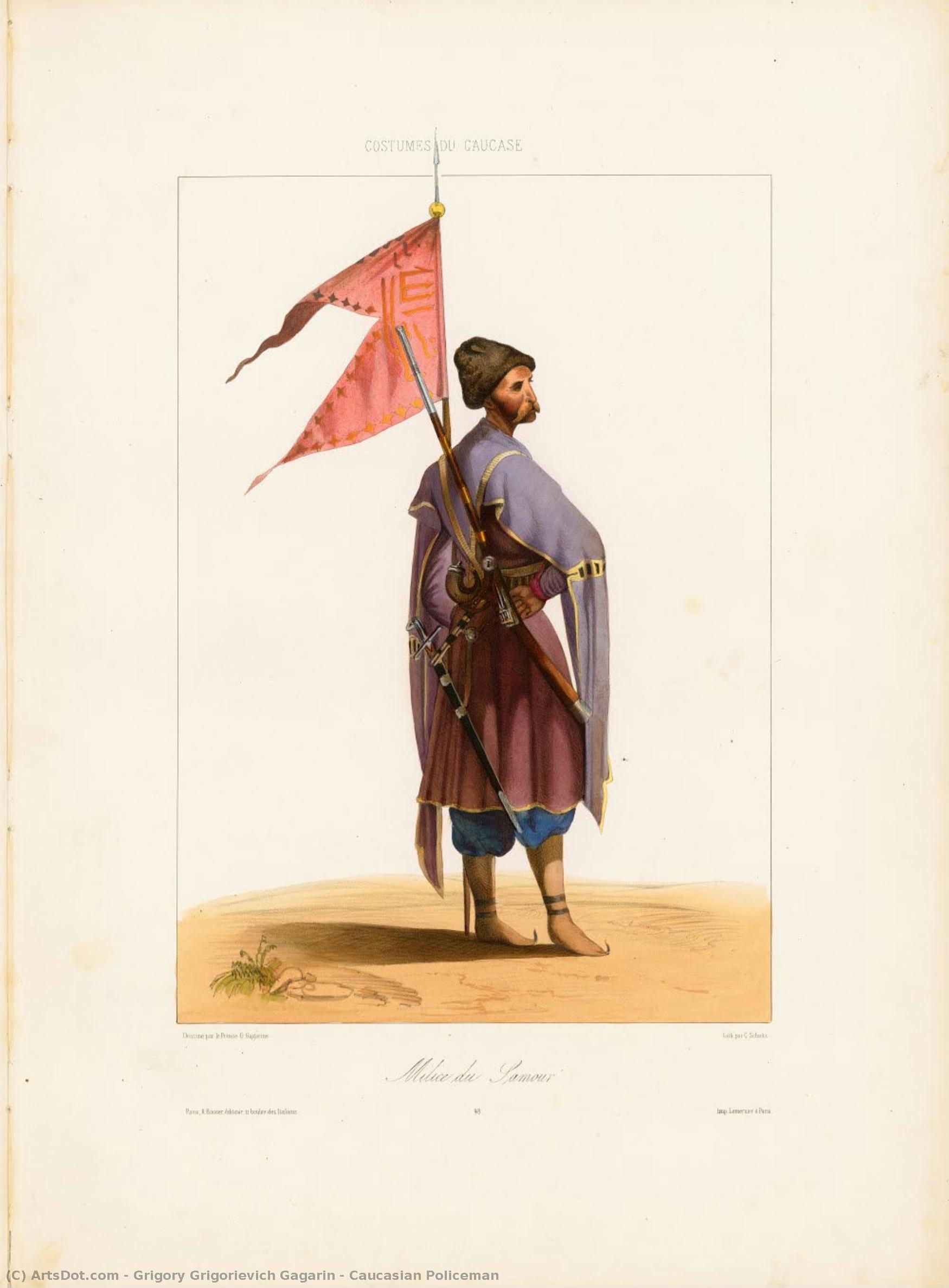
Grigory Gagarin's 'Caucasian Policeman,' painted in 1855, captures the spirit of Georgian culture through its portrayal of Circassian fighters and Shamil. Explore this iconic artwork’s rich symbolism and artistic merit.
Admire Grigory Gagarin’s captivating ‘Caucasian Policeman,’ a masterful depiction of Georgian nobility and military heroism from 1855, showcased at the Art Palace of Georgia.
Caucasian Policeman: A Portrait of Courage Amidst Imperial Ambition
Grigory Grigorievich Gagarin’s “Caucasian Policeman,” completed in 1855, stands as a remarkable testament to both artistic talent and the tumultuous era of Russian imperial expansion into Georgia. More than just a depiction of a soldier—a symbol of authority and order—the painting embodies the complex interplay between admiration for Georgian culture and the drive to impose Western ideals upon it.
- Subject Matter: The artwork portrays a Caucasian policeman, positioned prominently in a desert landscape. His gaze is direct, conveying determination and vigilance against a backdrop of arid terrain—a visual metaphor for the challenges faced by Russia as it sought to consolidate its influence over the Caucasus region.
- Style & Technique: Gagarin employed a masterful blend of realism and impressionistic brushstrokes. The palette leans towards muted earthy tones, reflecting the harsh environment but also hinting at an underlying solemnity. His use of guache—a pigment binder that creates translucent washes—allowed for subtle gradations of color and texture, capturing the nuances of light and shadow with remarkable precision.
- Historical Context: Created during Mikhail Vorontsov’s governorship in Tiflis (modern Tbilisi), “Caucasian Policeman” reflects the broader ambition of Tsar Nicholas I to assert Russian dominance over Georgia. Gagarin's involvement in monumental projects like the Sioni Cathedral and the theater underscored his commitment to transforming Tbilisi into a symbol of imperial grandeur.
The Artist’s Vision: Gagarin’s Engagement with Georgian Culture
Born in Saint Petersburg to the noble Rurikid family, Gagarin's artistic journey began under the tutelage of Karl Briullov—a figure synonymous with Romantic idealism. His friendship with Alexander Pushkin and Mikhail Lermontov cemented his place within Russia’s literary elite, influencing his worldview and informing his artistic sensibilities.
- Illustrations & Literary Influence: Gagarin famously illustrated Pushkin's “The Queen of Spades,” capturing the poet’s dramatic flair and exploring themes of ambition and obsession. This demonstrates his ability to translate literary ideas into visual form, prioritizing storytelling alongside aesthetic beauty.
- Monumental Projects & Artistic Patronage: Beyond individual portraits, Gagarin undertook ambitious undertakings like restoring frescoes in Georgian cathedrals—a profound engagement with Georgian Orthodox tradition. His role as Vice President of the Imperial Academy of Arts signaled his dedication to elevating Russian art and culture.
Symbolism & Emotional Resonance
"Caucasian Policeman" transcends mere representation; it speaks to larger ideas about power, duty, and cultural exchange. The policeman’s posture—straightened shoulders, unwavering gaze—represents steadfastness and responsibility against the backdrop of a desolate landscape symbolizing uncertainty and vulnerability. Gagarin's deliberate use of color contributes to this emotional impact, conveying both strength and melancholy.
- Color Palette & Texture: The muted hues of the desert evoke feelings of solitude and resilience. The textured brushstrokes capture the roughness of the terrain—mirroring the challenges faced by Russia in its quest for regional control.
- Composition & Narrative Suggestion: Gagarin’s careful arrangement of figures creates a dynamic visual narrative, inviting contemplation about the role of authority within a changing world.
A Legacy Enduring Through Reproduction
Today, “Caucasian Policeman” resides in the Art Palace of Georgia—a testament to its enduring value as a cultural artifact and an exemplar of Romantic artistic expression. ArtsDot’s meticulous reproductions offer art lovers worldwide the opportunity to experience this masterpiece firsthand, preserving its beauty and conveying its historical significance for generations to come.