Grigory Gagarin’s “Circassian Soldier”: A Portrait of Resilience Amidst Caucasus History
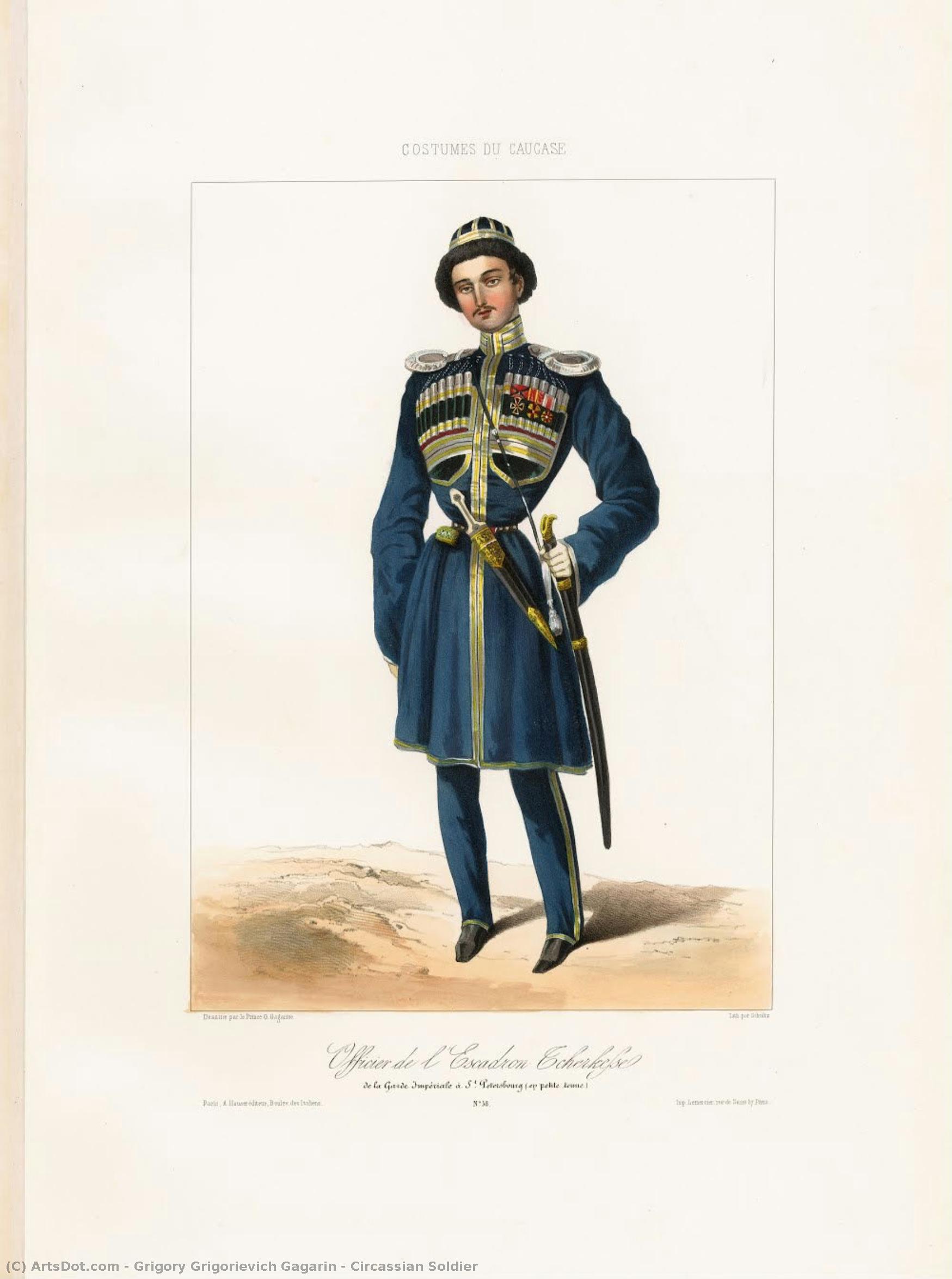
Grigory Gagarin’s “Circassian Soldier,” completed in 1855, stands as a remarkable testament to both artistic skill and historical observation. More than just a depiction of a military figure, it embodies the spirit of the Caucasus region during its turbulent era—a period marked by shifting alliances, imperial ambitions, and cultural encounters that profoundly shaped Russian art.
- Subject Matter: The painting portrays a Circassian soldier in uniform, meticulously rendered with attention to detail. He is positioned on a dirt ground, conveying a sense of immediacy and realism—a characteristic of Gagarin’s style which sought to capture the essence of everyday life within the Caucasus landscape.
- Style & Technique: Gagarin employed guache paint on paper, utilizing a technique known for its luminosity and ability to achieve subtle tonal variations. The artist's brushstrokes are confident yet controlled, conveying a sense of precision and capturing the textures of fabric and skin with remarkable accuracy. Notably, Gagarin’s work echoes the influence of Karl Briullov, whose dramatic realism had already established itself as a dominant aesthetic within Russian painting.
- Historical Context: The artwork emerged during Mikhail Vorontsov’s governorship in Tiflis (modern Tbilisi), Georgia—a time when Russia was actively engaged in consolidating its control over the Caucasus. Gagarin's involvement in the restoration of frescoes at Betania Monastery reflects a broader cultural effort to revive Georgian heritage under imperial patronage. Duma’s observation about the theatre building mirroring Pompey Theatre underscores Gagarin’s artistic ambition and his desire to elevate Russian art to levels of grandeur and sophistication.
- Symbolism & Emotional Impact: Beyond its technical merits, “Circassian Soldier” carries symbolic weight. The soldier represents strength, duty, and resilience—qualities admired during a period of imperial expansion and cultural exchange. Gagarin’s depiction captures not only the physical appearance of the Circassian but also hints at his inner character, conveying an aura of dignity and contemplation.
- Provenance & Significance: Currently housed in the Art Palace of Georgia—Museum of Cultural History—the painting exemplifies the artistic legacy of the Caucasus region during the mid-19th century. Its inclusion within Gagarin’s “Sketches and Drawings of Caucasian People” highlights his dedication to documenting the diverse cultures and landscapes of Russia's frontier territories, cementing its place as a cornerstone of Georgian art history.
The painting’s enduring appeal lies in its ability to transport viewers back to a pivotal moment in Russian cultural history—a period defined by artistic innovation and engagement with the traditions of neighboring nations. Gagarin's masterful execution ensures that “Circassian Soldier” continues to inspire admiration for its beauty, precision, and profound reflection on human experience.