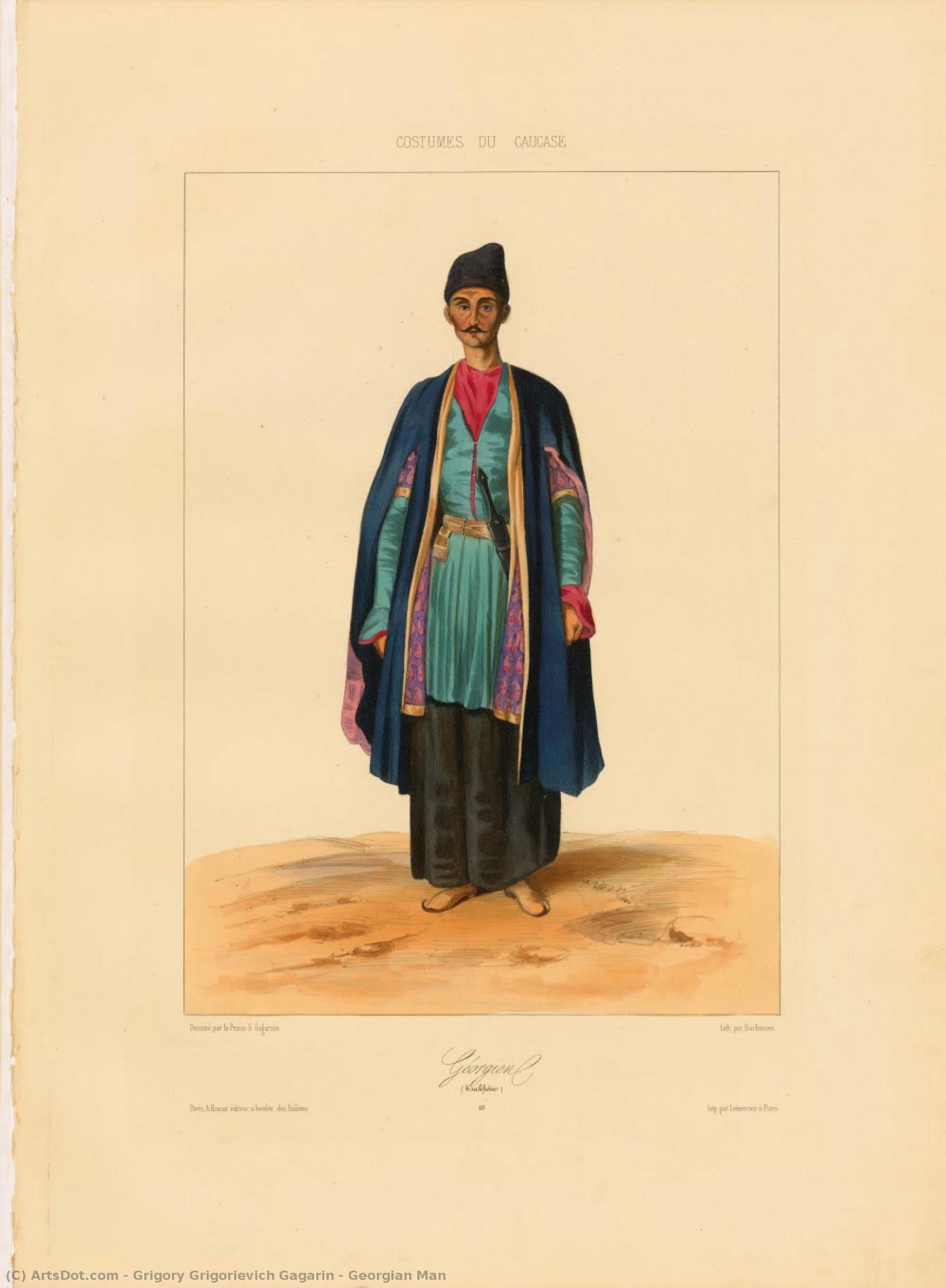
Georgian Man - A Portrait of Caucasus Spirit
Born in Saint Petersburg to the noble Rurikid princely family Grigory Gagarin was a Russian painter,Major General and diplomat.A friend of Alexander Pushkin and Mikhail Lermontov, In 1848-1855 Gagarin lived in Tiflis served under Mikhail Vorontsov. Among the military and administrative duties, Gagarin did a lot of works for the city. He built a theater, frescoed the Tbilisi Sioni Cathedral, and restored frescoes of the old Georgian cathedrals, including the Betania monastery. In his records ‘The journey to Caucasus’ a French writer Alexander Duma (the father) writes: I have never seen such a delightful theatre building before. With its vestibule, interior, theatre curtain and wall paintings it reminds me building of Pompey Theatre. The Art Palace of Georgia possesses a valuable collection of Gagarin’s ‘Sketches and Drawings of Caucasian People’
This striking portrait captures the essence of Georgian culture during the mid-19th century—a period marked by artistic revival and fascination with Eastern traditions. Grigory Gagarin, a prolific artist deeply influenced by Romanticism, skillfully employed oil paint on canvas to convey both realism and emotional depth. The composition centers around a dignified Caucasian gentleman dressed in traditional attire: a deep blue coat adorned with opulent gold trim, reflecting the wealth and prestige of his social standing. His gaze is direct, conveying confidence and composure—a hallmark of Gagarin’s artistic style.
The artist's meticulous attention to detail extends beyond mere representation; he sought to imbue the painting with symbolic significance. The sandy or dirt-like background subtly evokes the rugged landscape of Georgia, grounding the figure in its geographical context. Furthermore, Gagarin’s masterful brushwork—characterized by smooth blending and subtle tonal variations—creates a luminous effect that enhances the portrait's beauty and communicates a sense of serenity.
- Artist: Grigory Grigorievich Gagarin
- Born Year: 1810
- Death Year: 1893
- Birth City: Saint Petersburg
- Birth Country: Russia
Biography: Early life and education Grigory Grigorievich Gagarin, a russian painter, major general, and administrator, was born in 1810 in saint petersburg to the noble rurikid princely gagarin family. His father, prince grigory ivanovich gagarin, was a russian diplomat in france and later the ambassador to italy. Despite not receiving a formal artistic education, Gagarin took private lessons from the renowned russian painter karl briullov. Artistic career and notable works Gagary's artistic career is marked by his association with prominent literary figures of his time, including alexander pushkin and mikhail lermontov. He illustrated pushkin’s works, such as “the queen of spades” and “the tale of tsar saltan.” Some of his notable paintings include: Caucasus prince (59 x 42 cm, art palace of georgia - museum of cultural history, tbilisi, georgia, paper) - A testament to his time in the caucasus region. Circassian woman (59 x 42 cm, art palace of georgia - museum of cultural history, tbilisi, )
Historical Context
The painting’s creation coincided with a burgeoning interest in Caucasian culture within Russia—fueled by expeditions and diplomatic missions aimed at documenting the region's traditions and artistic heritage. Gagarin’s work reflects this scholarly spirit, capturing a moment of cultural exchange between East and West.
Style & Technique
Romanticism dominated Gagarin’s artistic vision, prioritizing emotion and imagination alongside meticulous observation. His technique—characterized by rich color palettes and expressive brushstrokes—aimed to convey not only visual accuracy but also psychological nuance. The Art Palace of Georgia - Museum of Cultural History holds a valuable collection of Gagarin’s ‘Sketches and Drawings of Caucasian People,’ showcasing his dedication to capturing the spirit of the Caucasus landscape.
Symbolism & Emotional Impact
The portrait transcends mere likeness; it embodies ideals of nobility, dignity, and cultural pride—values central to Georgian identity during the 19th century. Gagarin’s masterful composition evokes a feeling of quiet contemplation, inviting viewers to appreciate the beauty of both the subject and the artistic process.
Size & Dimensions
59 x 42 cm