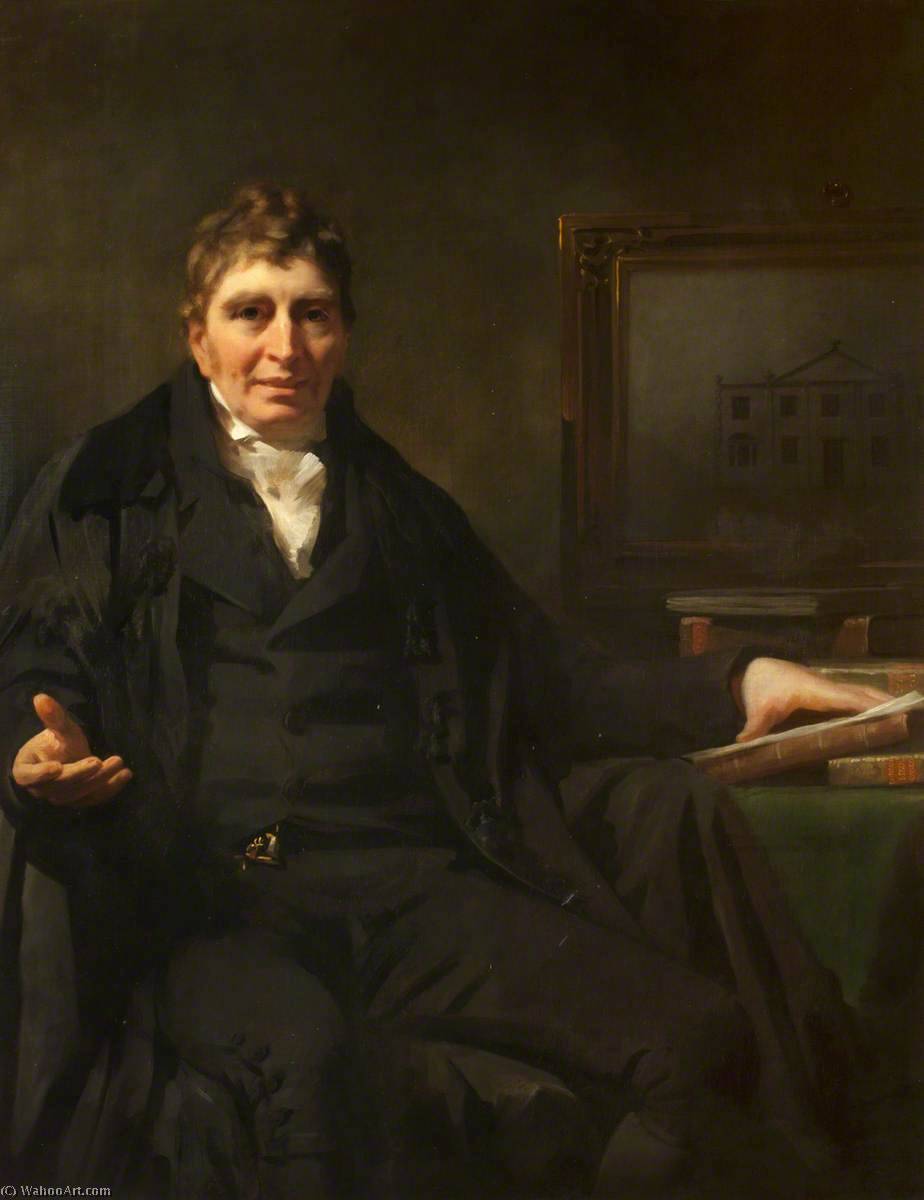
A Portrait of Dignified Reflection: Andrew Duncan by Henry Raeburn
Henry Raeburn’s “Andrew Duncan” is more than simply a likeness; it's a carefully constructed tableau of 18th-century Scottish identity, intellect, and the quiet dignity of a man deeply engaged with his profession. Painted around 1819, this oil on canvas portrait captures not just the physical appearance of Andrew Duncan, a prominent physician and medical reformer, but also an aura of thoughtful contemplation that speaks volumes about his character and standing within Edinburgh society. The painting resides in the Royal College of Physicians of Edinburgh, a testament to its enduring value as both a work of art and a historical document.
Raeburn’s masterful technique is immediately apparent. He employs a dramatic chiaroscuro – a stark contrast between light and shadow – that sculpts Duncan's face with remarkable precision. The strong directional lighting, originating from an unseen source, emphasizes the lines of his brow, the subtle wrinkles around his eyes, and the texture of his coat, lending him a palpable sense of age and experience. The artist’s meticulous brushwork is evident in every detail, from the folds of the fabric to the delicate rendering of the lace collar. This isn't merely a representation; it’s an embodiment of Duncan’s presence, imbued with a quiet authority.
A Window into the Enlightenment
“Andrew Duncan” firmly places itself within the context of the Scottish Enlightenment – a period of intellectual and cultural flourishing that profoundly shaped Britain. Raeburn, as one of the era's most celebrated portraitists, was deeply intertwined with this movement. His subjects were often leading figures in science, medicine, law, and politics, reflecting the importance placed on reason, knowledge, and civic engagement. The inclusion of the framed drawing of a grand building – likely an architectural study or plan – subtly reinforces Duncan’s profession and his connection to the intellectual pursuits of the time. It suggests a mind occupied not just with healing bodies but also with shaping the physical landscape of Edinburgh.
Symbolism and Social Standing
Beyond its technical brilliance, the portrait is rich in symbolic meaning. The seated posture of Duncan – relaxed yet attentive – conveys a sense of self-assuredness and intellectual curiosity. His gaze, directed slightly off to the side, suggests contemplation rather than direct confrontation, hinting at a man comfortable in his own mind. The dark, richly textured clothing speaks to his social standing and wealth, while the lace collar adds an element of refinement and formality typical of the era. The composition itself is carefully balanced, creating a sense of stability and order – mirroring the values Raeburn sought to capture in his portraits.
A Legacy of Realism
Henry Raeburn’s “Andrew Duncan” stands as a pivotal work in the history of British portraiture. His commitment to realism, combined with an acute understanding of human psychology and a keen eye for detail, established him as a leading figure in his field. The painting's enduring appeal lies not only in its technical mastery but also in its ability to evoke a sense of connection – inviting viewers to contemplate the life and character of a man who embodied the spirit of the Scottish Enlightenment. It’s a portrait that transcends mere representation, offering a glimpse into a bygone era and reminding us of the power of art to capture both the outward appearance and the inner essence of its subject.