A Somber Encounter in Charcoal
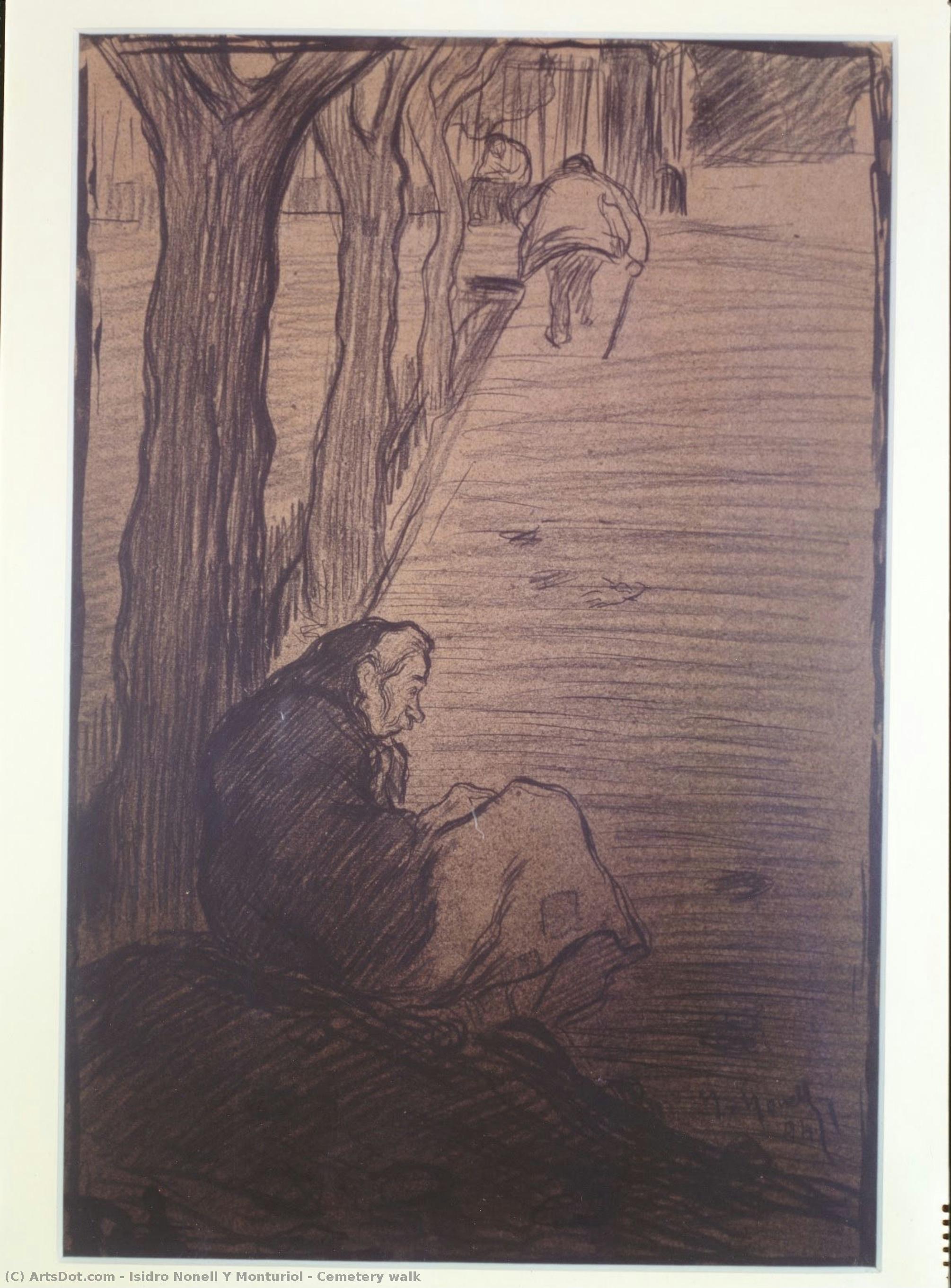
In the quiet, shadowed corners of 1894 Barcelona, Isidro Nonell y Monturiol captured a moment of profound stillness that transcends time. His work, Cemetery Walk, is not merely a depiction of a landscape but an intimate window into the human condition. The drawing presents a monochromatic world where the boundaries between life and memory seem to blur. An elderly woman sits anchored to a bench, her presence heavy with the weight of years, while a solitary man lingers in the background, a spectral observer in this hallowed ground. Through the masterful use of light and shadow, Nonell transforms a simple cemetery scene into a stage for deep, psychological drama, inviting the viewer to step into a space of quiet contemplation.
The technique employed in this piece speaks to the raw, expressive power of charcoal and fine line work. Eschewing the polished finish of academic realism, Nonell utilizes dense hatching and vigorous cross-hatching to sculpt form out of the darkness. The texture is tactile and rugged, with every stroke contributing to a sense of atmospheric depth. This linear approach creates a rhythmic quality that guides the eye through the vertical composition, emphasizing the towering, skeletal trees that enclose the figures. The lighting is deliberately subdued, casting deep, melancholic shadows that swallow the edges of the frame, leaving only the most essential shapes to emerge from the gloom.
Symbolism and the Weight of Solitude
Beyond its technical prowess, Cemetery Walk serves as a poignant meditation on themes of aging, grief, and the inevitable passage of time. The cemetery setting acts as a powerful symbol of transition and remembrance, providing a backdrop where the living and the departed exist in a shared, silent dialogue. The seated woman, often interpreted as a figure of quiet resignation, embodies the dignity found in solitude. Her stillness contrasts with the watchful presence of the man behind her, creating a tension between being seen and being alone. This interplay of figures evokes a universal sense of nostalgia and the bittersweet nature of reflection.
For the discerning collector or interior designer, this artwork offers more than just aesthetic beauty; it provides an emotional anchor for a space. The piece possesses a timeless quality that complements sophisticated, minimalist, or classical interiors, where its monochromatic palette can serve as a focal point of understated elegance. As a high-quality reproduction, it brings the somber, evocative spirit of Catalan Impressionism into the modern home, offering a sense of historical depth and intellectual intrigue. To hang this work is to invite a moment of stillness and a deep, resonant connection to the artistry of the late 19th century.