 Preview
 Send
Send Share
Share
 Details

 Download
 Similars
 X-Ray
X-Ray Diaporama
Cemetery walk
 Charcoal
- WallArt
- Realism
 1894
1894- 19th Century
 31.0 x 22.0 cm
 Cau Ferrat Museum
 Read More
Hand Made Oil Reproduction
Hand-painted oil on canvas in your size and frame, made to order by our artists. ( Buy Print Buy Image)




P118B $10

P118H $10

P118W $10

P438Z $10

P508JH $12

P508YH $12

P805H $10

P805Z $10

P919BZ $10

P919G $10

P919XJ $10

P959ZH $10

P968JZ $12

W106C $8

W218G $10

W218JH $8

W218Y $10

W307PJ $10

W316G $10

W316PJ $8

W316Y $10

W398PJ $8

W4111J $10

W500HY $15

W500JH $15

W692G $12

W849H $8

W940BG $15

W953PJ $8




Pick from our preset sizes that match the artwork's original proportions.

You may enter your own dimensions to fit a specific frame or space. If your selected size does not match the original image's proportions, we will either crop the artwork or extend the painting with additional hand-painted elements. A digital mockup will be sent for your approval before production begins.
Please note that the on-screen preview does not reflect the actual cropping or extension. Only the mockup will accurately show the final composition.
While custom sizes are available, we recommend selecting a dimension from the predefined list to preserve the original proportions.
After order, ArtsDot.com team will email client for instructions and provide a mockup preview
Worldwide Delivery () in 3/4 weeks instead of standard 5 weeks. (17 August). No compromise on quality.

Free Worldwide Express Shipping

High-Quality Linen Canvas

Full Shipping Insurance

Customs Tax Refund Guarantee

True Color Matching Guarantee

60-Day Return Policy (Defects Only)

100% Money-Back Guarantee

Bulk Discount Offer
 Glass option is only available in size under 110 CM

Cemetery walk
Reproduction Medium
Reproduction Size
-


Total Price
$ 288
Artwork Description
A Somber Encounter in Charcoal
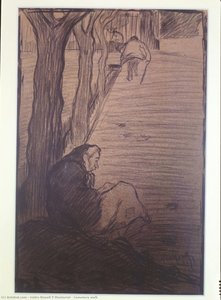
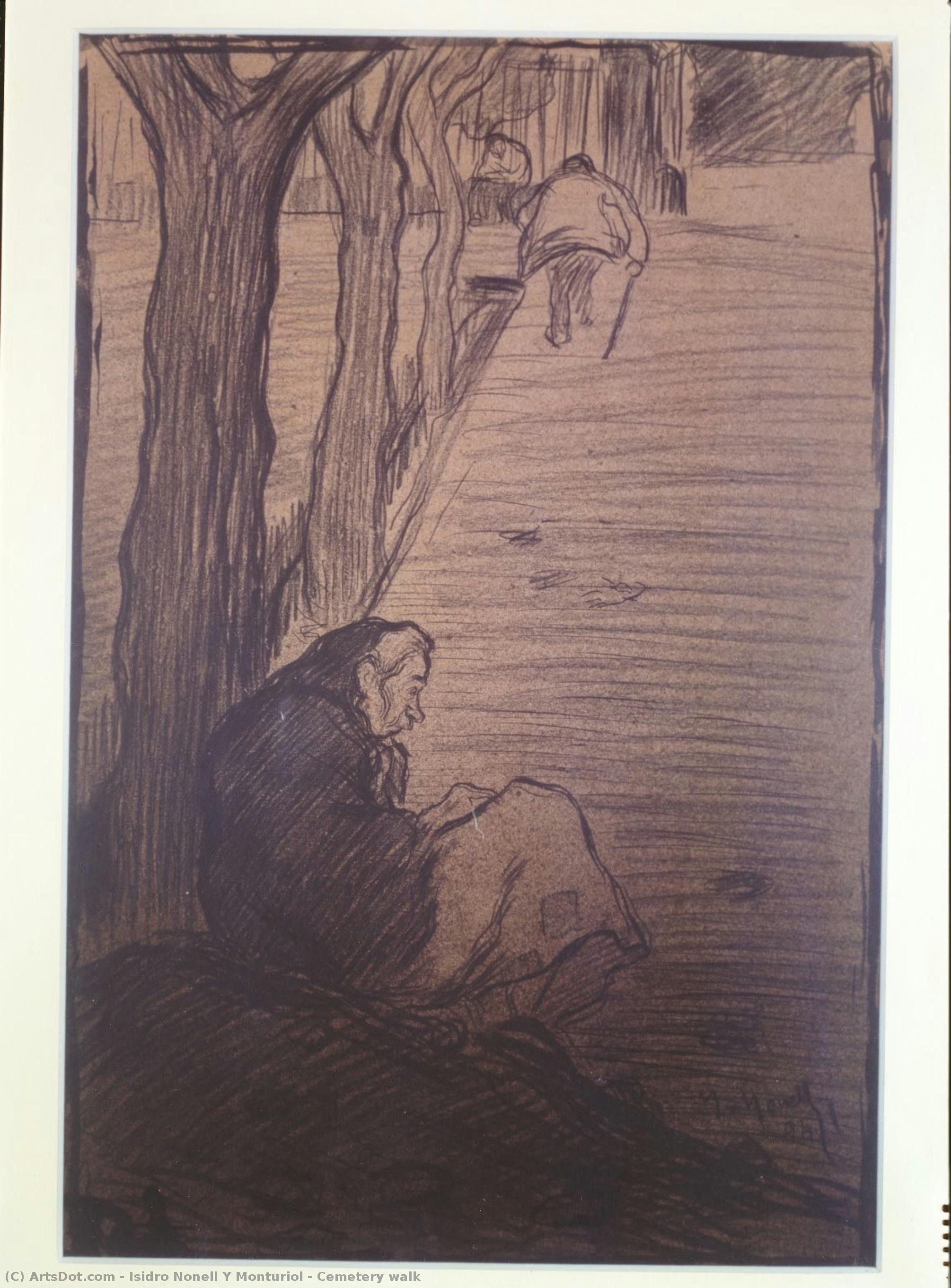
In the quiet, shadowed corners of 1894 Barcelona, Isidro Nonell y Monturiol captured a moment of profound stillness that transcends time. His work, Cemetery Walk, is not merely a depiction of a landscape but an intimate window into the human condition. The drawing presents a monochromatic world where the boundaries between life and memory seem to blur. An elderly woman sits anchored to a bench, her presence heavy with the weight of years, while a solitary man lingers in the background, a spectral observer in this hallowed ground. Through the masterful use of light and shadow, Nonell transforms a simple cemetery scene into a stage for deep, psychological drama, inviting the viewer to step into a space of quiet contemplation.
The technique employed in this piece speaks to the raw, expressive power of charcoal and fine line work. Eschewing the polished finish of academic realism, Nonell utilizes dense hatching and vigorous cross-hatching to sculpt form out of the darkness. The texture is tactile and rugged, with every stroke contributing to a sense of atmospheric depth. This linear approach creates a rhythmic quality that guides the eye through the vertical composition, emphasizing the towering, skeletal trees that enclose the figures. The lighting is deliberately subdued, casting deep, melancholic shadows that swallow the edges of the frame, leaving only the most essential shapes to emerge from the gloom.
Symbolism and the Weight of Solitude
Beyond its technical prowess, Cemetery Walk serves as a poignant meditation on themes of aging, grief, and the inevitable passage of time. The cemetery setting acts as a powerful symbol of transition and remembrance, providing a backdrop where the living and the departed exist in a shared, silent dialogue. The seated woman, often interpreted as a figure of quiet resignation, embodies the dignity found in solitude. Her stillness contrasts with the watchful presence of the man behind her, creating a tension between being seen and being alone. This interplay of figures evokes a universal sense of nostalgia and the bittersweet nature of reflection.
For the discerning collector or interior designer, this artwork offers more than just aesthetic beauty; it provides an emotional anchor for a space. The piece possesses a timeless quality that complements sophisticated, minimalist, or classical interiors, where its monochromatic palette can serve as a focal point of understated elegance. As a high-quality reproduction, it brings the somber, evocative spirit of Catalan Impressionism into the modern home, offering a sense of historical depth and intellectual intrigue. To hang this work is to invite a moment of stillness and a deep, resonant connection to the artistry of the late 19th century.
Related Artworks
Artist Biography
Piet Mondrian: Architect of Abstraction
Piet Mondrian, a name synonymous with modern art’s radical shift towards abstraction, was more than just a painter; he was a visionary architect of form and color, driven by a profound belief in the underlying harmony of the universe. Born Pieter Cornelis Mondriaan in Amersfoort, Netherlands, on March 7, 1872, his artistic journey began not with grand pronouncements but with quiet observation – initially of landscapes, mirroring the traditions of the Hague School. However, a pivotal encounter with Cubism in 1911 irrevocably altered his trajectory, setting him on a path to dismantle representation and construct a new visual language entirely. This wasn’t merely an aesthetic choice; it was a deeply held philosophical pursuit rooted in a desire to express universal truths beyond the confines of the tangible world.Early Influences and Artistic Training
Mondrian's early life was steeped in artistic influence, nurtured by his father, a schoolmaster with an amateur interest in drawing, and his uncle, Frits Mondriaan, a landscape painter. These familial connections provided him with foundational skills and instilled within him a respect for the discipline of art. He formally studied at the Amsterdam Academy from 1892 to 1897, honing his technical abilities while simultaneously exploring various artistic styles. His early work reflected this period, characterized by landscapes imbued with the atmospheric qualities of the Hague School. However, Mondrian’s ambition extended beyond mere imitation; he sought a deeper understanding of art's potential and began experimenting with pointillism – a technique employing small dots of color to create an optical effect – in 1908. This experimentation signaled a nascent desire to move away from direct representation and towards a more expressive, internalized form of painting. Crucially, his friendship with Simon Mans introduced him to theosophical ideas, which profoundly influenced his later belief in a universal order and harmony that could be expressed through art.The Birth of Neo-Plasticism and De Stijl
The watershed moment in Mondrian’s artistic development arrived in 1911 with his exposure to Cubism. He recognized its revolutionary approach to depicting form, acknowledging its breaking away from natural appearances. However, he didn't simply adopt Cubist techniques; instead, he distilled them to their essential elements, moving towards a radically simplified abstraction. This culminated in the development of Neo-Plasticism – “New Plasticity” – in 1920. This style, characterized by strictly orthogonal (right-angle) lines and primary colors (red, blue, yellow) on a white ground, represented Mondrian’s attempt to create a universal visual language devoid of illusionistic depth or subjective emotion. He believed that this reduction would reveal the underlying structure of reality itself. Alongside his artistic explorations, Mondrian became deeply involved with *De Stijl*, an international movement founded in 1917 alongside Theo van Doesburg. *De Stijl* encompassed not just painting but also architecture, design, and typography, all guided by a shared belief in the power of geometric abstraction to create harmony and order. Mondrian’s theoretical writings for *De Stijl*, particularly his essay “Neoplasticism,” articulated the core principles of this movement, outlining its aesthetic philosophy and advocating for a synthesis between art and life.Mature Works and Philosophical Underpinnings
Mondrian's mature works – paintings like *Composition with Red Lines* (1930) and *Broadway Boogie-Woogie* (1942-43) – are instantly recognizable for their stark simplicity and geometric precision. These pieces aren’t merely arrangements of lines and colors; they represent a profound attempt to capture the essence of existence, to reveal the underlying order that governs the universe. His later works, particularly those created during his time in New York after 1940, saw him introduce subtle variations – colored lines and rhythmic patterns – suggesting a shift towards a more dynamic and expressive approach while still adhering to the core principles of Neo-Plasticism. Mondrian’s philosophy extended beyond aesthetics; he believed that art could play a crucial role in social transformation. He envisioned a future where abstract forms would dissolve the boundaries between art and life, leading to a harmonious society based on universal values. His declaration in 1914 – “Art is higher than reality and has no direct relation to reality. To approach the spiritual in art, one will make as little use as possible of reality, because reality is opposed to the spiritual” – encapsulates this utopian vision.Legacy and Historical Significance
Piet Mondrian died in New York City on February 1, 1944, leaving behind a legacy that continues to resonate profoundly within the art world. His pioneering work laid the foundation for countless abstract artists who followed, influencing movements such as Minimalism and Color Field painting. His rigorous approach to abstraction – his relentless pursuit of pure form and color – remains an enduring testament to the power of artistic reduction. Mondrian’s influence extends far beyond painting; his ideas have shaped architectural design, graphic design, and even fashion, demonstrating the lasting impact of his revolutionary vision. He is rightly considered one of the most important figures in 20th-century art, a true architect of abstraction who forever altered our perception of what art could be.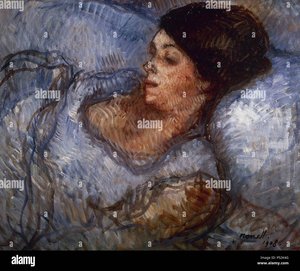
isidro nonell y monturiol
1872 - 1911 , Spain
Quick Facts
- Artistic Movement Or Style:
- Cubism
- Neo-Plasticism
- De Stijl
- Artists Or Movements Influenced By This Artist:
- Kandinsky
- Malevich
- Artists Who Influenced This Artist:
- Simon Mans
- Abraham Kuyper
- Date Of Birth: March 7, 1872
- Date Of Death: February 1, 1944
- Full Name: Piet Mondrian
- Nationality: Dutch
- Notable Artworks:
- Roadway and Farm Building near Arnhem
- Evening; Red Tree
- Gray Tree
- Place Of Birth: Amersfoort, Netherlands
Related Articles
The Nuances of Graphite: Exploring Emotional Depth & Technical Mastery in Pencil Drawing
Explore the captivating world of graphite drawing! Discover its rich history, master essential techniques like chiaroscuro, and learn how artists evoke emotion through this timeless medium. Expert insights for art enthusiasts.

The Enduring Power of Line: Exploring Themes & Techniques in Drawing Across Art History
Explore the rich history of drawing! Discover key techniques like linear perspective & iconic artists from the Renaissance to modern times. Enhance your art appreciation with ArtsDot.
The Subtleties of Shade: Exploring Monochrome's Enduring Power in Art History & Contemporary Practice
Explore the captivating world of monochrome painting! Discover its rich history, from Renaissance chiaroscuro to contemporary minimalism. Uncover the emotional power and artistic techniques behind this enduring art form.
Frederick Bridgman: Anatomical Mastery & the Evolution of Figure Drawing Instruction
Explore the anatomical mastery of George B. Bridgman & his revolutionary figure drawing techniques. Discover how his methods transformed art instruction and continue to inspire artists today. Learn more at ArtsDot.

Monochrome Visions: Exploring the Aesthetic & Historical Significance of Black & White Photography
Explore the rich history & artistic power of black and white photography. From early techniques to iconic masters like Ansel Adams, discover why monochrome continues to captivate art lovers today. Expert insights for collectors.