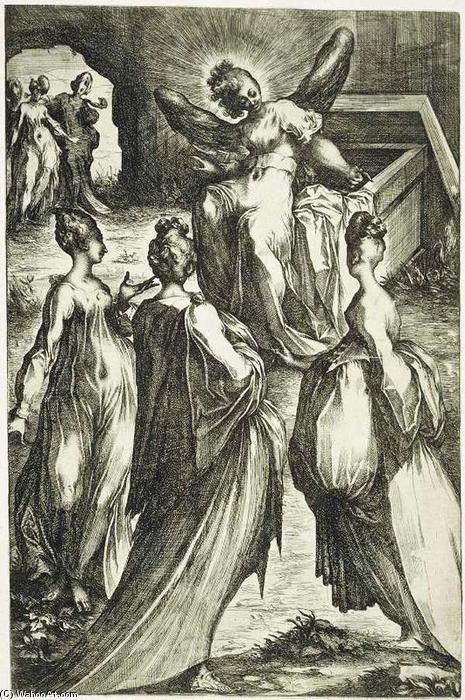
The Three Marys at the Tomb: A Northern Mannerist Masterpiece
Jacques Bellange’s “The Three Marys at the Tomb,” painted around 1620, is not merely a depiction of a biblical scene; it's a profound meditation on grief, faith, and the mysteries surrounding Christ’s death and resurrection. This arresting engraving, now housed within the walls of the Art Institute of Chicago, offers a rare glimpse into the intensely personal style of a Northern Mannerist artist largely obscured by history – Jacques Bellange himself. His work, characterized by dramatic contrasts, elongated figures, and an almost palpable psychological depth, stands as a testament to his unique vision, a vision that continues to resonate with viewers centuries later.
The scene unfolds within a cavernous space dominated by the stark simplicity of a tomb. Three women – traditionally identified as Mary Magdalene, Mary of Clopas, and Mary Salome – gather in sorrowful contemplation before it. The composition is meticulously constructed, employing a complex layering of figures that creates an overwhelming sense of density and drama. Bellange masterfully utilizes perspective to draw the viewer into the scene, utilizing diagonal lines to guide the eye through the crowded space and emphasizing the emotional weight of the moment. The figures themselves are rendered with elongated forms and exaggerated gestures – a hallmark of Mannerism – conveying not just physical presence but also intense inner turmoil.
A Study in Dramatic Light and Shadow
Bellange’s technical skill is immediately apparent in his masterful manipulation of line and texture. The engraving, executed using the burin tool on a metal plate, showcases an extraordinary level of detail. The folds of the women's drapery are rendered with painstaking precision, creating a tactile illusion that invites the viewer to almost feel the fabric’s weight and texture. Similarly, the rough-hewn stone of the tomb is depicted with remarkable realism, contrasting sharply with the smooth, polished surfaces of the angels’ garments. The use of light and shadow is particularly striking; a central source illuminates key figures while casting deep shadows that heighten the sense of drama and mystery.
The composition's spatial arrangement—with the women positioned in the foreground and the tomb receding into the background—creates an illusion of depth, drawing the viewer’s eye towards the central event. The placement of the angel hovering above the tomb is crucial; its presence signifies divine intervention and offers a glimmer of hope amidst the sorrowful scene. Bellange's deliberate use of diagonals further enhances this sense of movement and dynamism, capturing the emotional intensity of the moment.
Symbolism and Historical Context
“The Three Marys at the Tomb” is deeply rooted in the religious and artistic currents of its time – the Northern Mannerist period. This style, flourishing primarily in the Low Countries and Germany during the 16th century, emphasized emotional expression, psychological complexity, and a departure from the idealized forms of the Renaissance. Bellange’s work reflects these trends through his use of elongated figures, dramatic lighting, and emotionally charged gestures.
The scene itself is laden with symbolism. The tomb represents mortality and the finality of death, while the presence of the three Marys signifies grief, mourning, and ultimately, faith. The angel embodies divine grace and offers a promise of resurrection. Bellange’s choice to depict the women in such an intimate and emotionally charged manner—their faces etched with sorrow, their bodies contorted in grief—underscores the profound impact of Christ's sacrifice on the human soul. The inclusion of the soldiers asleep speaks to the indifference of the world to spiritual matters.
A Legacy Rediscovered
Despite his remarkable talent and the enduring quality of his work, Jacques Bellange’s legacy remained largely obscured for centuries. His lack of surviving paintings led scholars to speculate about his origins and artistic influences. However, in recent decades, renewed interest in Northern Mannerism has brought Bellange's engravings back into the spotlight, revealing him as a significant figure in the history of European art. “The Three Marys at the Tomb” stands as a powerful example of his unique vision—a testament to his technical skill, emotional depth, and profound understanding of the human condition.