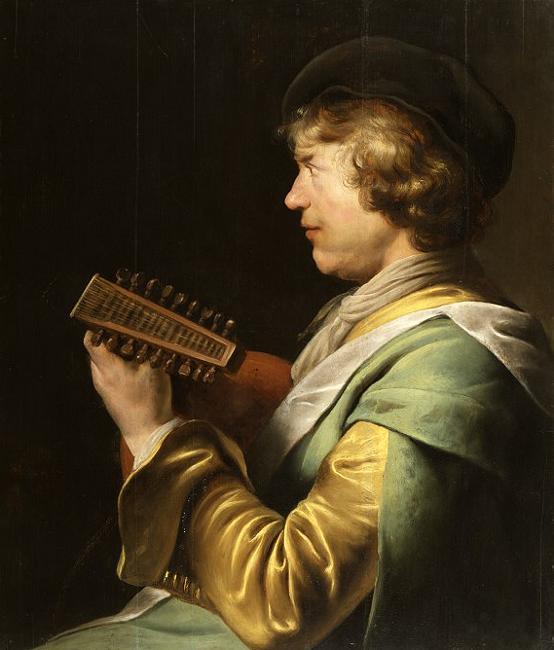
The Lute Player: A Portrait of Introspection in Baroque Splendor
Jan Andrea Lievens’s “The Lute Player,” painted circa 1629, is more than just a depiction of a musician; it's a carefully constructed tableau of human emotion and artistic ambition. This captivating work, now housed within the Walters Art Museum in Baltimore, offers a rare glimpse into the burgeoning world of Dutch Baroque painting, revealing the influence of both Caravaggio’s dramatic lighting and the prevailing trends of the Utrecht School. The subject, a young man lost in contemplation as he plays his lute, embodies a quiet dignity that belies the vibrant artistic currents swirling around him.
Lievens, a talented artist who apprenticed under Joris Verschoten and later collaborated closely with Rembrandt van Rijn, masterfully captures a moment of serene intensity. The figure is presented in a half-length pose, a compositional choice favored by Utrecht painters who sought to draw the viewer into the scene through intimate detail. His posture—slightly turned towards the left, his gaze directed upwards—suggests not merely playing an instrument but engaging with its music, lost in a world of melody and emotion. The subtle upward tilt of his head and the slight smile hint at a private joy, a moment of solace amidst perhaps a more demanding life.
A Caravaggisti Influence: Light, Shadow, and Dramatic Realism
The painting’s power resides significantly in Lievens' skillful manipulation of light and shadow—a technique deeply indebted to the innovations of Michelangelo Merisi da Caravaggio. Unlike the bright, airy landscapes often associated with Dutch art, this piece is dominated by a deep, enveloping darkness that serves to isolate the figure and intensify his expression. A single, focused light source illuminates his face, hands, and the lute itself, creating dramatic contrasts and highlighting the textures of his clothing and instrument. This chiaroscuro effect not only adds depth and volume but also imbues the scene with an almost theatrical quality, as if we are witnessing a private performance.
The meticulous rendering of details—the folds in the garment, the texture of the lute’s wood, the delicate sheen on his hair—further enhances the realism. Lievens demonstrates a remarkable ability to capture not just the appearance but also the essence of his subject, conveying a sense of immediacy and authenticity that is characteristic of Baroque painting. The choice of muted colors – primarily browns, reds, and yellows – contributes to the overall mood of quiet contemplation, while subtle highlights draw attention to key elements within the composition.
Symbolism and Context: Music, Patronage, and Artistic Circles
The lute itself is a potent symbol in this painting. Throughout Western art history, the lute has represented music, love, and even melancholy. Its presence here suggests a celebration of artistic expression and the pursuit of beauty. The inclusion of a madrigal—a vocal composition typically accompanied by instruments—further reinforces this theme. Scholars believe that Lievens’s model was likely Rembrandt van Rijn himself, reflecting the close professional relationship between the two artists during their early careers in Leiden.
The painting's creation occurred within a vibrant artistic milieu, fueled by the patronage of figures like Maurice of Nassau, Prince of Orange. This period witnessed an explosion of creativity and experimentation, as artists sought to push the boundaries of traditional styles. Lievens’s work exemplifies this spirit of innovation, blending elements of Caravaggisti realism with the more intimate and psychologically nuanced approach favored by Utrecht painters. The painting's provenance—having been part of the collection of Gustave de Rothschild—testifies to its enduring appeal and artistic merit.
A Timeless Portrait of Human Emotion
“The Lute Player” is a testament to Jan Andrea Lievens’s skill as a painter and his ability to capture the complexities of human emotion. It's a work that invites contemplation, prompting us to consider not only the beauty of the music being played but also the inner world of the musician himself. The painting’s enduring appeal lies in its quiet dignity, dramatic lighting, and masterful execution—a timeless portrait of introspection and artistic ambition within the rich tapestry of Dutch Baroque art.