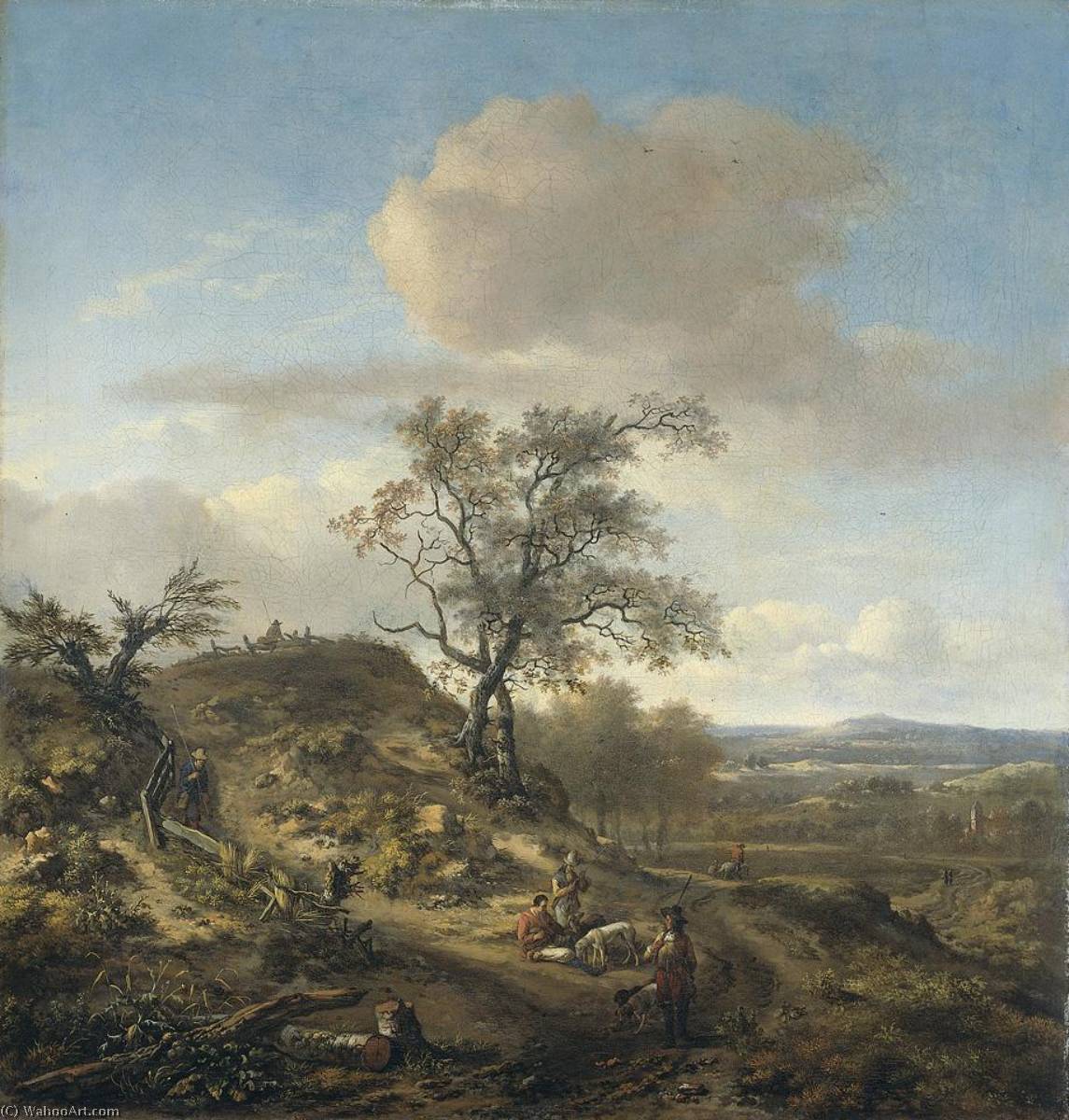
A Serene Vision of the Dutch Golden Age
Jan Jansz Wijnants’ “Landscape with a Hunter and Figures” is more than just a depiction of a rural scene; it's a carefully constructed meditation on humanity’s place within the vastness of nature, imbued with the quiet dignity characteristic of the Dutch Golden Age. Painted around 1670, this work transports us to a tranquil hillside in what appears to be the Netherlands, a landscape rendered with a remarkable sensitivity to light and atmosphere – a hallmark of Wijnants' style and a testament to his training under the esteemed Pieter Bruegel the Elder.
The composition unfolds with an understated elegance. A small group of figures—a hunter and two companions—occupy the central foreground, their postures suggesting a leisurely pursuit of game. Beyond them, a modest farmhouse nestles amongst rolling hills, dotted with scattered trees that frame the scene like a gentle embrace. The sky, rendered in soft, cloudy hues, hints at an approaching storm, adding a subtle layer of drama to the otherwise peaceful vista. Noticeably absent is any grand architectural statement or dramatic event; instead, Wijnants focuses on the quiet rhythms of rural life and the harmonious relationship between man and his environment.
The Influence of Bruegel and Mannerist Innovation
Wijnants’ work stands as a compelling example of the influence exerted by Pieter Bruegel the Elder upon a generation of Dutch painters. While not a direct copy, “Landscape with a Hunter” shares Bruegel's penchant for depicting everyday scenes with a keen observational eye and a subtle symbolic depth. However, Wijnants departs from Bruegel’s more overtly narrative approach, favoring a greater emphasis on atmospheric perspective and the delicate rendering of light and shadow. This shift reflects a broader trend within Dutch art during this period – a move towards a more refined and contemplative style, informed by the principles of Mannerism.
The inclusion of small figures in the distant background, reminiscent of Pieter Aertsen’s works, is particularly noteworthy. This technique, known as “Mannerist inversion,” deliberately places humble, everyday activities—such as farming and fishing—in the foreground, while relegating more significant events to the distance. This subtle shift in perspective serves to highlight the importance of these ordinary pursuits, suggesting a quiet dignity and resilience within the lives of the rural population.
Symbolism and Emotional Resonance
Beyond its purely descriptive qualities, “Landscape with a Hunter” is rich in symbolic meaning. The hunter himself represents not just a pursuit of sustenance but also a connection to tradition and the rhythms of nature. The figures in the foreground are engaged in simple tasks—plowing, tending sheep—suggesting a harmonious relationship between humanity and the land. The distant farmhouse symbolizes security and community, while the approaching storm hints at the unpredictable forces of nature that govern all aspects of life.
Ultimately, Wijnants’ painting evokes a sense of serene contemplation and quiet beauty. It is a reminder of the enduring appeal of the natural world and the importance of finding contentment in simple pleasures. The work's subtle emotional resonance—a blend of tranquility, resilience, and perhaps even a touch of melancholy—continues to captivate viewers centuries after its creation.
Further Research: