 Preview
 Send
Send Share
Share
 Details

 Download
 Similars
 X-Ray
X-Ray Diaporama
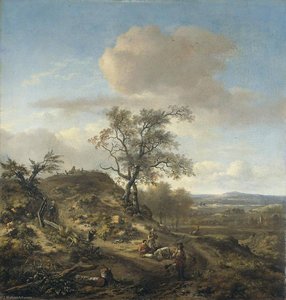
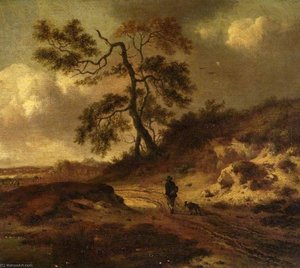
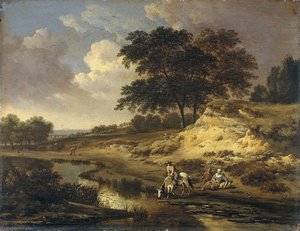
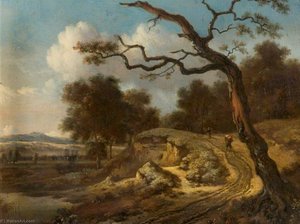
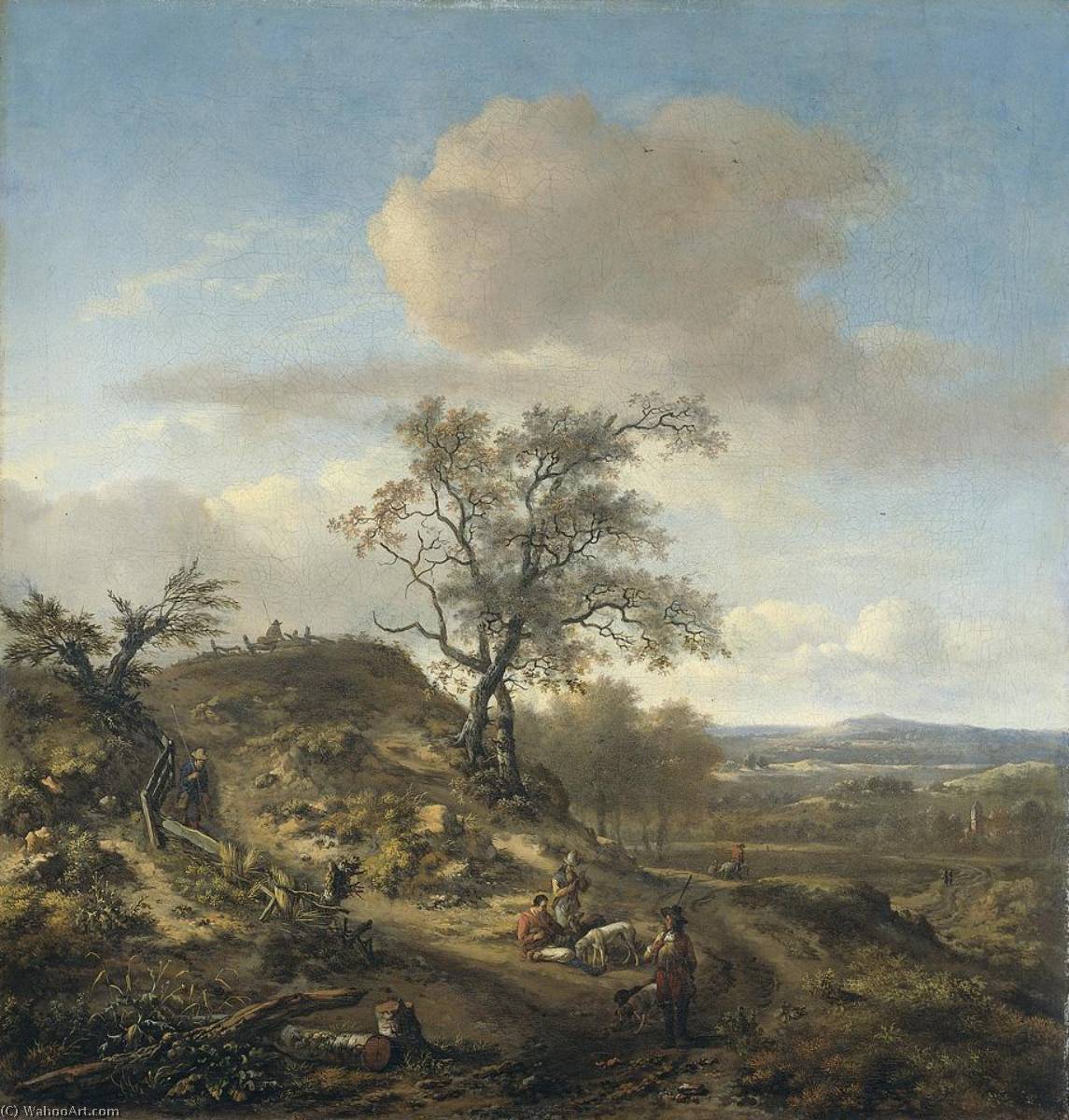
Landscape with a Hunter and Figures
 Acrylic On Canvas
- WallArt
- Dutch Golden Age
 1670
1670 67.0 x 63.0 cm
 Rijksmuseum Amsterdam
 Read More
Hand Made Oil Reproduction
Hand-painted oil on canvas in your size and frame, made to order by our artists. ( Buy Print Buy Image)




P118B $10

P118H $10

P118W $10

P438Z $10

P508JH $12

P508YH $12

P805H $10

P805Z $10

P919BZ $10

P919G $10

P919XJ $10

P959ZH $10

P968JZ $12

W106C $8

W218G $10

W218JH $8

W218Y $10

W307PJ $10

W316G $10

W316PJ $8

W316Y $10

W398PJ $8

W4111J $10

W500HY $15

W500JH $15

W692G $12

W849H $8

W940BG $15

W953PJ $8




Pick from our preset sizes that match the artwork's original proportions.

You may enter your own dimensions to fit a specific frame or space. If your selected size does not match the original image's proportions, we will either crop the artwork or extend the painting with additional hand-painted elements. A digital mockup will be sent for your approval before production begins.
Please note that the on-screen preview does not reflect the actual cropping or extension. Only the mockup will accurately show the final composition.
While custom sizes are available, we recommend selecting a dimension from the predefined list to preserve the original proportions.
After order, ArtsDot.com team will email client for instructions and provide a mockup preview
Worldwide Delivery () in 3/4 weeks instead of standard 5 weeks. (17 August). No compromise on quality.

Free Worldwide Express Shipping

High-Quality Linen Canvas

Full Shipping Insurance

Customs Tax Refund Guarantee

True Color Matching Guarantee

60-Day Return Policy (Defects Only)

100% Money-Back Guarantee

Bulk Discount Offer
 Glass option is only available in size under 110 CM

Landscape with a Hunter and Figures
Reproduction Medium
Reproduction Size
-


Total Price
$ 263
Artwork Description
A Serene Vision of the Dutch Golden Age
Jan Jansz Wijnants’ “Landscape with a Hunter and Figures” is more than just a depiction of a rural scene; it's a carefully constructed meditation on humanity’s place within the vastness of nature, imbued with the quiet dignity characteristic of the Dutch Golden Age. Painted around 1670, this work transports us to a tranquil hillside in what appears to be the Netherlands, a landscape rendered with a remarkable sensitivity to light and atmosphere – a hallmark of Wijnants' style and a testament to his training under the esteemed Pieter Bruegel the Elder.
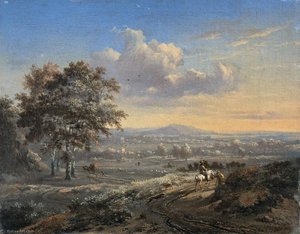
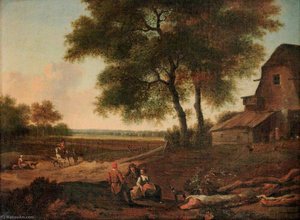
The composition unfolds with an understated elegance. A small group of figures—a hunter and two companions—occupy the central foreground, their postures suggesting a leisurely pursuit of game. Beyond them, a modest farmhouse nestles amongst rolling hills, dotted with scattered trees that frame the scene like a gentle embrace. The sky, rendered in soft, cloudy hues, hints at an approaching storm, adding a subtle layer of drama to the otherwise peaceful vista. Noticeably absent is any grand architectural statement or dramatic event; instead, Wijnants focuses on the quiet rhythms of rural life and the harmonious relationship between man and his environment.
The Influence of Bruegel and Mannerist Innovation
Wijnants’ work stands as a compelling example of the influence exerted by Pieter Bruegel the Elder upon a generation of Dutch painters. While not a direct copy, “Landscape with a Hunter” shares Bruegel's penchant for depicting everyday scenes with a keen observational eye and a subtle symbolic depth. However, Wijnants departs from Bruegel’s more overtly narrative approach, favoring a greater emphasis on atmospheric perspective and the delicate rendering of light and shadow. This shift reflects a broader trend within Dutch art during this period – a move towards a more refined and contemplative style, informed by the principles of Mannerism.
The inclusion of small figures in the distant background, reminiscent of Pieter Aertsen’s works, is particularly noteworthy. This technique, known as “Mannerist inversion,” deliberately places humble, everyday activities—such as farming and fishing—in the foreground, while relegating more significant events to the distance. This subtle shift in perspective serves to highlight the importance of these ordinary pursuits, suggesting a quiet dignity and resilience within the lives of the rural population.
Symbolism and Emotional Resonance
Beyond its purely descriptive qualities, “Landscape with a Hunter” is rich in symbolic meaning. The hunter himself represents not just a pursuit of sustenance but also a connection to tradition and the rhythms of nature. The figures in the foreground are engaged in simple tasks—plowing, tending sheep—suggesting a harmonious relationship between humanity and the land. The distant farmhouse symbolizes security and community, while the approaching storm hints at the unpredictable forces of nature that govern all aspects of life.
Ultimately, Wijnants’ painting evokes a sense of serene contemplation and quiet beauty. It is a reminder of the enduring appeal of the natural world and the importance of finding contentment in simple pleasures. The work's subtle emotional resonance—a blend of tranquility, resilience, and perhaps even a touch of melancholy—continues to captivate viewers centuries after its creation.
Further Research:
Related Artworks
Artist Biography
A Serene Vision of the Dutch Golden Age: The Life and Art of Jan Jansz Wijnants
Jan Jansz Wijnants, a name perhaps less immediately recognizable than some of his contemporaries, nevertheless occupies a significant place within the pantheon of 17th-century Dutch landscape painters. Born in Haarlem in 1632, Wijnants dedicated his life to capturing the tranquil beauty of the Low Countries, imbuing his scenes with an atmospheric depth and a quiet lyricism that resonated deeply with the sensibilities of his time. His work offers a window into a world steeped in pastoral charm, populated by figures engaged in everyday life amidst idyllic settings.
Early Life and Artistic Formation
Wijnants’s artistic journey began within a family already connected to the art world; his father, Jan Wijnants, was a Catholic art dealer active in Haarlem. This familial connection undoubtedly provided early exposure to paintings and fostered an appreciation for visual culture. Following his mother's death, his father remarried Maria Jans van Stralen, creating a unique artistic kinship as her son, Egbert Jaspersz van Heemskerck, became Wijnants’ stepbrother. The precise details of Wijnants’ early training remain somewhat elusive, but it is known he was active in Haarlem until approximately 1660. This period likely saw him absorbing the influences of local masters and developing his distinctive style.
The Move to Amsterdam and a Blossoming Career
Around 1660, Wijnants relocated to Amsterdam, a bustling center of commerce and artistic innovation. It was here that his career truly flourished. While biographical details from this period are sparse, the paintings he produced during his time in Amsterdam reveal a mature artist fully confident in his vision. He specialized in landscapes featuring cattle on country roads, scenes with resting figures, and expansive views reminiscent of the Italian countryside – a style known as “Italianate landscape.” These works weren’t simply topographical representations; they were carefully constructed compositions designed to evoke a sense of peace, harmony, and idealized beauty.
Influences and Artistic Style
Wijnants's art demonstrates a fascinating interplay of influences. While firmly rooted in the Dutch tradition of realistic landscape painting, his work also reveals an appreciation for the compositional principles and atmospheric effects favored by Italianate masters. The influence of painters like Nicolaes de Vree and Adriaen van de Velde is evident in his early works, but he quickly developed a style uniquely his own. His paintings often feature a soft, diffused light, delicate brushwork, and a subtle palette that creates a sense of atmospheric depth. He was particularly adept at rendering the textures of foliage, the play of sunlight on water, and the naturalistic poses of his figures. Later artists such as Thomas Gainsborough and Wilhelm von Kobell would draw inspiration from Wijnants’s serene compositions.
Legacy and Historical Significance
Jan Jansz Wijnants died in Amsterdam in 1684, leaving behind a body of work that continues to captivate viewers today. Though not as prolific as some of his contemporaries, his paintings are prized for their exquisite beauty, technical skill, and evocative atmosphere. His landscapes offer a glimpse into the Dutch Golden Age’s fascination with nature, its appreciation for pastoral life, and its commitment to realistic representation. His works can be found in prominent collections, including the Memling Museum in Bruges, serving as a testament to his enduring legacy. Wijnants's ability to imbue ordinary scenes with a sense of tranquility and poetic beauty ensures his place among the most beloved landscape painters of the Dutch Golden Age.
jan jansz wijnants
1632 - 1684 , Netherlands
Quick Facts
- Artistic Movement Or Style: Dutch Golden Age landscape
- Artists Or Movements Influenced By This Artist:
- Thomas Gainsborough
- Wilhelm von Kobell
- Date Of Birth: 1632
- Date Of Death: 1684
- Full Name: Jan Jansz Wijnants
- Nationality: Dutch
- Notable Artworks:
- Landscape with a Peddler...
- Landscape with Cattle on...
- Landscape
- Place Of Birth: Haarlem, Netherlands
Related Articles
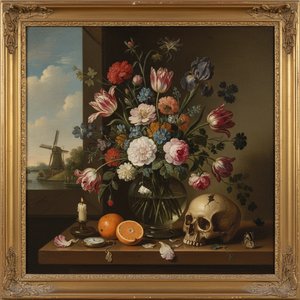
Jan Jansz Wijnants: A Study in Dutch Golden Age Still Life & Floral Transience
Explore the captivating world of Jan Wijnants and Dutch Golden Age still life painting. Discover symbolism, masterful techniques & lasting influence on floral art history. Learn more!

Dutch Masters: 10 Golden Age Paintings That Still Inspire |
Journey into the Dutch Golden Age! Explore 10 iconic paintings by Rembrandt, Vermeer & Hals. Discover the stories behind these Baroque masterpieces and find museum-quality art reproductions to elevate your home decor on .
Golden Light & Dutch Skies: Bringing the Magic of Dutch Golden Age Landscapes into Your Home
Transform your home with the breathtaking light of Dutch Golden Age landscapes. Discover how hand-painted oil reproductions of masterworks like Ruisdael and Vermeer bring timeless elegance, atmosphere, and soulful texture to modern interiors. Elevate your space with museum-quality art.
Nicolaes Berchem: Dutch Golden Age Pastoralism & the Evolution of Landscape Painting
Explore the captivating world of Nicolaes Berchem, a leading Dutch Golden Age painter. Discover his idyllic landscapes, masterful technique & lasting influence on art history. Learn more at ArtsDot.
Charles Leickert: Capturing the Dutch Golden Age Light – A Comprehensive Study of Technique, Context, and Legacy
Explore the captivating winter landscapes of Charles Leickert, a master of Dutch Golden Age light & atmosphere. Discover his techniques, symbolism, and lasting legacy – a comprehensive study for art enthusiasts and collectors.