The Rise of Dutch Romantic Landscape Painting: Setting the Stage
Dutch Golden Age painting is the painting of the Dutch Golden Age, a period in Dutch history roughly spanning the 17th century, during and after the later part of the Eighty Years' War (1568–1648) for Dutch independence. The new Dutch Republic was th...
The 19th century witnessed a fascinating revival of landscape painting, particularly within the Netherlands. Following decades marked by political upheaval and societal shifts stemming from the Eighty Years’ War, a renewed sense of national identity blossomed, inextricably linked to the country's pastoral beauty. This wasn’t merely a return to representational accuracy; it was an emotional reclamation of Dutch heritage, expressed through scenes that evoked tranquility, resilience, and a deep connection to the land. While earlier Dutch masters like Jacob van Ruisdael had established a tradition of realistic depiction, artists of the 19th century infused their work with a Romantic sensibility – a yearning for the sublime, an appreciation for atmospheric effects, and often, a subtle undercurrent of melancholy. This fertile ground provided the perfect context for the emergence of painters like Charles Leickert, who would become synonymous with capturing the ethereal beauty of Dutch winter scenes.
The period saw a shift away from grand historical narratives towards more intimate portrayals of everyday life and the natural world. The burgeoning middle class sought art that reflected their values – peaceful domesticity, quiet contemplation, and an appreciation for the simple pleasures of life. This demand fueled a proliferation of landscape painting, with artists specializing in various sub-genres: seascapes, river views, townscapes, and, crucially, winter scenes. The Dutch Golden Age’s legacy of detailed realism provided a strong foundation, but these new painters weren't simply replicating their predecessors; they were building upon that tradition, adding layers of emotional depth and technical innovation.
Leickert’s Early Influences & Artistic Development in The Hague
Charles Henri Joseph Leickert (22 September 1816, Brussels – 5 December 1907, Mainz) was a Dutch painter of landscapes. As a specialist in winter landscapes, he explored the nuances of the evening sky and the rosy-fingered dawn. == Biography == Cha...
Charles Henri Joseph Leickert (1816-1907) embarked on his artistic journey in The Hague, a city steeped in artistic tradition. His initial training under Bartholomeus van Hove provided him with a solid grounding in the fundamentals of landscape painting. However, it was his tutelage under Wijnand Nuijen and, more significantly, Andreas Schelfhout that truly shaped his aesthetic sensibility. Schelfhout, a master of winter landscapes himself, imparted not only technical skills but also a profound understanding of light, color, and composition. Leickert’s early works clearly demonstrate this influence – a meticulous attention to detail, a preference for realistic depiction, and a growing fascination with the nuances of atmospheric perspective.
The Hague itself played a crucial role in Leickert's development. The city’s proximity to the North Sea, its flat landscapes, and its often-grey skies provided ample inspiration. He began specializing in winter scenes around 1840, quickly establishing himself as a skilled interpreter of frozen waterways, snow-covered fields, and rosy-fingered dawns. His dedication to this specific genre wasn’t accidental; it allowed him to explore his fascination with light and its transformative power on the landscape. From 1841 to 1846, Leickert honed his skills in The Hague before moving to Amsterdam, where he would further refine his style and reach a wider audience.
Mastering Light and Atmosphere: A Technical Analysis of Leickert's Style
 Dutch winter scene Sun
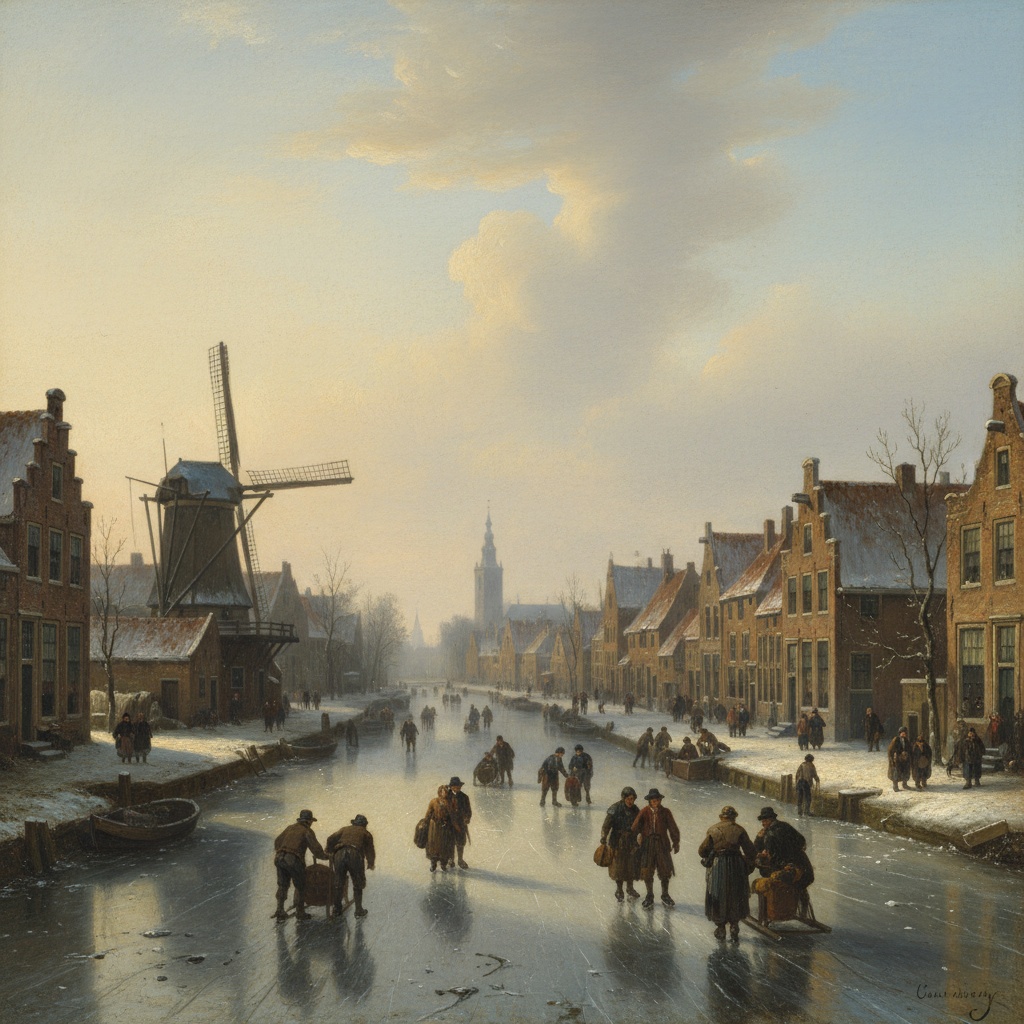
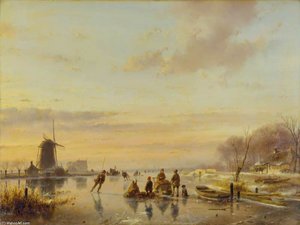
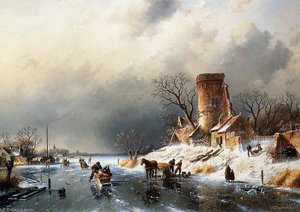
Charles Leickert’s "Dutch Winter Scene Sun" captures a serene 19th-century village on frozen waters. Explore this Dutch Golden Age landscape's realism, atmospheric detail & symbolic resilience.
Leickert’s enduring appeal lies in his masterful manipulation of light. He wasn’t simply depicting winter scenes; he was capturing the *feeling* of winter – the crispness of the air, the stillness of the landscape, and the subtle interplay of sunlight on snow and ice. His technique involved a meticulous layering of paint, building up textures to create a sense of depth and realism. He employed a limited palette, favoring blues, greys, pinks, and ochres, but skillfully blended these colors to achieve an astonishing range of atmospheric effects.
A close examination of paintings like “Dutch Winter Scene Sun” reveals his sophisticated understanding of perspective. He used subtle variations in tone and color to create a sense of distance, drawing the viewer’s eye into the landscape. The reflections on the frozen waters are particularly noteworthy – they aren't merely accurate depictions but rather shimmering illusions that enhance the painting’s ethereal quality. Leickert also paid close attention to detail, meticulously rendering figures, buildings, and trees with a remarkable degree of precision. However, this detail wasn’t simply for the sake of accuracy; it served to ground the scene in reality, making the overall effect even more compelling. His watercolor river landscapes demonstrate his ability to capture atmospheric perspective with fluidity and grace.
Winter Scenes as Symbolic Representations: Decoding Leickert’s Imagery
While seemingly straightforward depictions of Dutch life, Leickert's winter scenes are often imbued with subtle symbolism. The frozen waterways can be interpreted as metaphors for the challenges and hardships faced by the Dutch people throughout their history – a resilience born from enduring difficult conditions. The presence of figures skating or traveling across the ice suggests a sense of community and perseverance in the face of adversity. Even the rosy-fingered dawns, so characteristic of his work, can be seen as symbols of hope and renewal.
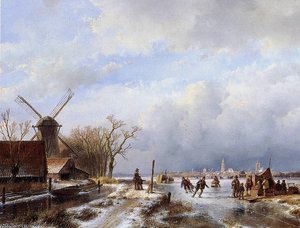
His paintings frequently feature windmills, iconic structures deeply rooted in Dutch culture. These weren’t merely picturesque elements; they represented ingenuity, hard work, and a connection to the land. The inclusion of castles or stately homes often alluded to the country's rich history and cultural heritage. Leickert wasn’t overtly didactic – his symbolism is subtle and open to interpretation. However, it’s clear that he was consciously creating images that resonated with a sense of national pride and optimism. Paintings like “Figures in a Dutch Town by a Frozen Canal” capture this serene mood perfectly, inviting viewers to contemplate the beauty and resilience of the Dutch landscape.
Leickert’s Legacy and Place within the Dutch Golden Age Tradition
Charles Leickert's prolific career spanned over six decades, leaving behind an extensive body of work that continues to captivate art enthusiasts today. While he may not be as widely recognized as some of his contemporaries, his contribution to the Dutch Romantic landscape tradition is undeniable. He successfully blended the realism of the Golden Age with a heightened sense of emotional depth and atmospheric nuance.
His paintings offer a glimpse into a bygone era – a time of peaceful contemplation, quiet beauty, and unwavering resilience. Leickert’s influence can be seen in the work of later landscape painters who sought to capture the ethereal quality of Dutch winter scenes. He remains a testament to the enduring power of art to evoke emotion, celebrate cultural heritage, and transport viewers to another time and place. Today, his works are highly sought after by collectors, representing not only an investment but also a connection to a rich artistic tradition. ArtsDot.com proudly offers reproductions of Leickert’s masterpieces, allowing art lovers worldwide to experience the beauty and tranquility of his serene landscapes firsthand.