A Moment of Quiet Intrigue: Jean-Baptiste Le Prince’s “Visit to a Palmist”
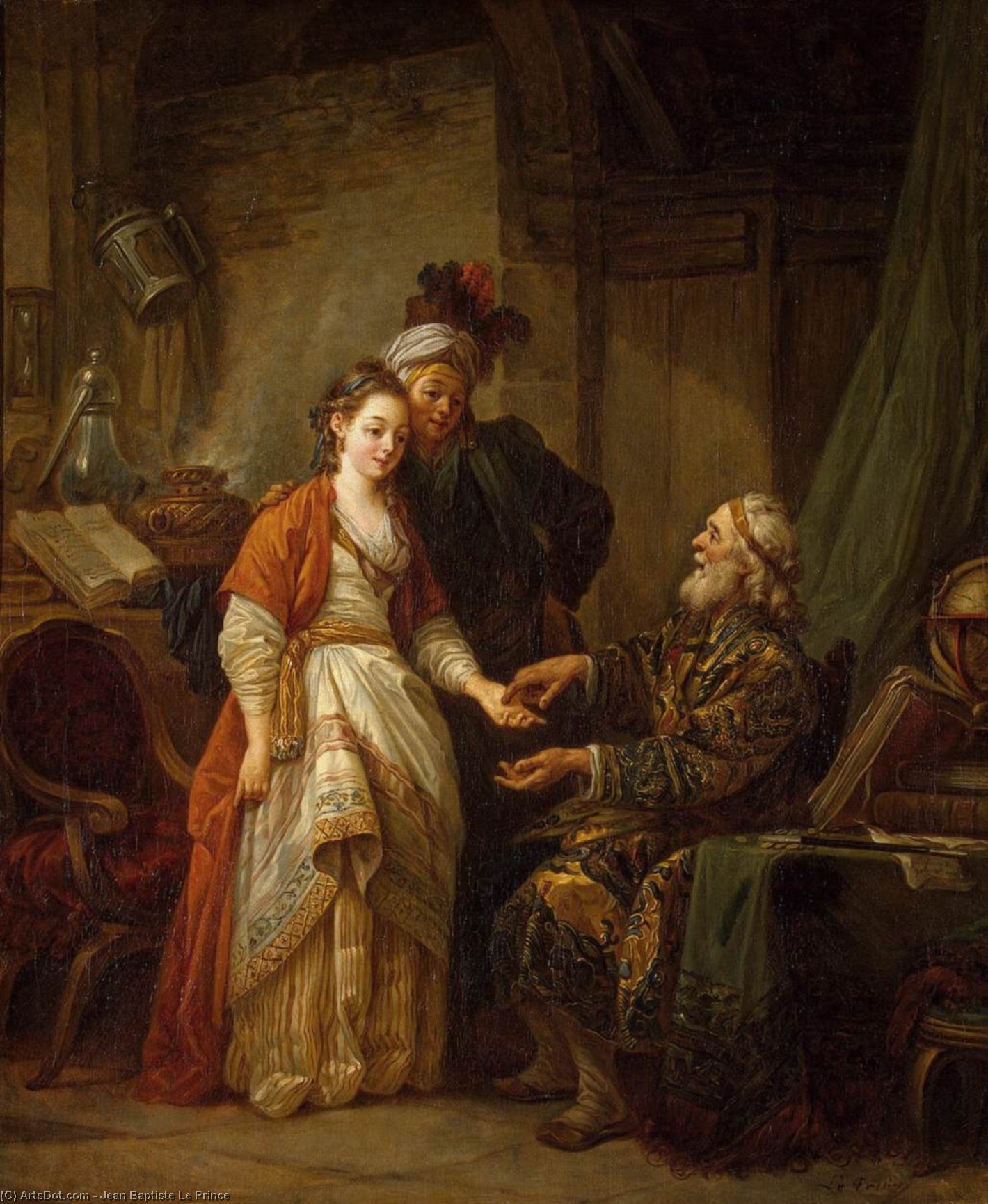
Jean-Baptiste Le Prince's "Visit to a Palmist," painted in 1775, is more than just a portrait; it’s a carefully constructed tableau of social observation and veiled mystery. The scene unfolds within a modestly furnished room – a dining table dominates the space, surrounded by chairs suggesting an intimate gathering – yet the focus immediately rests on the central figures: three individuals caught in a delicate exchange. A woman, likely a client, extends her hand towards a seated man, presumably a palmist, his face partially obscured and hinting at a practiced detachment. The presence of a second woman adds another layer of complexity to this silent drama, suggesting perhaps an observer or a fellow participant in the unfolding scene.
Le Prince’s style firmly anchors the painting within the Neoclassical tradition, yet it possesses a subtle softness that distinguishes it from the rigid formality often associated with the movement. The figures are rendered with a remarkable degree of realism, their clothing and gestures conveying a sense of everyday life. However, Le Prince skillfully employs light and shadow to create an atmosphere of quiet contemplation, drawing the viewer’s eye to the nuanced expressions on each face. Notice how the diffused light illuminates the woman's hand, emphasizing her gesture while simultaneously casting subtle shadows that hint at unspoken intentions.
The Context of Enlightenment Observation
To fully appreciate “Visit to a Palmist,” it’s crucial to understand the intellectual climate of 18th-century France. The era was marked by an intense interest in observation, both scientific and social. The Enlightenment championed reason and empirical inquiry, yet there remained a deep fascination with the mysteries of human behavior – particularly those related to intuition, psychology, and the supernatural. Palmistry, the practice of reading fortunes from the lines of the hand, was a popular pastime among the aristocracy, offering a seemingly accessible means of understanding the future and navigating social complexities.
Le Prince’s painting reflects this cultural preoccupation with divination and the human desire for knowledge. The palmist himself embodies this fascination – his posture suggests both expertise and a carefully cultivated air of detachment. He is not overtly mystical, but rather presents himself as an interpreter of hidden truths, inviting the viewer to contemplate the potential significance of the lines etched upon the client’s hand.
Symbolism and the Language of Gesture
The painting is rich in symbolic details that invite interpretation. The dining table, a symbol of hospitality and social interaction, underscores the importance of this encounter. The woman's gesture – extending her hand – represents an offering, a request for guidance or insight. The palmist’s response, though unseen, holds the key to understanding the scene’s meaning. The muted color palette—predominantly browns, creams, and ochres—contributes to the painting’s somber mood, suggesting a sense of gravity and introspection.
Furthermore, consider the positioning of the figures within the room. The woman is positioned slightly off-center, drawing attention to her vulnerability and dependence on the palmist's interpretation. The second woman, observing from the side, adds an element of intrigue – is she a confidante, a skeptic, or simply a witness to this private exchange? The subtle details—the folds in the clothing, the arrangement of the furniture—all contribute to a complex narrative that defies simple explanation.
A Legacy of Precision and Psychological Insight
Jean-Baptiste Le Prince was a highly regarded painter during his time, known for his historical and allegorical works. “Visit to a Palmist” stands as a testament to his skill in capturing the nuances of human interaction and conveying a sense of psychological depth. His meticulous attention to detail—particularly in rendering facial expressions and body language—is remarkable, offering a rare glimpse into the inner lives of his subjects.
Reproductions of this captivating painting retain its power to intrigue and provoke thought. Its timeless themes – trust, uncertainty, and the search for meaning – continue to resonate with viewers today. Whether displayed in a private collection or a public gallery, “Visit to a Palmist” remains a compelling example of Neoclassical artistry and a poignant reflection on the enduring human fascination with the unknown.