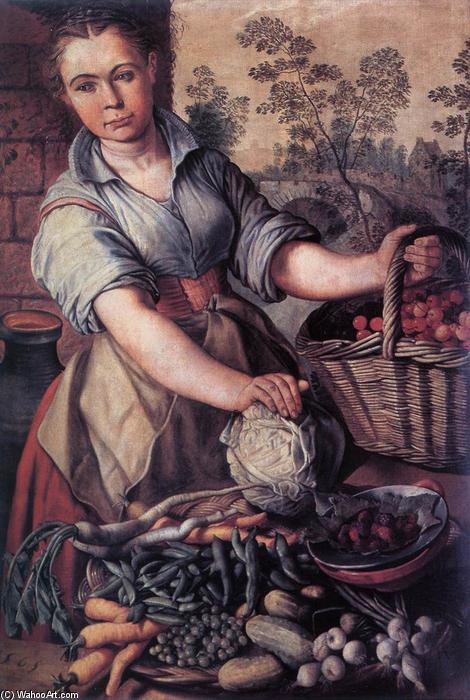
Joachim Beuckelaer: The Quiet Triumph of Observation
Joachim Beuckelaer stands as an intriguing figure in the constellation of Flemish Renaissance painters—a master whose influence resonates through generations, yet whose name often lacks the immediate recognition afforded to his contemporaries like Pieter Bruegel or Rubens. He carved out a distinctive niche within the artistic landscape of Antwerp and beyond, specializing in scenes depicting everyday life, particularly bustling marketplaces and domestic interiors populated by meticulously rendered figures engaged in commonplace activities. While overshadowed by more flamboyant personalities, Beuckelaer’s work possesses a remarkable subtlety—a quiet triumph of observation that anticipates the burgeoning genre of still life art and elevates the mundane to an aesthetic level worthy of contemplation.
- A Pioneer of Market Views: Beuckelaer's contribution to art history lies primarily in his masterful depiction of market scenes. Unlike many artists of his time who focused on grand narratives or mythological allegories, he turned his gaze inward, capturing the vibrant energy and sensory richness of a typical Flemish marketplace. His paintings aren’t merely representations of commerce; they are carefully constructed compositions designed to convey a sense of realism and immediacy—a feat achieved through painstaking detail and masterful use of perspective.
- The Influence of Pieter Aertsen: Beuckelaer's artistic development was profoundly shaped by his teacher, Pieter Aertsen, who is credited with initiating the genre of market view. Aertsen’s pioneering explorations into portraying domestic interiors and marketplaces established a precedent for subsequent artists—including Beuckelaer—to delve deeper into capturing the textures and nuances of everyday life.
- Symbolism Embedded in Detail: Beyond mere visual accuracy, Beuckelaer's paintings are imbued with symbolic meaning. Like Aertsen before him, he skillfully incorporated religious iconography into his market scenes—often subtly referencing biblical narratives through architectural elements or depictions of figures engaged in ritualistic gestures. These additions elevate the artwork beyond a simple depiction of daily life, inviting viewers to consider broader themes of faith and morality.
- Technique: Chalk Ground and Layered Paint: Beuckelaer’s technique exemplifies the meticulous craftsmanship characteristic of Flemish painting during the Renaissance. He began by applying a chalk ground to his oak panels—a preparatory layer that ensured optimal adhesion for subsequent paint layers. The artist then meticulously built up the image using thin, translucent glazes—a technique perfected by Aertsen—allowing him to achieve remarkable luminosity and depth.
- The Legacy of Observation: Perhaps Beuckelaer’s most enduring legacy is his unwavering commitment to observing and representing the world around him with unflinching honesty. He eschewed grand gestures or stylized conventions, opting instead for a quiet realism that anticipates the stylistic innovations of later artists—particularly those who would champion the genre of still life art. His work reminds us that beauty can be found in the simplest of subjects—a testament to Beuckelaer’s profound understanding of artistic expression as a means of capturing and conveying the essence of human experience.
Notable Works: The Vegetable Market and Beyond
Among Beuckelaer's oeuvre, *The Vegetable Market* stands out as arguably his most celebrated masterpiece—a luminous depiction of a Flemish marketplace brimming with fresh produce and populated by figures engaged in the transaction of goods. Executed in 1567, this painting exemplifies Beuckelaer’s signature style: meticulous detail combined with subtle symbolic resonance. The artwork's vibrant colors—particularly the reds and greens—capture the vitality of the scene, while its composition draws inspiration from Pieter Aertsen’s pioneering explorations into market views. Recent conservation efforts revealed hidden layers of varnish and retouching, highlighting the challenges faced by preserving artworks from bygone eras.
Further Research
Detailed analysis of Beuckelaer's artistic process—including his use of underdrawings and glazing techniques—provides invaluable insight into the evolution of Renaissance painting. Examination of related works by Pieter Aertsen illuminates the shared influences that shaped their artistic vision, demonstrating a collaborative spirit within Antwerp’s artistic community. Ongoing scholarly research continues to refine our understanding of Beuckelaer's life and career, uncovering new information about his family background and his role in shaping the cultural landscape of 16th-century Flanders. KMSKA’s comprehensive documentation of *The Vegetable Market* offers a valuable resource for art historians and enthusiasts alike—a testament to the enduring fascination with this remarkable artist and his contribution to the history of visual culture.