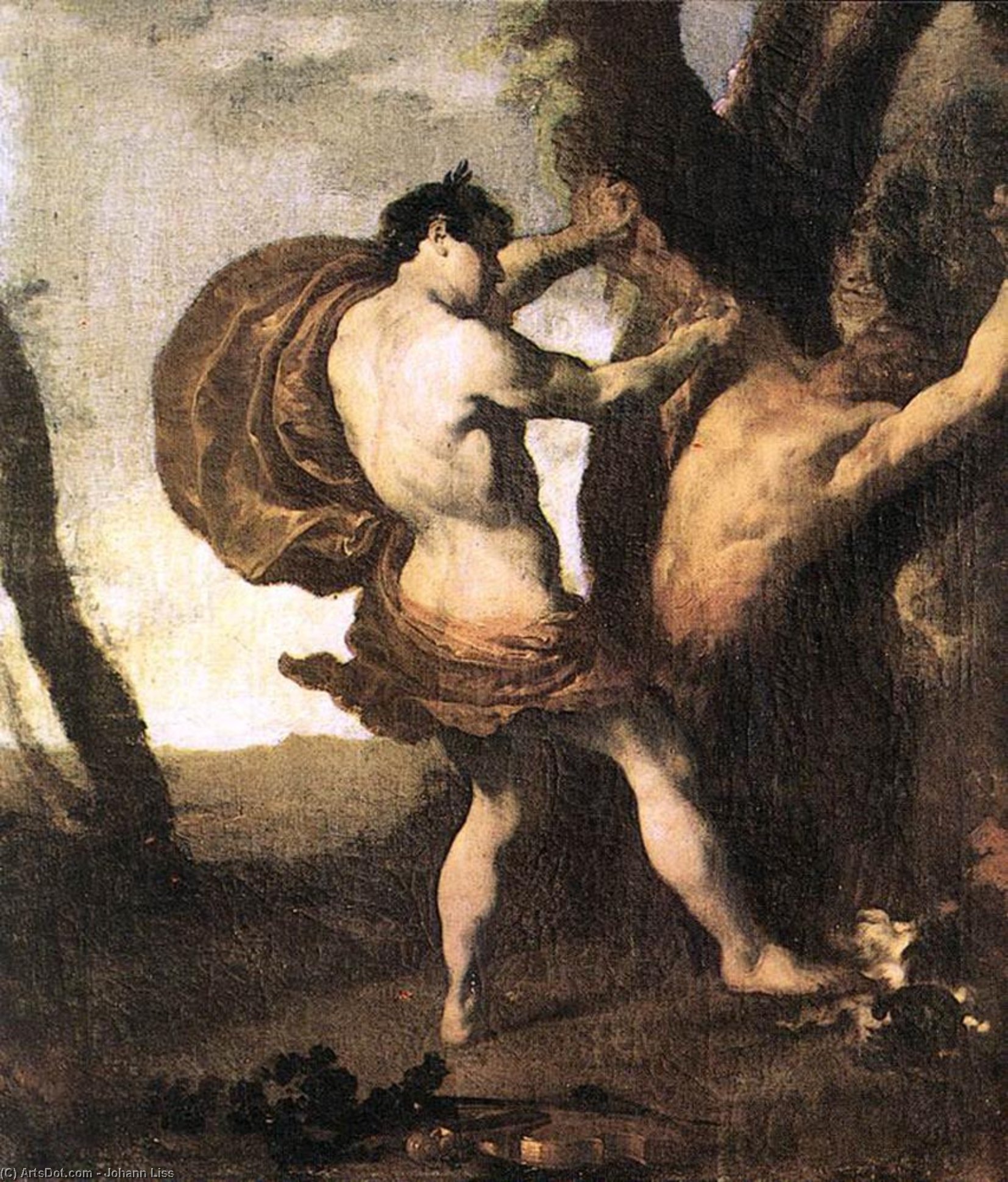
A Dramatic Confrontation: Johann Liss's "Apollo and Marsyas"
Johann Liss’s “Apollo and Marsyas,” painted in 1627, is more than just a depiction of a classical myth; it’s a powerful exploration of hubris, divine justice, and the intoxicating allure of artistic competition. The canvas pulsates with tension as we witness the fateful moment when Apollo, god of music and light, prepares to deliver judgment upon Marsyas, a satyr who dared challenge him in a musical contest. Liss, working within the vibrant currents of Venetian Baroque painting, captures this ancient conflict with a dramatic flair that draws the viewer directly into the heart of the narrative.
The Myth Unveiled: A Tale of Pride and Punishment
The story itself is steeped in symbolism. Marsyas, representing earthly skill and untamed nature, believed his mastery of the aulos (a double-reeded wind instrument) could rival Apollo’s divine musical prowess, typically associated with the lyre. This act of defiance, this challenge to the established order of the gods, was inherently doomed. The myth served as a cautionary tale—a reminder that mortal ambition should not overstep its boundaries and question the authority of the divine. Liss doesn't shy away from the gravity of the situation; his figures are caught in a moment of heightened emotion – Apollo’s poised strength contrasting with Marsyas’s evident apprehension, hinting at the brutal consequences to come. The presence of other figures surrounding them adds to the sense of solemnity and underscores the significance of this pivotal event.
Baroque Brilliance: Liss's Technique and Style
Liss, influenced by both Italian Mannerism (as noted in early training under Hendrik Goltzius) and the burgeoning Baroque style he encountered in Venice, masterfully employs a hazy, atmospheric technique. Rather than sharp lines and precise detail, Liss favors loose brushstrokes and subtle gradations of color to create an almost dreamlike quality. This approach softens the harshness of the impending punishment while simultaneously amplifying the emotional intensity of the scene. The light itself plays a crucial role; it doesn't illuminate with stark clarity but rather filters through the foliage, casting long shadows and highlighting key figures—Apollo’s commanding presence and Marsyas’s vulnerable form. This technique foreshadowed later Rococo styles, demonstrating Liss’s innovative approach to color and composition.
A Legacy of Artistic Innovation
Johann Liss's career was tragically cut short; he died in 1629, leaving behind a relatively small but impactful body of work. Despite his brief artistic life, Liss left an indelible mark on Venetian painting, influencing later generations of artists like Sebastiano Ricci and Giovanni Battista Tiepolo. "Apollo and Marsyas" stands as a testament to his skill—a compelling narrative rendered with Baroque brilliance, capturing not just the story of a mythological contest but also exploring universal themes of pride, consequence, and the enduring power of art itself. Owning a reproduction of this painting is owning a piece of that legacy – a window into the dramatic world of 17th-century Venetian artistry.