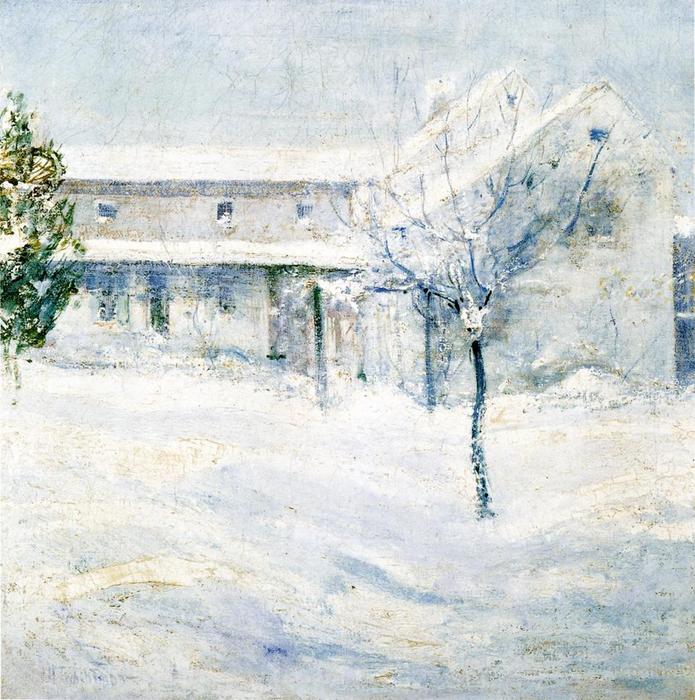
Old Holley House, Cos Cob – A Winter’s Hush
John Henry Twachtman's "Old Holley House, Cos Cob" is more than just a depiction of a snowy landscape; it’s a poignant meditation on stillness, memory, and the enduring beauty of the Connecticut countryside. Painted in 1890, during his most intensely productive period, this artwork captures a moment of profound quietude at the Bush–Holley House, a pivotal location within the burgeoning Cos Cob Art Colony. The scene unfolds with a deliberate restraint, reflecting Twachtman’s evolving approach to Impressionism – one that prioritized atmosphere and emotional resonance over purely representational accuracy.
The house itself, rendered with meticulous detail despite its softened edges, anchors the composition. Its rectangular form provides a structural counterpoint to the swirling snowdrifts and the blurred forms of the surrounding landscape. The bare tree in the foreground isn’t merely a compositional element; it speaks to themes of dormancy and the cyclical nature of time – a common motif within Twachtman's work, often interpreted as reflecting his own contemplative state.
A Palette of Quietude
Twachtman masterfully employs a muted color palette dominated by whites, blues, and grays. This isn’t a vibrant celebration of winter; rather, it’s an exploration of the subtle nuances of light and shadow on a snowy day. The diffused lighting, characteristic of an overcast winter afternoon, creates a sense of ethereal calm. Notice how he uses variations in gray – from the deepest shadows cast by the house to the lighter tones reflecting off the snow – to build depth and create a palpable sense of atmosphere. Subtle browns appear in the tree branches, grounding the scene and adding a touch of warmth against the prevailing coolness.
Impressionistic Technique & The Cos Cob Colony
Executed in oil paints on canvas, “Old Holley House” exemplifies Twachtman’s signature Impressionistic technique. Loose brushstrokes, layered washes of color, and broken forms contribute to a sense of movement and immediacy. This isn't about precise detail; it’s about capturing the *impression* of light and form. The painting’s texture is deliberately implied – you can almost feel the roughness of the snow and the weathered surface of the building through the artist’s expressive application of paint. It’s crucial to understand that Twachtman was a key figure in the Cos Cob Art Colony, a group of artists who sought to break away from academic constraints and explore new ways of seeing and representing the world. The Bush–Holley House served as a gathering place for these artists – Weir, Robinson, Hassam – fostering an environment of experimentation and collaboration.
Symbolism & Emotional Impact
Beyond its technical brilliance, “Old Holley House” possesses a quiet emotional depth. The scene evokes a sense of solitude and reflection, inviting the viewer to contemplate the passage of time and the beauty of the natural world. The stillness of the landscape mirrors a contemplative mood, suggesting a moment of respite from the demands of daily life. It’s a painting that rewards patient observation – encouraging us to slow down and appreciate the subtle wonders of a winter afternoon. This artwork offers a window into the artistic spirit of a pivotal era in American art history, and its enduring appeal lies in its ability to transport us to a place of serene beauty and quiet contemplation.