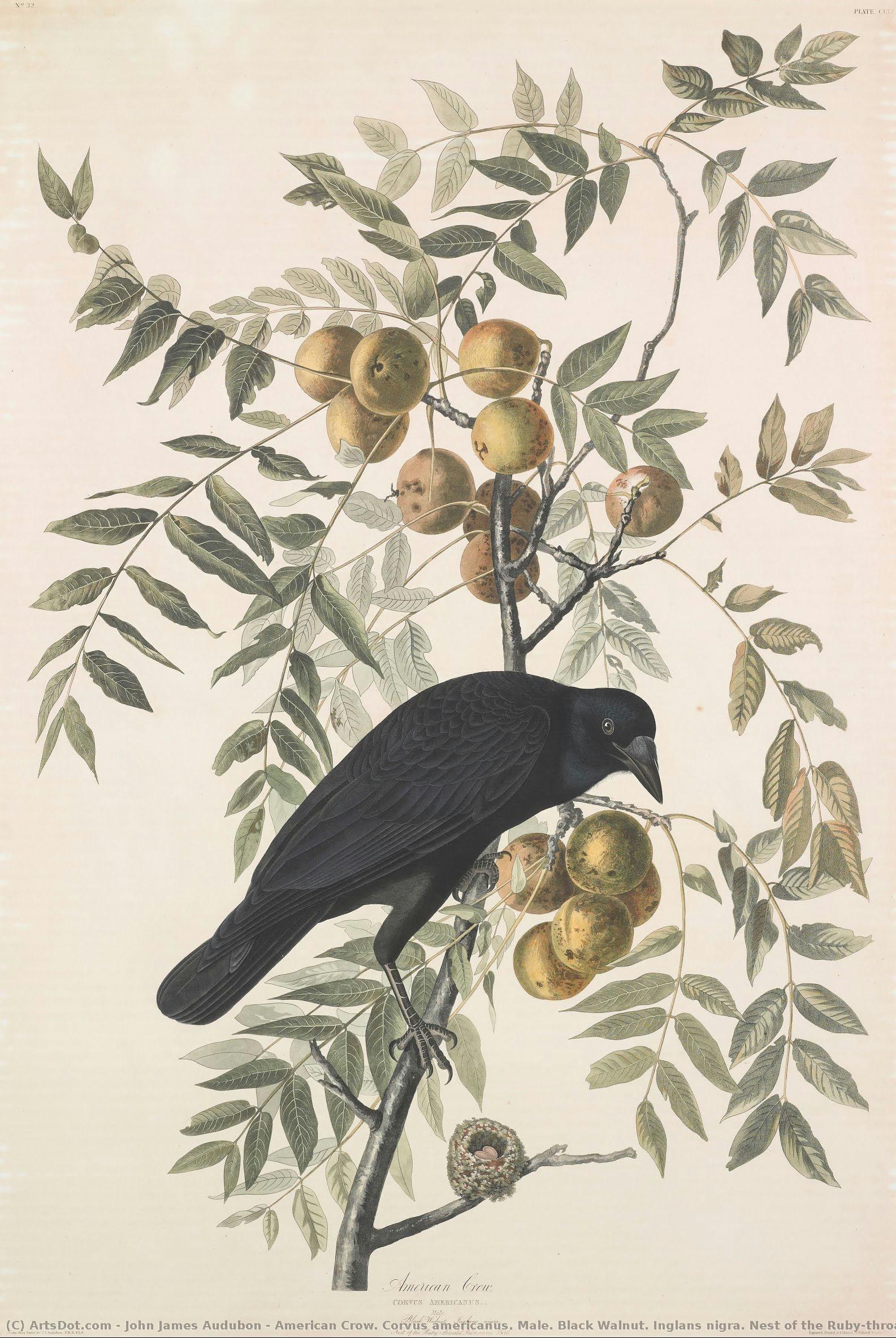
A Study in Black and Gold: John James Audubon’s “American Crow”
John James Audubon's "American Crow" (Corvus americanus) is more than just a depiction of a bird; it’s a meticulously rendered window into the burgeoning naturalism of 19th-century America. Painted in 1833, this artwork captures the essence of the American landscape and the artist’s profound connection to the avian world. The painting's immediate impact lies in its dramatic use of color – the intense black of the crow itself contrasted against the warm golds and browns of the walnuts and apples creates a visual tension that draws the viewer’s eye immediately to the central subject. Audubon’s masterful technique, honed through years of painstaking observation and experimentation with watercolor, allows for an astonishing level of detail, from the individual feathers of the crow to the delicate veins in the leaves. The inclusion of the clock, a seemingly incongruous element, adds another layer of complexity, perhaps representing the relentless passage of time or the artist’s own dedication to his work – a pursuit that consumed much of his life.
The Audubon Legacy: Observation and Romanticism
- Historical Context: Audubon's work emerged during a period of significant scientific exploration and artistic change. The rise of natural history illustration, fueled by the Enlightenment’s emphasis on empirical observation, provided fertile ground for his talent. Simultaneously, the Romantic movement celebrated emotion, imagination, and the sublime beauty of nature – qualities vividly present in Audubon’s art.
- Technique: Audubon pioneered a revolutionary watercolor technique, employing multiple layers of washes to achieve unprecedented depth and realism. He meticulously documented every detail, often spending days or weeks observing a single bird before beginning its portrait. His use of light and shadow is particularly striking, creating a sense of three-dimensionality that was rare for the time.
- Biography: Born Jean-Jacques Rabin in Les Cayes, Haiti, Audubon’s early life profoundly shaped his artistic vision. His experiences in the Caribbean – a land teeming with exotic wildlife – instilled in him a lifelong fascination with birds and their behavior. This passion led him to dedicate his life to documenting North American avifauna, ultimately producing some of the most celebrated ornithological illustrations in history.
Symbolism and Interpretation
The crow itself holds significant symbolic weight across cultures. In Native American traditions, it is often associated with wisdom, prophecy, and transformation. Audubon’s choice to depict a male crow further emphasizes these qualities. The inclusion of the walnuts and apples adds another layer of meaning – representing abundance, fertility, and perhaps even temptation or mortality. The clock, as mentioned earlier, introduces an element of temporal reflection, prompting viewers to consider the fleeting nature of beauty and the enduring legacy of art.
A Timeless Masterpiece: Reproduction Details
This hand-painted reproduction captures every nuance and detail of Audubon’s original artwork. Created using archival quality materials and employing traditional artistic techniques, this reproduction offers a faithful representation of this iconic piece. The dimensions of 64 x 97 cm make it suitable for a variety of interior design settings – from formal studies to contemporary living rooms. Whether you are an art collector, an admirer of Audubon’s work, or simply seeking a stunning decorative piece, this reproduction offers a unique opportunity to own a fragment of American artistic history.