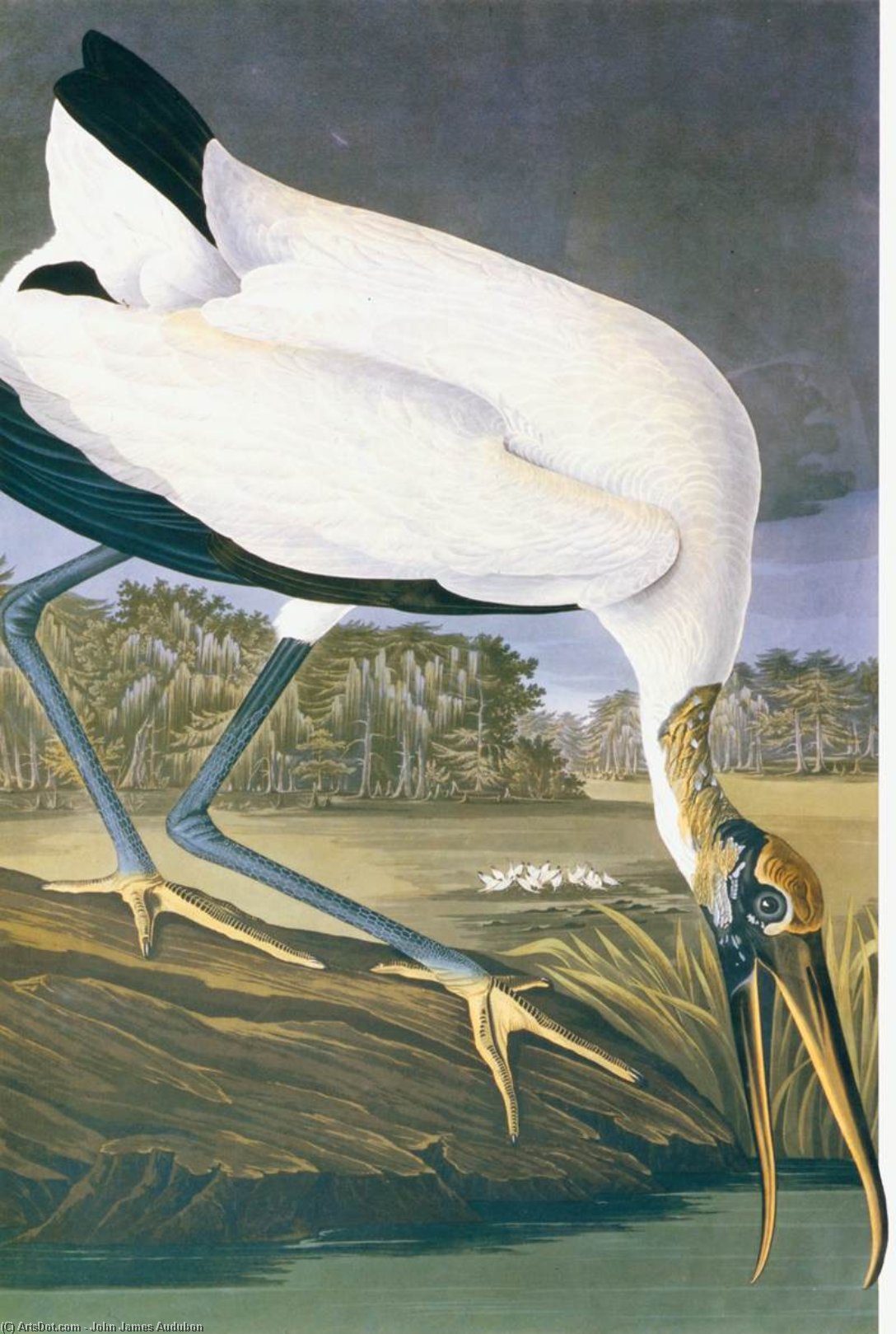
Admire John James Audubon’s iconic American Stork watercolor masterpiece – meticulously crafted in 1827 and now residing at the National Audubon Society. Explore its stunning realism and serene landscape setting.
Explore the art of John James Audubon, pioneer of ornithology & American wildlife art! His stunning watercolors capture North America's birds with detail and beauty. Discover his legacy!
Explore the National Audubon Society's legacy of bird conservation & scientific research in NYC! Discover its history, citizen science initiatives, and commitment to protecting avian habitats.
A Window Into Audubon’s Vision: The American Stork
The watercolor painting “American Stork” by John James Audubon stands as an enduring emblem of 19th-century ornithological artistry and a poignant reflection on the burgeoning Romantic movement's fascination with the sublime beauty of nature. Executed in 1827, this masterpiece resides within the hallowed halls of the National Audubon Society in New York City, safeguarding its place amongst America’s most treasured artistic treasures. More than just a depiction of avian anatomy—though Audubon’s meticulous detail is undeniable—the Stork embodies a deeper ethos: an unwavering commitment to scientific observation coupled with an ardent appreciation for the grandeur and tranquility of the natural world.
The Artist's Method & Style
Audubon’s approach was revolutionary for his time. Rejecting the prevailing academic style, which prioritized idealized representations over accurate portrayals, he championed a technique rooted in direct observation. Spending years painstakingly documenting birds across North America—often venturing into perilous expeditions—he sketched them *in situ*, capturing their movements and postures with unparalleled precision. This dedication to realism is evident in “American Stork,” where Audubon skillfully renders the bird’s plumage with delicate washes of color, achieving a luminosity that transcends mere pigment; it's an illusion of life itself. The muted palette – dominated by earthy browns and greens – contributes to the painting’s serene atmosphere, mirroring Audubon’s belief that art should inspire contemplation and reverence for the natural order.
Historical Context: Romanticism & Scientific Inquiry
The painting emerged during a pivotal moment in European intellectual history—the Romantic era. Artists like Audubon sought inspiration from emotion and imagination alongside reason and scientific understanding. Unlike the Enlightenment's focus on rational thought, Romanticism celebrated the power of feeling and embraced the untamed wilderness as a source of spiritual renewal. Audubon’s work exemplifies this duality perfectly; he meticulously documented avian species while simultaneously conveying an overwhelming sense of awe at their majesty. The Stork itself carries symbolic weight within Romantic iconography – representing stability, grace, and fertility—themes central to the movement's exploration of human experience against the backdrop of vast landscapes.
Symbolism Beyond Representation
Beyond its technical brilliance, “American Stork” speaks volumes about Audubon’s worldview. The bird’s solitary stance on one leg symbolizes resilience and balance amidst adversity – a reflection of Audubon’s own arduous journey to establish himself as a naturalist and artist. Furthermore, the inclusion of a tranquil river or lake serves as a visual metaphor for the interconnectedness of life and the importance of preserving natural habitats. Audubon wasn't merely illustrating a bird; he was conveying an ethical imperative—a conviction that humanity must strive to harmonize with the rhythms of the natural world.
Emotional Resonance & Legacy
Today, “American Stork” continues to captivate viewers with its understated beauty and profound emotional depth. Its meticulous detail invites contemplation, prompting us to consider Audubon’s unwavering dedication to scientific observation and his profound respect for the sublime grandeur of nature. As a cornerstone of American wildlife art, it serves as an inspiration for contemporary artists striving to capture the essence of the natural world with sensitivity and accuracy—a testament to Audubon's enduring legacy as one of the greatest ornithologists and painters of all time. For those seeking a stunning reproduction of this iconic artwork, explore https://ArtsDot.com/.