A Moment Frozen in Time: The Quiet Intensity of Elsie Palmer
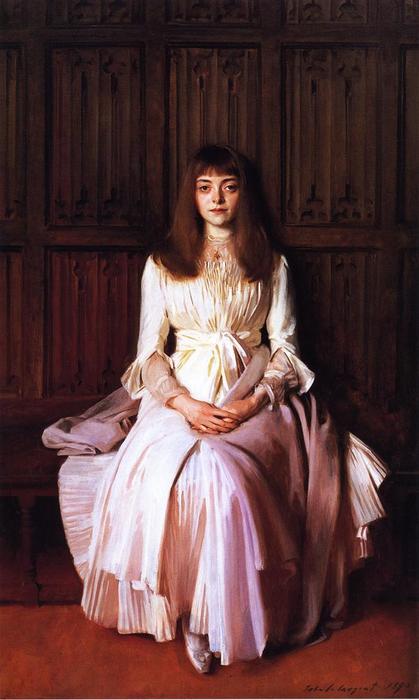
In the vast, shimmering repertoire of John Singer Sargent, few works capture the delicate intersection of youthful innocence and profound introspection quite like Elsie Palmer (Study). Painted in 1889, a year when Sargent was deeply immersed in the vibrant, transformative atmosphere of Paris, this portrait serves as much more than a mere likeness; it is a carefully constructed window into a soul. The painting presents us with Elsie Palmer, a young woman whose presence anchors the composition with a sense of poised dignity. As she sits upon a carved wooden bench, her gaze meets the viewer with a serious, almost melancholic expression that invites immediate emotional connection. There is an undeniable gravity in her eyes, a quiet intensity that suggests a depth of thought far beyond her years, making the piece a captivating study of character rather than just a social record.
The brilliance of this work lies in Sargent’s ability to marry the meticulous realism of his training with the burgeoning light-filled freedom of Impressionism. While the subject is rendered with remarkable precision—notably the delicate bone structure of her face and the thoughtful curve of her lips—Sargent employs a broken brushstroke technique that breathes life into the canvas. This approach allows for a shimmering, atmospheric quality where light does not merely sit upon surfaces but seems to dance within them. The vibrant yellow of Elsie’s dress acts as a luminous focal point, a bold splash of color against the more muted, earthy tones of the background. Through his masterful manipulation of pigment, Sargent creates an illusion of depth and luminosity, ensuring that the fabric appears not as flat color, but as a tactile, light-catching material.
The Artistry of Light and the Gilded Age Legacy
To behold this portrait is to step into the aesthetic splendor of the late 19th century. Sargent, an artist whose life was defined by the cosmopolitan elegance of Europe, possessed a unique ability to capture the very essence of the Belle Époque. In Elsie Palmer, we see his technical prowess in full bloom; he utilizes thin glazes and layered oils to achieve a sculptural form, sculpting the contours of the subject with a soft, diffused light that avoids the harshness of dramatic shadows. This technique creates an atmosphere of understated elegance, making the painting feel both intimate and monumental. The background, featuring the subtle presence of other figures and garden elements, provides a sense of place without distracting from the psychological weight of the sitter.
For the discerning collector or interior designer, this piece offers a profound sense of timelessness. It is an artwork that commands attention through its emotional resonance and sophisticated palette. Whether placed in a sun-drenched morning room to highlight the warmth of the yellow tones, or in a more formal study to complement its serious, contemplative mood, a high-quality reproduction of this Sargent masterpiece brings with it a legacy of artistic excellence. It is an invitation to slow down, to observe the nuances of light and shadow, and to find beauty in the quiet, unscripted moments of human existence.