The Enigmatic Beauty of “La Monstrua”: Juan Carreño de Miranda’s Portrait of Eugenia Martínez Valleji
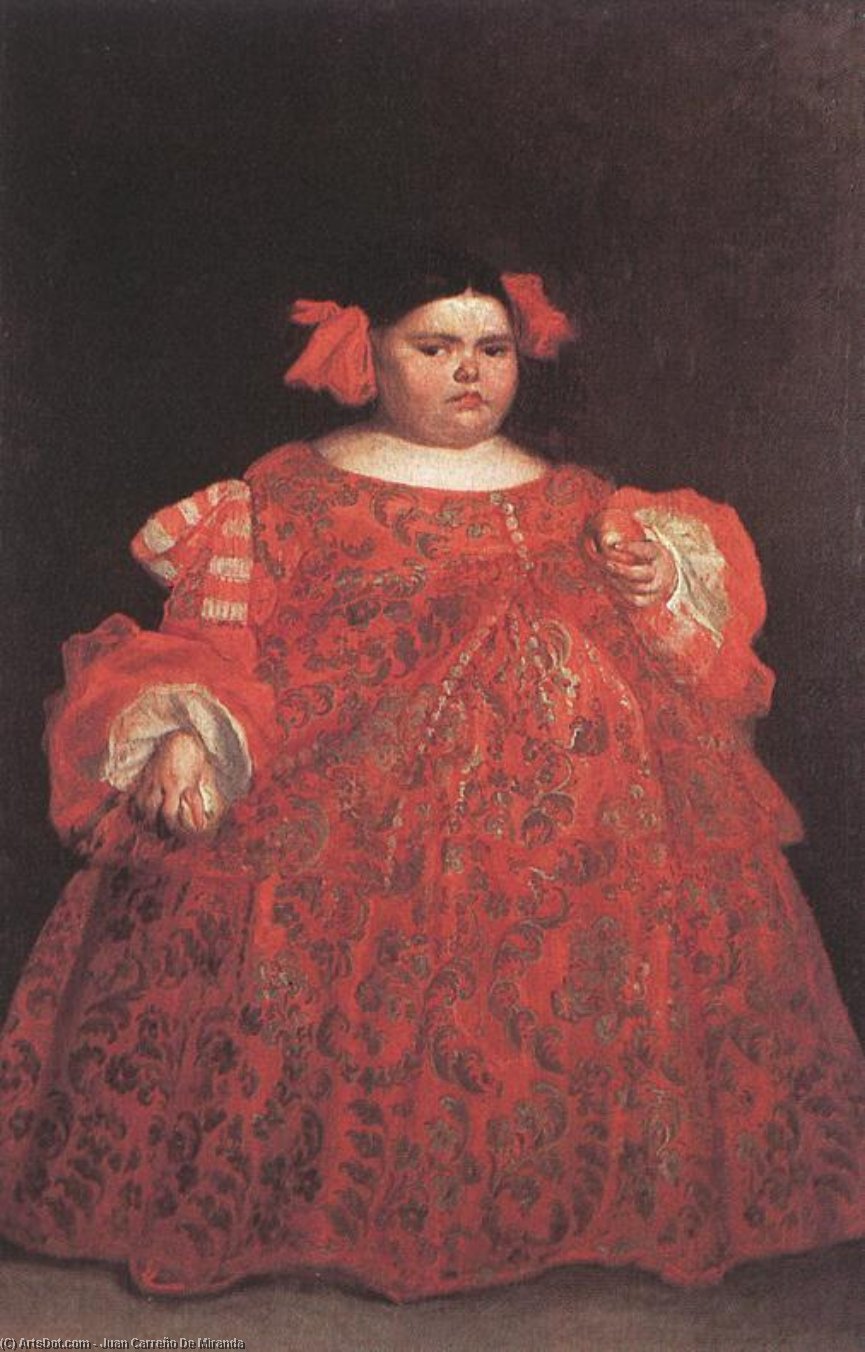
Juan Carreño de Miranda's "Eugenia Martinez Valleji, called La Monstrua," painted around 1680, is far more than a simple portrait; it’s a captivating enigma wrapped in the sumptuous fabrics and meticulous detail characteristic of the Spanish Baroque. This remarkable work, now housed within the Museo del Prado in Madrid, offers a poignant glimpse into a young woman's life – a life marked by both extraordinary physical characteristics and a surprising grace that transcends her unusual appearance. The painting immediately draws the eye with its dramatic contrast: the vibrant red of Eugenia’s dress explodes against the dark, almost theatrical background, instantly establishing her as the central figure and focal point of the composition.
Eugenia's attire speaks volumes about her status within 17th-century Spanish society. The elaborate lace sleeves, the intricately embroidered bodice – these details suggest a noble or wealthy family, highlighting not just her beauty but also her social standing. The careful arrangement of her hair, secured with a delicate bow, further reinforces this impression of formality and ceremonial occasion. Yet, it’s the subject herself that truly commands attention. Her expression is remarkably neutral, almost contemplative; she possesses a subtle tilt of the head that invites speculation – is she curious, amused, or perhaps slightly melancholic? This ambiguity is key to the painting's enduring power.
A Portrait Shaped by Medical Curiosity and Courtly Intrigue
The story behind “La Monstrua” is as compelling as the artwork itself. Eugenia Martínez Valleji was born in 1674 in a small village near Burgos, Spain, and quickly gained notoriety for her unusually large size and weight – conditions now understood to be linked to Prader-Willi syndrome. News of this remarkable young woman reached the ears of King Charles II of Spain, who, fascinated by her unique appearance, summoned her to the court in Madrid. It was during this time that Carreño de Miranda, one of the most celebrated portraitists of his era, was commissioned to paint two portraits: one depicting her dressed formally and the other nude.
This commission wasn’t simply a display of royal curiosity; it reflects a broader cultural fascination with physical anomalies during the Baroque period. Monarchs often held individuals with disabilities in their courts, viewing them as objects of both wonder and entertainment. Eugenia's presence provided a spectacle for the court, while also offering an opportunity for artists like Carreño to explore themes of beauty, deformity, and the human condition. The painting serves as a testament to this complex interplay between art, society, and medical understanding – a time when the unusual was not only tolerated but actively celebrated.
Baroque Technique and Symbolism: A Masterful Composition
Carreño de Miranda’s technical skill is evident in every brushstroke. The painting showcases the hallmarks of Baroque artistry: rich textures, dramatic lighting, and a meticulous attention to detail. Note the incredibly fine rendering of the lace, the subtle shading that gives depth to Eugenia's features, and the way the fabric drapes realistically around her form. The artist masterfully employs chiaroscuro – the contrast between light and dark – to draw the viewer’s eye directly to the subject, emphasizing her beauty and creating a sense of drama.
Beyond its technical brilliance, “La Monstrua” is laden with symbolism. The red dress, often associated with passion and royalty, contrasts sharply with the darkness, suggesting both vulnerability and strength. Eugenia’s gaze, directed towards something beyond the frame, hints at a hidden world or an inner life that transcends her physical appearance. It's this element of mystery – combined with the painting’s inherent beauty – that has captivated viewers for centuries.
A Timeless Masterpiece: Reproductions and Artistic Legacy
ArtsDot offers meticulously hand-painted reproductions of “Eugenia Martinez Valleji, called La Monstrua,” allowing you to experience this extraordinary artwork in stunning detail. Our skilled artisans recreate Carreño de Miranda’s masterful technique, capturing the painting's dramatic lighting, rich textures, and evocative atmosphere with unparalleled accuracy. Whether displayed as a statement piece in your home or office, or as an investment for discerning collectors, our reproduction ensures that the beauty and mystery of “La Monstrua” will endure for generations to come.
Consider this painting not just as a portrait, but as a window into a fascinating period of history – a testament to human resilience, artistic innovation, and the enduring power of beauty in all its forms.