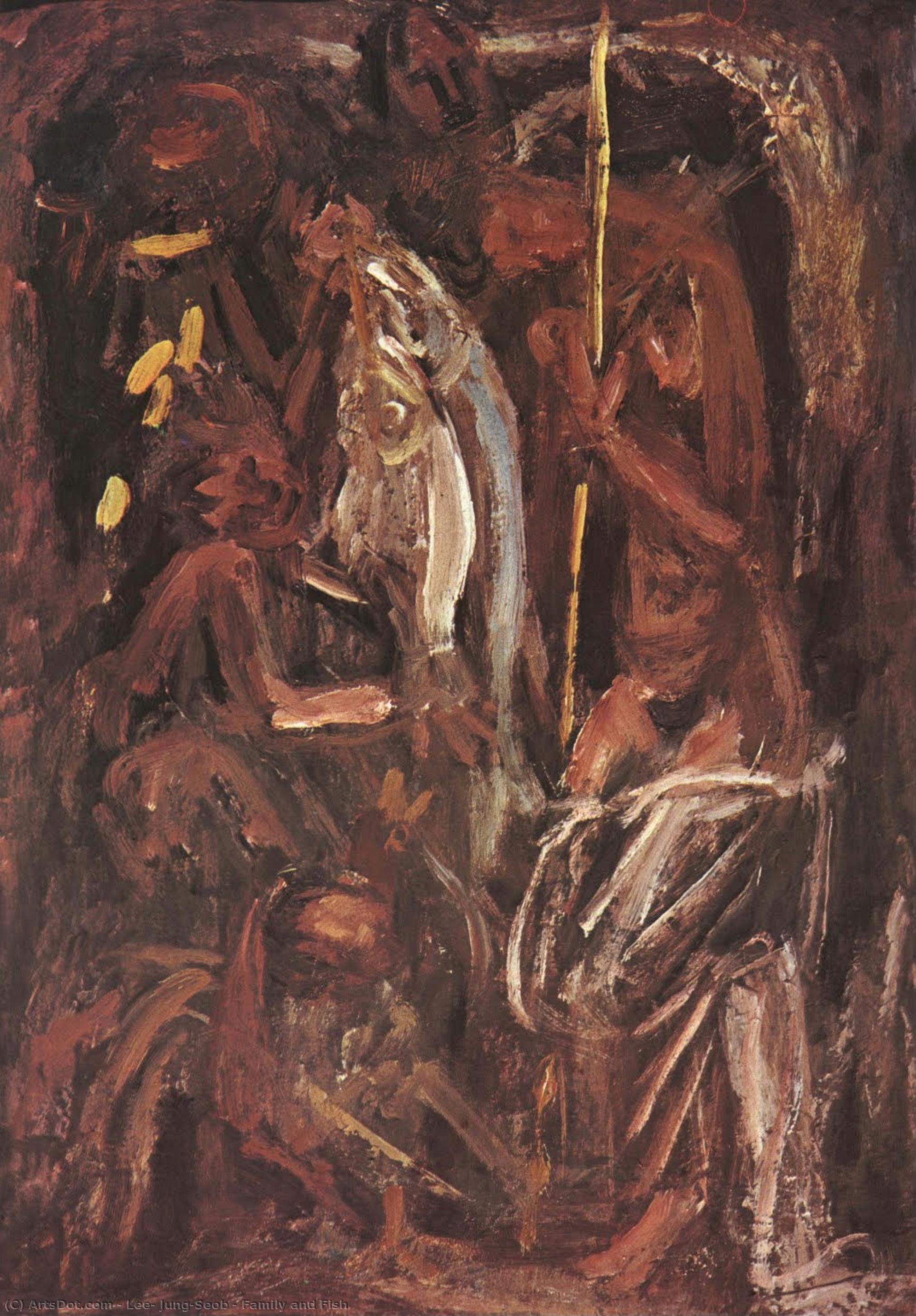
Explore Lee Jung-seob's evocative watercolor 'Family and Fish,' depicting a family scene with symbolic elements like fish and crab, reflecting Korean heritage blended with modern artistic techniques.
Discover Lee Jung-seob (1916-1956), a pivotal Korean artist renowned for his powerful oil paintings, iconic 'White Ox', and evocative depictions of family & Korean life. Explore his blend of traditional themes with modern techniques.
Explore Korea's rich history & art at the National Museum of Seoul! Discover ancient relics, royal treasures, and captivating cultural exhibits – a journey through millennia.
A Poignant Tableau of Resilience
In the delicate, translucent layers of Lee Jung-seob’s "Family and Fish," we encounter more than just a watercolor; we step into a sanctuary of memory and survival. Painted around 1956, this evocative work serves as a profound window into the Korean soul during one of its most turbulent eras. The scene captures a familial tableau that feels both intimate and universal, presenting a moment of quiet togetherness that seems to defy the external chaos of the mid-20th century. As the eye wanders through the composition, one is struck by the way Lee manages to weave together the warmth of human connection with the subtle, underlying tension of an era defined by the aftermath of the Korean War. It is a piece that does not merely depict a family; it preserves their very essence against the tide of history.
The mastery of Lee Jung-seob is most evident in his command of the watercolor medium. Eschewing the heavy, opaque textures of oil, he utilizes luminous washes to create a sense of depth and ethereal light. This technique is particularly breathtaking in the depiction of the fish, which appear to glide through a liquid atmosphere, their forms shimmering beneath the water's surface. There is a meticulous precision in his brushwork—a careful rendering of hair and the soft folds of clothing—that grounds the dreamlike quality of the watercolor in a striking realism. This duality between the fluid, atmospheric background and the sharp, detailed figures creates a visual rhythm that keeps the viewer perpetually engaged, searching for the fine details hidden within the light.
Symbolism and the Weight of History
Beyond its aesthetic grace, "Family and Fish" is rich with symbolic resonance. To understand this painting is to understand the cultural landscape of post-war Korea. The presence of the fish is far from accidental; in Korean tradition, they often serve as potent symbols of abundance, prosperity, and the vital flow of life. Yet, by placing these creatures beneath the surface, Lee introduces a layer of vulnerability. Much like the family members depicted on land, the fish exist in a delicate balance with their environment. This serves as a moving metaphor for the Korean people during this period—striving for stability and growth while navigating the unpredictable and often perilous currents of political and social upheaval.
For the discerning collector or interior designer, this artwork offers a profound emotional depth that transcends mere decoration. It is a piece that invites contemplation, making it an ideal centerpiece for spaces dedicated to reflection, such as a private study or a sophisticated living salon. The understated palette and the dramatic interplay of light and shadow provide a sophisticated aesthetic that complements both contemporary minimalist interiors and more traditional, classic settings. Owning a reproduction of this masterpiece means bringing into one's home a narrative of enduring strength, a testament to the ability of the human spirit—and the family unit—to find tranquility and beauty even in the most challenging of times.