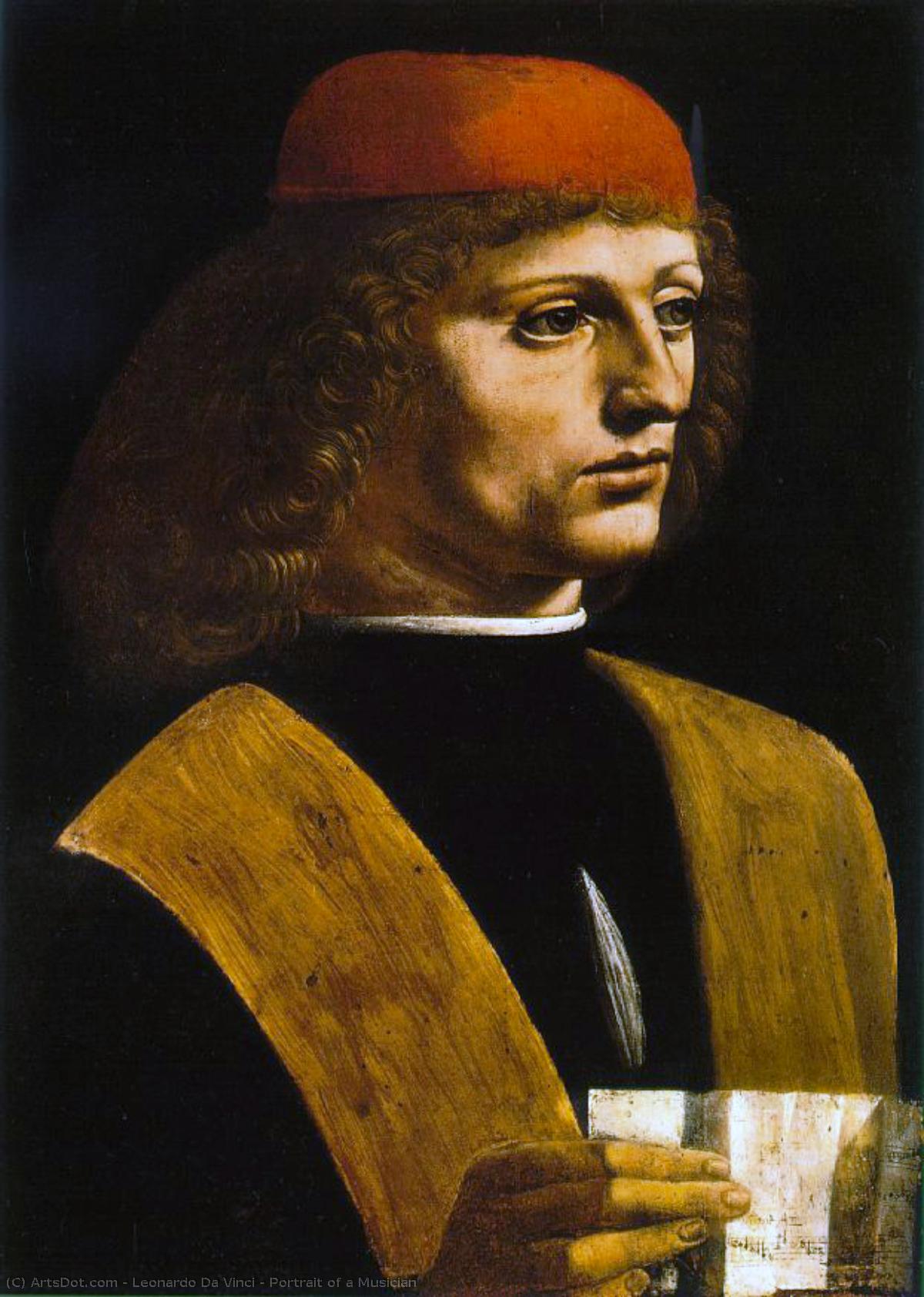
Portrait of a Musician
Leonardo da Vinci’s
Portrait of a Musician, housed at the Pinacoteca Ambrosiana in Milan, Italy, is an intriguing and captivating piece that has garnered significant attention from art enthusiasts and scholars alike. This oil on panel painting, measuring 43 x 31 cm, was created around 1490 and is attributed to Da Vinci by some scholars.
Artistic Significance
The
Portrait of a Musician stands out for its unique blend of Renaissance artistry and the enigmatic nature of its subject. The man depicted in the painting wears a red hat with a gold trim, has long hair, and appears to be looking directly at the viewer. He holds a piece of paper in his hand, which is believed to be part of a musical score. The painting's significance lies in its departure from the traditional profile portraiture that was prevalent during the 15th century in Milan. Instead, Da Vinci opted for a more intimate and direct approach, showcasing the subject’s face in a three-quarter view. This stylistic choice reflects the influence of Antonello da Messina’s introduction of Early Netherlandish portrait painting to Italy.
Identity of the Subject
The identity of the musician has been a topic of debate among scholars. Initially, it was believed to be Ludovico Sforza, a Duke of Milan and Da Vinci's employer. However, during a restoration in 1904-1905, the removal of overpainting revealed a hand holding sheet music, indicating that the sitter was indeed a musician. Several musicians active in Milan have been proposed as the subject, including Franchinus Gaffurius, Atalante Migliorotti, Josquin des Prez, and Gaspar van Weerbeke. Despite these suggestions, there is no historical evidence to definitively identify the sitter.
Artistic Techniques
The painting's unfinished state has led some scholars to believe that Da Vinci was assisted by one of his students. The body of the subject appears stiff and rigid, which is uncharacteristic of Da Vinci’s work. However, this could be attributed to the painting’s incomplete nature. Leonardo skillfully employed sfumato—a technique characterized by subtle gradations of tone—to soften contours and create an ethereal atmosphere, mirroring the prevailing artistic sensibilities of his time. The meticulous rendering of facial features demonstrates Da Vinci's unparalleled anatomical precision, a hallmark of his scientific pursuits as well as his artistic endeavors.
Conclusion
The
Portrait of a Musician by Leonardo da Vinci is a masterpiece that showcases his innovative approach to portraiture and his ability to capture the essence of his subjects. Despite the mystery surrounding the subject’s identity, this painting remains an important work in Da Vinci's oeuvre. For those interested in exploring more of Da Vinci’s works,
Leonardo Da Vinci: Portrait of a Musician is available on ArtsDot. Additionally, the Pinacoteca Ambrosiana, where the original painting is housed, can be explored further through
Pinacoteca Ambrosiana, a Hidden Gem of Milan. To learn more about Leonardo da Vinci and his works, visit
List of works by Leonardo da Vinci on Wikipedia.