The Majesty of Handel: A Marble Testament
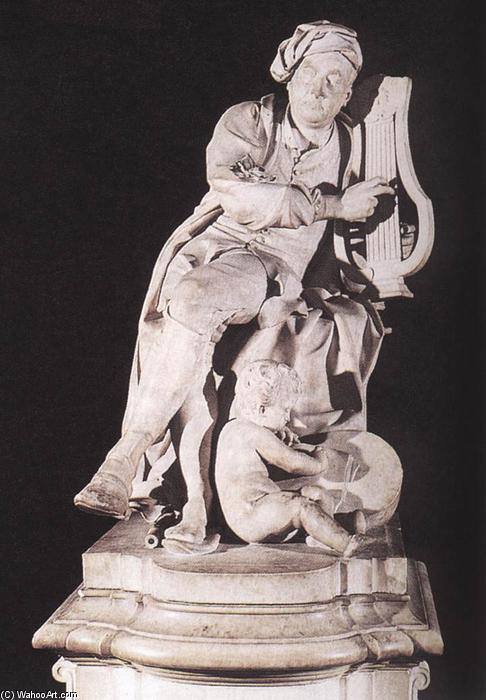
Louis-François Roubiliac’s sculpted portrait of George Frideric Handel stands as more than just a likeness; it's a carefully constructed embodiment of the Baroque era’s grandeur and burgeoning Rococo sensibilities. Completed in 1738, this remarkable marble figure captures not merely the physical appearance of the renowned composer but also his spirit – a potent blend of intellectual rigor, theatrical flair, and profound musical genius. The sculpture resides on a substantial pedestal, its base constructed from what appears to be weathered stone or concrete, lending an air of timeless solidity to the scene. Roubiliac’s masterful manipulation of marble demonstrates a deep understanding of light and shadow, creating a palpable sense of volume and texture that draws the viewer into Handel's world.
Handel is depicted in a seated pose, his posture radiating both authority and contemplative grace. He holds what appears to be a lute or small guitar – an instrument intimately linked with his prolific career as a composer and performer. The detail here is exquisite; observe the meticulous carving of the instrument’s strings, the delicate curve of its body, and the subtle suggestion of its resonance. His attire—a flowing robe draped elegantly over one leg, revealing a bare foot—is characteristic of the period, reflecting both classical ideals of beauty and a touch of aristocratic nonchalance. The folds in the fabric are rendered with astonishing precision, showcasing Roubiliac’s technical skill and his ability to convey movement and texture through purely sculptural means.
A Sculptor Bridging Eras
Louis-François Roubiliac's artistic journey is a fascinating tale of adaptation and innovation. Born in Lyon, France, in 1702, he initially trained under Balthasar Permoser in Dresden, absorbing the dramatic intensity of Baroque sculpture influenced by Bernini’s dynamism. This early exposure to Baroque principles was further refined through studies with Nicolas Coustou in Paris, where he honed his classical techniques and developed a keen eye for proportion and form. Roubiliac's relocation to England in 1730 marked a pivotal shift; he quickly established himself as one of the most celebrated sculptors of the era, skillfully blending Baroque grandeur with the more intimate and playful qualities of Rococo style. His ability to capture not just likeness but also the very essence of his sitters—a remarkable feat achieved during a period of significant artistic transition—cemented his legacy.
Symbolism and Context
The choice of depicting Handel with a musical instrument is deeply symbolic, immediately connecting the sculpture to his profession. The lute, in particular, evokes images of ancient Greece and its legendary musician Orpheus, suggesting that Handel’s music possesses a timeless quality and the power to move audiences across generations. The bare foot, a common motif in classical sculpture, symbolizes connection to the earth and a rejection of worldly vanity – qualities often associated with artistic genius. The dark background serves not as an absence but rather as a deliberate focus on the figure, emphasizing his importance and drawing the viewer’s attention entirely to Handel's presence. The sculpture was commissioned by Jonathan Tyers, owner of Vauxhall Gardens, a fashionable pleasure ground in London during the mid-18th century – a setting that underscores the connection between art, entertainment, and social status.
A Legacy in Marble
Roubiliac’s “George Frideric Handel” is more than just a portrait; it's a testament to the sculptor’s skill, his understanding of Baroque and Rococo aesthetics, and his ability to capture the spirit of a remarkable man. The sculpture’s enduring appeal lies in its combination of technical mastery, symbolic richness, and emotional resonance. Reproductions offer an exceptional opportunity to bring this captivating work into any setting, allowing viewers to appreciate the artistry and historical significance of Handel's life and music. It is a piece that speaks volumes about the intersection of art, culture, and the enduring power of human creativity.