Emperor Maximilian I: A Portrait of Power and Intrigue
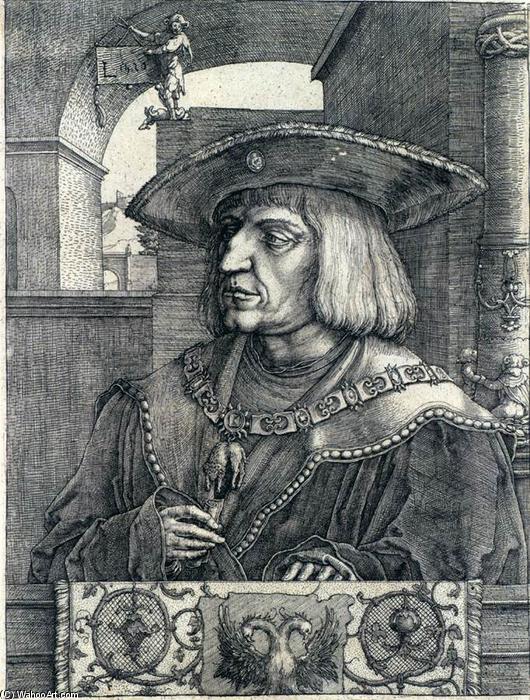
Lucas van Leyden’s “Emperor Maximilian” is more than just a portrait; it's a meticulously crafted window into the tumultuous world of 16th-century Europe, a visual testament to ambition, political maneuvering, and the burgeoning power of printmaking. Completed in 1520, this etching and engraving captures the likeness of Holy Roman Emperor Maximilian I – a figure both revered and controversial – against a backdrop of architectural grandeur that speaks volumes about his imperial aspirations. The artwork’s enduring appeal lies not only in its technical brilliance but also in the complex narrative it subtly unfolds.
Van Leyden, a pivotal figure in the transition from Gothic to Renaissance art in the Netherlands, demonstrates an extraordinary command of technique here. He masterfully employs the contrasting methods of etching and engraving, a relatively new approach at the time, to achieve remarkable detail and tonal variation. The delicate lines of the engraving define Maximilian’s face – his regal brow, piercing gaze, and meticulously rendered attire—while the subtle textures and shading created by the etching imbue the portrait with a sense of depth and realism. Note particularly the precision in capturing the folds of his velvet robes and the intricate details of his elaborate hat, adorned with feathers that symbolize imperial authority.
A Ruler Defined: Context and Symbolism
Maximilian I’s reign was marked by both triumph and tragedy. Ascending to the throne in 1506, he skillfully navigated a complex web of political alliances, expanding the Habsburg empire through strategic marriages and military campaigns. However, his later years were shadowed by financial instability, personal extravagance, and ultimately, a disastrous marriage to Mary Tudor, daughter of Henry VIII. The portrait itself reflects this duality; Maximilian is depicted in full imperial regalia – a large feathered hat, a jeweled sword, and the robes of an emperor—underscoring his power and status. Yet, there’s also a hint of melancholy in his expression, perhaps hinting at the burdens of leadership and the challenges he faced.
The architectural setting further enhances the portrait's symbolic weight. The columns and arches suggest an opulent palace or imperial court—a space designed to project authority and reinforce Maximilian’s position as ruler of a vast empire. The inclusion of decorative motifs, such as birds and flowers, adds a layer of Renaissance refinement, reflecting the artistic trends of the era. These elements collectively communicate a message of power, wealth, and cultural sophistication.
The Dawn of Printmaking: Innovation and Legacy
“Emperor Maximilian” represents a significant milestone in the history of printmaking. Van Leyden’s innovative use of both etching and engraving—techniques typically employed separately—demonstrates his mastery of the medium and pushed the boundaries of what was possible with woodcuts and metal plates. This pioneering approach paved the way for future generations of printmakers, establishing new standards for detail, tonal range, and artistic expression. The work’s influence can be seen in subsequent portraits and historical prints produced throughout Europe.
The portrait's enduring appeal also lies in its ability to evoke a sense of timelessness. Despite being created over 500 years ago, “Emperor Maximilian” continues to captivate viewers with its striking realism and subtle emotional depth. It serves as a powerful reminder of the complexities of power, ambition, and the lasting legacy of one of history’s most fascinating figures. Reproductions of this artwork offer a unique opportunity to bring this masterpiece into any setting, adding a touch of historical grandeur and artistic sophistication.