The Echoes of Raphael: Marcantonio Raimondi’s “Venus and Cupid”
Within the hushed galleries of museums and the intimate spaces of collectors' homes, certain prints transcend mere reproductions; they become windows into a bygone era, whispering tales of artistic patronage, technical innovation, and enduring beauty. Marcantonio Raimondi’s “Venus and Cupid,” created around 1500-27, stands as a prime example – a meticulously crafted engraving that not only captures the essence of Raphael’s vision but also reveals the intricate processes and evolving aesthetic sensibilities of Renaissance printmaking.
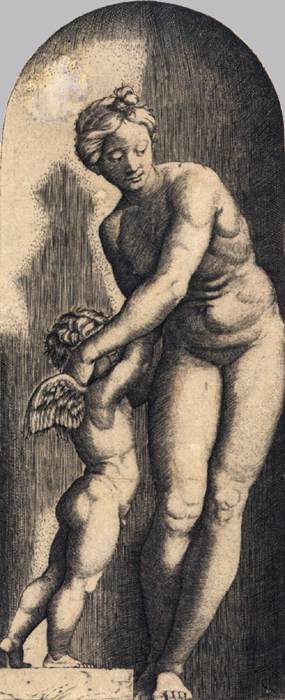
At first glance, the image presents a scene of serene intimacy: Venus, the goddess of love, stands gracefully within a shadowed niche, her gaze directed towards Cupid, her son, who playfully pushes a flaming torch toward her. The composition is deceptively simple, yet imbued with a profound sense of classical harmony and emotional resonance. Raimondi’s skill lies not just in his ability to faithfully reproduce Raphael's design – a commission that cemented Raimondi’s reputation as one of the foremost engravers of his time – but also in his subtle refinements and masterful execution. The figures are rendered with an exquisite attention to detail, from the delicate folds of Venus’ drapery to the mischievous expression on Cupid’s face. Notice particularly the way light plays across their forms, creating a sense of depth and volume that belies the limitations of the engraving medium.
A Technical Masterpiece: The Art of Engraving
Raimondi's achievement is all the more remarkable considering the demanding nature of engraving during this period. Unlike painting or sculpture, where artists directly manipulate materials to create form and texture, engravers worked on a metal plate – typically copper – using sharp tools to incise lines that would later be inked and transferred onto paper. The process was laborious and required immense precision, patience, and an understanding of how ink behaved on the surface of the metal. Raimondi’s work demonstrates a deep mastery of these techniques. He employed a complex system of burin strokes – delicate cuts made with a pointed tool – to build up layers of tone and texture, creating subtle gradations of light and shadow that give the image its remarkable realism. The intricate detailing in the drapery, for instance, is achieved through countless tiny lines, each carefully controlled to mimic the way fabric folds and drapes in reality.
Furthermore, Raimondi’s engraving showcases a sophisticated understanding of perspective and composition. He skillfully utilizes atmospheric perspective – creating the illusion of depth by making distant objects appear paler and less detailed – to draw the viewer's eye into the scene. The use of chiaroscuro—the dramatic contrast between light and dark—further enhances the sense of three-dimensionality, emphasizing the figures’ forms and adding a powerful emotional impact.
Symbolism and Renaissance Ideals
Beyond its technical brilliance, “Venus and Cupid” is rich in symbolic meaning. The scene itself draws upon classical mythology, referencing the legendary love affair between Venus and Mars – a union that represented not only romantic passion but also the fundamental forces of creation and fertility. Cupid’s torch, symbolizing ardent desire, playfully directed towards Venus, suggests the generative power of love and its ability to inspire both beauty and conflict. The setting within a niche—a small, enclosed space—creates a sense of intimacy and seclusion, further emphasizing the private nature of their relationship.
The work also reflects broader Renaissance ideals – particularly the revival of interest in classical antiquity and the celebration of human beauty and virtue. Raphael’s original design, itself inspired by classical models, embodies these values through its idealized depiction of Venus and Cupid. Raimondi's engraving serves as a powerful testament to the enduring legacy of the High Renaissance and its profound influence on Western art.
A Timeless Reproduction: Bringing Beauty Home
Today, reproductions of “Venus and Cupid” are treasured by collectors and interior designers alike. The original engraving, housed in prestigious museums worldwide, offers a glimpse into a pivotal moment in artistic history. However, high-quality hand-printed reproductions capture the essence of Raimondi’s masterpiece – its exquisite detail, subtle tonal variations, and profound emotional resonance – with remarkable fidelity. Whether adorning a formal salon or a more casual living space, this image continues to evoke a sense of timeless beauty, romantic allure, and the enduring power of art.