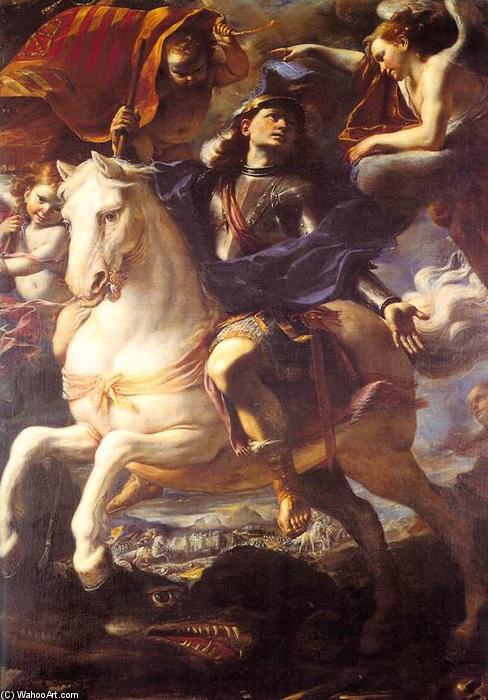
The Visionary Knight: Mattia Preti’s “St. George on Horseback”
Within the opulent confines of St. John's Co-Cathedral in Valletta, Malta, resides an arresting masterpiece – Mattia Preti’s “St. George on Horseback,” painted in 1658. More than simply a depiction of a legendary hero, this oil on canvas is a vibrant embodiment of Baroque drama, a testament to the artist's Neapolitan roots and his profound understanding of light, movement, and emotional intensity. It’s a painting that immediately commands attention, drawing the viewer into a dynamic scene brimming with heroic fervor and spiritual significance.
Preti, known as “Il Cavalier Calabrese,” was a pivotal figure in 17th-century Italian art, renowned for his dramatic frescoes and masterful use of chiaroscuro. His early training under Giovanni Battista Caracciolo instilled within him the Caravaggist tradition – a commitment to realistic depiction combined with an expressive manipulation of light and shadow. Moving to Malta in 1659, he transformed the cathedral’s interior with a series of monumental works, including this iconic Saint George panel, solidifying his legacy as one of the island's most celebrated artists. The painting itself is an altarpiece, originally intended for the Chapel of the Langue of Aragon, and it served as Preti’s introduction to Malta – a pivotal moment in his artistic career.
A Symphony of Light and Movement
The composition of “St. George on Horseback” is a masterclass in Baroque dynamism. The central figure, Saint George himself, dominates the scene, mounted upon a magnificent white horse that surges forward with incredible speed and power. Preti’s technique is characterized by an almost frenetic energy; brushstrokes are visible yet seamlessly blended, creating a sense of swirling motion that captures the very essence of the charge. Notice how light dramatically sculpts George's form – highlighting his muscular physique, the gleam of his armor, and the determined expression on his face. The contrast between the bright highlights and deep shadows generates an intense visual drama, pulling the viewer directly into the heart of the action.
The dragon, a formidable beast rendered in rich, textured scales, is positioned to George’s right, poised to strike. Preti doesn't shy away from depicting the creature’s terrifying power – its gaping maw and menacing claws are vividly portrayed. However, it’s not merely a monster; there’s an element of theatricality to its portrayal, suggesting a stylized representation rather than a purely realistic depiction. The dragon is almost a symbol of evil, embodying the forces George must overcome.
Symbolism and Spiritual Resonance
Beyond the thrilling action, “St. George on Horseback” is rich in symbolic meaning. Saint George’s lance and shield – emblems of his Christian faith – are prominently displayed, underscoring the painting's religious narrative. The two angels flanking George represent divine intervention and protection, their outstretched hands offering a sense of hope and victory. The red and blue cloths held by the angels further amplify this symbolism, representing respectively the blood of Christ and the purity of the Virgin Mary.
The legend itself – the story of Saint George slaying a dragon to rescue a princess – is a potent allegory for good triumphing over evil, faith overcoming temptation. It’s a narrative that resonated deeply within Christian culture, embodying the struggle between virtue and vice, light and darkness. Preti skillfully translates this complex symbolism into a visually arresting image, making it accessible and emotionally engaging for his audience.
A Legacy of Baroque Grandeur
“St. George on Horseback” stands as a prime example of Mattia Preti’s unique artistic vision – a synthesis of Neapolitan dynamism, Caravaggist realism, and the dramatic flair characteristic of the Baroque period. Its vibrant colors, masterful composition, and profound symbolism continue to captivate viewers centuries after its creation. Today, it remains a cornerstone of St. John's Co-Cathedral’s collection, offering a glimpse into the artistic genius of one of Malta’s most celebrated artists and a powerful testament to the enduring appeal of this timeless legend.