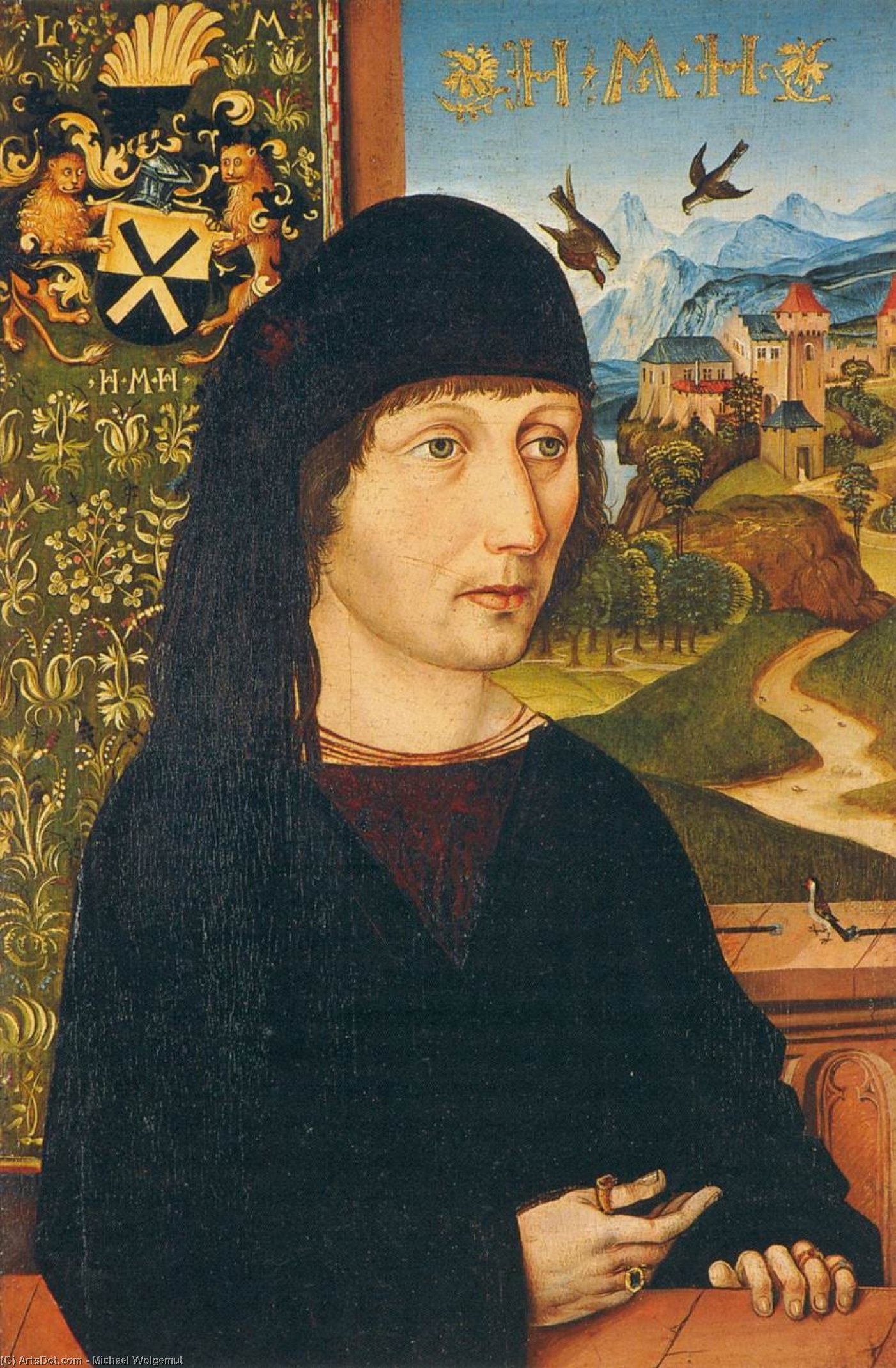
A Window into Fifteenth-Century Nuremberg: Michael Wolgemut’s Portrait of Levinus Memminger
The year is 1485, and within the bustling workshop of Michael Wolgemut in Nuremberg, a portrait emerges – a meticulously rendered depiction of Levinus Memminger, a prominent figure in the city's civic life. More than simply a likeness, this painting offers a captivating glimpse into the artistic sensibilities and social dynamics of early Renaissance Germany. Wolgemut’s work isn’t merely a representation; it’s an invitation to contemplate status, wealth, and the intricate symbolism woven into the fabric of 15th-century identity.
The subject himself, Levinus Memminger, was a respected judge in Nuremberg, a position that demanded both legal acumen and social standing. Wolgemut captures this duality with remarkable precision. The composition centers on Memminger’s face and upper body, framed by an elaborate backdrop – a landscape punctuated by architectural elements and heraldic devices. This isn't the naturalistic portrayal favored by later artists; instead, it adheres to the conventions of Early Netherlandish painting, characterized by its emphasis on linear perspective and symbolic detail. Notice how the distant mountains recede into a carefully constructed space, creating an illusion of depth that draws the viewer’s eye inward.
The Language of Line and Color: Wolgemut's Technique
Wolgemut’s mastery lies in his meticulous technique – a hallmark of the Early Netherlandish style. He employs a painstaking layering of thin, translucent glazes of oil paint, building up color and luminosity with remarkable control. This method, perfected by artists like Jan van Eyck, allows for subtle gradations of tone and texture, imbuing the portrait with a remarkable sense of realism. The smooth surfaces of the figure’s skin and clothing contrast subtly with the more textured appearance of the background, achieved through deliberate brushwork. The use of lines is precise and controlled; they define the contours of the face, clothing, and architectural details with an almost geometric clarity.
Observe how light plays a crucial role in shaping form. The directional lighting, originating from the left, casts subtle shadows that accentuate the subject’s features and volumes. This masterful manipulation of light not only enhances realism but also contributes to the painting's overall sense of drama and presence. The artist’s careful attention to detail extends beyond mere representation; it reflects a deep understanding of how materials interact with light and how these interactions can be used to create visual impact.
Symbolism Woven into the Canvas
Beyond its technical brilliance, the portrait is rich in symbolic meaning. The landscape itself speaks volumes about Memminger’s status – it suggests wealth, land ownership, and a connection to the natural world. The architectural elements, particularly the heraldic devices displayed prominently in the background, reinforce his position of authority and social standing. Notably, the tapestry bearing Memminger's coat-of-arms and initials—l.m.h.—is a key element, anchoring the portrait within its specific context. The arrangement of these letters, along with the subtle inclusion of additional symbols in the sky, hints at a personal motto or perhaps a reference to his family lineage.
The falcon depicted soaring through the heavens adds another layer of interpretation. In medieval symbolism, falcons often represented vigilance and divine protection – qualities highly valued in a judge presiding over the affairs of the city. Even the seemingly simple inclusion of a bird suggests a deeper connection between Memminger’s role and the broader spiritual landscape of Nuremberg.
A Legacy of Artistic Influence
Michael Wolgemut's Portrait of Levinus Memminger stands as a testament to the artistic ferment of early Renaissance Germany. His work, deeply influenced by the traditions of the Netherlands, particularly the meticulous realism and symbolic richness of artists like Dirk Bouts, laid the groundwork for the later innovations of Albrecht Dürer, his protégé. Studying this portrait offers a valuable window into not only the life of a prominent citizen but also the artistic values and cultural context of a pivotal moment in European art history. Reproductions of this captivating work continue to inspire appreciation for the beauty and complexity of Early Netherlandish painting.