The Enigmatic Lily Pad: Exploring Philipp Otto Runge’s “Genii on a Lily”
Philipp Otto Runge's "Genii on a Lily," completed in 1809, stands as a cornerstone of German Romanticism—a visual embodiment of the movement’s preoccupation with spirituality, imagination, and the sublime. More than just a depiction of flora, this monochrome watercolor captures a profound meditation on human existence against the backdrop of an idealized landscape.
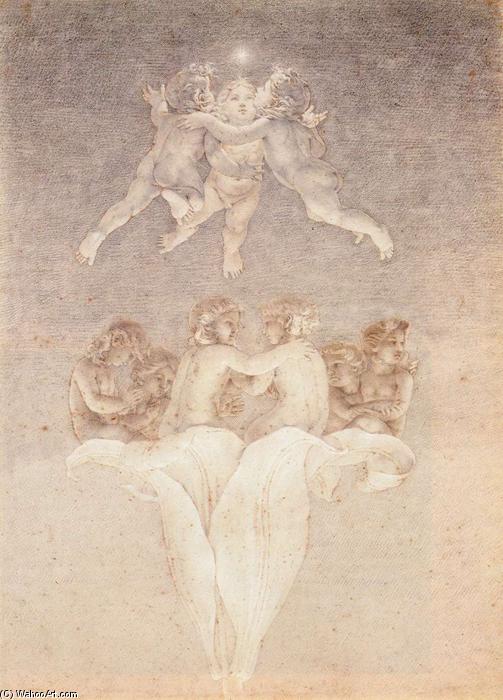
The artwork itself is strikingly simple in its composition: three figures dominate the upper register, engaged in an intimate embrace—a gesture simultaneously conveying connection and vulnerability. Beneath them rests a quartet seated upon a lily pad, their postures radiating serenity and contemplation. Runge’s masterful use of tonal gradations—ranging from pale grey to deep charcoal—creates a palpable sense of depth and luminosity, drawing the viewer into the scene's ethereal atmosphere.
Runge’s technique is characterized by meticulous detail achieved through delicate pencil strokes and subtle washes of watercolor. The artist employed *scissor-cut silhouettes*, a method he honed throughout his career, to achieve an unparalleled level of precision in capturing the contours of the figures and foliage. This painstaking process reflects Runge's belief that art should strive for intellectual rigor alongside emotional resonance.
Symbolically, “Genii on a Lily” speaks powerfully to Romantic ideals. The lily pad represents purity and regeneration—a motif frequently invoked by Romantic artists as a symbol of spiritual renewal. The embracing figures symbolize harmony between humanity and nature, mirroring the movement’s fascination with the interconnectedness of all things. Furthermore, Runge's deliberate choice of monochrome reinforces the artwork's contemplative mood, inviting viewers to contemplate profound questions about life, death, and beauty.
The emotional impact of “Genii on a Lily” is undeniable. It evokes feelings of tranquility, wonder, and melancholy—a testament to Runge’s ability to translate inner vision into visual form. The painting's understated elegance continues to captivate audiences today, securing its place as an enduring masterpiece of Romantic art.
Additional Research: This preparatory study for “The Morning” exemplifies Runge’s commitment to exploring the relationship between science and spirituality. It demonstrates his pioneering use of color theory—specifically, the Color Sphere—to represent the spectrum of human emotion. The meticulous detail achieved through scissor-cut silhouettes underscores Runge's dedication to artistic precision.
File Usage: This image is available on Wikimedia Commons under CC ZERO 1.0 license, allowing for unrestricted reuse and distribution. It’s featured prominently in the Web Gallery of Art (https://www.wga.hu/html_m/r/runge/z_genii.html) and serves as a cornerstone of online art scholarship.
Artist Information: Philipp Otto Runge (1777-1810), born in Wolgast, Germany, was a German Romantic painter celebrated for his symbolic landscapes, portraits & pioneering color theory ('Color Sphere'). Discover his mystical art and lasting influence.