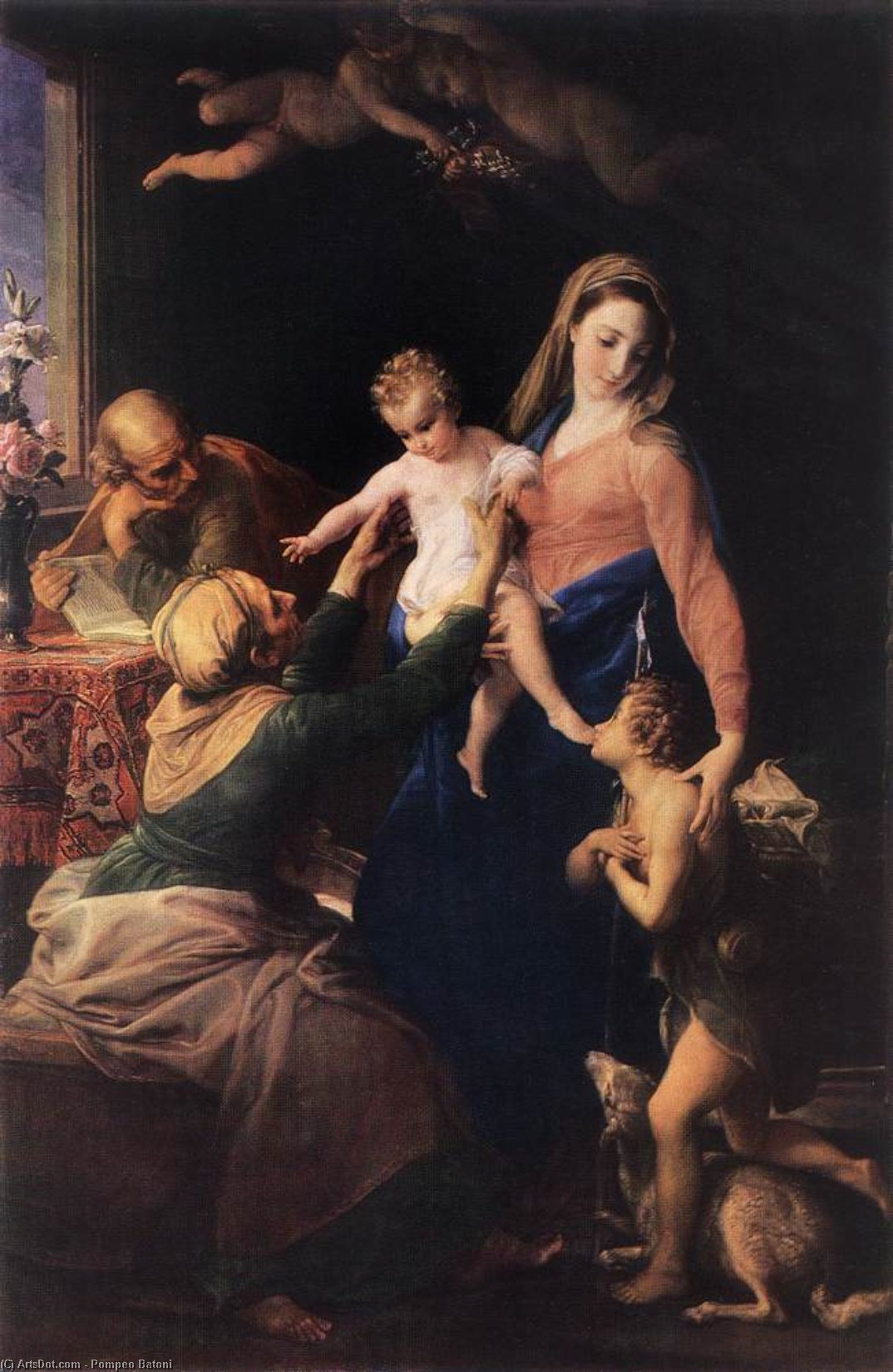
Pompeo Batoni’s “Holy Family”: A Window into Baroque Grace
Pompeo Batoni's "Holy Family," painted in 1777, isn't merely a depiction of a biblical scene; it’s an immersive experience of serene beauty and profound familial devotion. This masterpiece, currently residing within the esteemed collection of the State Hermitage Museum in St. Petersburg, offers a captivating glimpse into the artistic sensibilities of late Baroque Italy – a period where religious fervor intertwined seamlessly with classical ideals. Batoni, a pivotal figure bridging the gap between the dramatic intensity of the Baroque and the burgeoning Neoclassicism, masterfully employs light, color, and composition to evoke a sense of timeless peace and spiritual resonance.
The painting immediately draws the eye to the central figures: Mary cradling the infant Jesus, her expression radiating maternal tenderness. Beside her stands Saint Elizabeth, holding her own child, John the Baptist – a poignant representation of lineage and divine grace. The inclusion of two additional figures, subtly positioned in the background, adds depth and narrative complexity, hinting at the broader context of faith and family within the Holy Family’s story. Batoni's skill lies not just in rendering realistic forms but in imbuing them with an almost ethereal quality, as if they exist outside the constraints of ordinary time.
A Symphony of Light and Color – Batoni’s Technique
Batoni was renowned for his masterful use of light—a technique he termed “chiaroscuro,” a dramatic interplay between illumination and shadow. Here, it's particularly evident in the soft, diffused glow that bathes the figures, creating an atmosphere of warmth and intimacy. The rich, velvety textures of the fabrics – Mary’s flowing robes, Elizabeth’s mantle – are rendered with meticulous detail, showcasing Batoni’s exceptional skill as a colorist. He expertly blended warm earth tones—russets, ochres, and browns—with cooler blues and greens to create a harmonious palette that is both visually stunning and emotionally evocative.
The composition itself is carefully orchestrated. The figures are arranged within a shallow space, creating a sense of immediacy and drawing the viewer into the scene. Batoni’s use of pyramidal structure – with Mary and Jesus forming the apex – lends stability and balance to the image, while subtle details, such as the folds in the drapery and the expressions on the faces, contribute to the overall realism and emotional depth.
Symbolism and Historical Context
“Holy Family” is deeply rooted in the artistic conventions of its time. It directly references Raphael’s own “Holy Families,” a cornerstone of Renaissance art, but Batoni elevates the subject matter with his characteristic Baroque flair. The inclusion of Saint Elizabeth symbolizes the Virgin Mary's lineage and her role as a mother figure within the Christian narrative. John the Baptist, holding a scroll bearing the words "I baptize with water, but he who is coming after me will baptize with the Holy Spirit and fire," represents the promise of salvation and divine intervention.
Painted during the late 18th century, “Holy Family” reflects the prevailing religious sentiments of Europe. The Catholic Church was experiencing a period of renewed influence, and art served as a powerful tool for promoting faith and piety. Batoni’s work exemplifies this trend, offering a visually compelling representation of Christian values and family devotion. The painting also speaks to the Grand Tour—the fashionable European journey undertaken by wealthy young men—and Batoni's success was largely due to his ability to cater to the tastes of these travelers, producing works that were both aesthetically pleasing and religiously meaningful.
A Timeless Masterpiece – Reproductions and Beyond
Today, “Holy Family” stands as a testament to Batoni’s artistic genius. High-quality reproductions capture the painting's luminous beauty and emotional depth, making it accessible to a wider audience. When commissioning a reproduction, consider the meticulous hand-painting process employed by artisans who strive to replicate Batoni’s original techniques—the subtle gradations of color, the delicate rendering of fabrics, and the overall sense of serenity that defines this iconic work. Whether displayed in a private home or a public space, “Holy Family” continues to inspire contemplation and evoke a profound appreciation for the enduring power of art.