 Preview
 Send
Send Share
Share
 Details

 Download
 Similars
 X-Ray
X-Ray Diaporama
Holy Family
 Oil On Canvas
- WallArt
- Baroque Rococo
 1777
1777 226.0 x 150.0 cm
 Hermitage Museum
 Read More
Hand Made Oil Reproduction
Hand-painted oil on canvas in your size and frame, made to order by our artists. ( Buy Print Buy Image)




P118B $10

P118H $10

P118W $10

P438Z $10

P508JH $12

P508YH $12

P805H $10

P805Z $10

P919BZ $10

P919G $10

P919XJ $10

P959ZH $10

P968JZ $12

W106C $8

W218G $10

W218JH $8

W218Y $10

W307PJ $10

W316G $10

W316PJ $8

W316Y $10

W398PJ $8

W4111J $10

W500HY $15

W500JH $15

W692G $12

W849H $8

W940BG $15

W953PJ $8




Pick from our preset sizes that match the artwork's original proportions.

You may enter your own dimensions to fit a specific frame or space. If your selected size does not match the original image's proportions, we will either crop the artwork or extend the painting with additional hand-painted elements. A digital mockup will be sent for your approval before production begins.
Please note that the on-screen preview does not reflect the actual cropping or extension. Only the mockup will accurately show the final composition.
While custom sizes are available, we recommend selecting a dimension from the predefined list to preserve the original proportions.
After order, ArtsDot.com team will email client for instructions and provide a mockup preview
Worldwide Delivery () in 3/4 weeks instead of standard 5 weeks. (17 August). No compromise on quality.

Free Worldwide Express Shipping

High-Quality Linen Canvas

Full Shipping Insurance

Customs Tax Refund Guarantee

True Color Matching Guarantee

60-Day Return Policy (Defects Only)

100% Money-Back Guarantee

Bulk Discount Offer
 Glass option is only available in size under 110 CM

Holy Family
Reproduction Medium
Reproduction Size
-


Total Price
$ 263
Artwork Description
Pompeo Batoni’s “Holy Family”: A Window into Baroque Grace
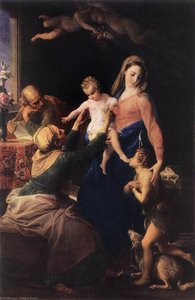
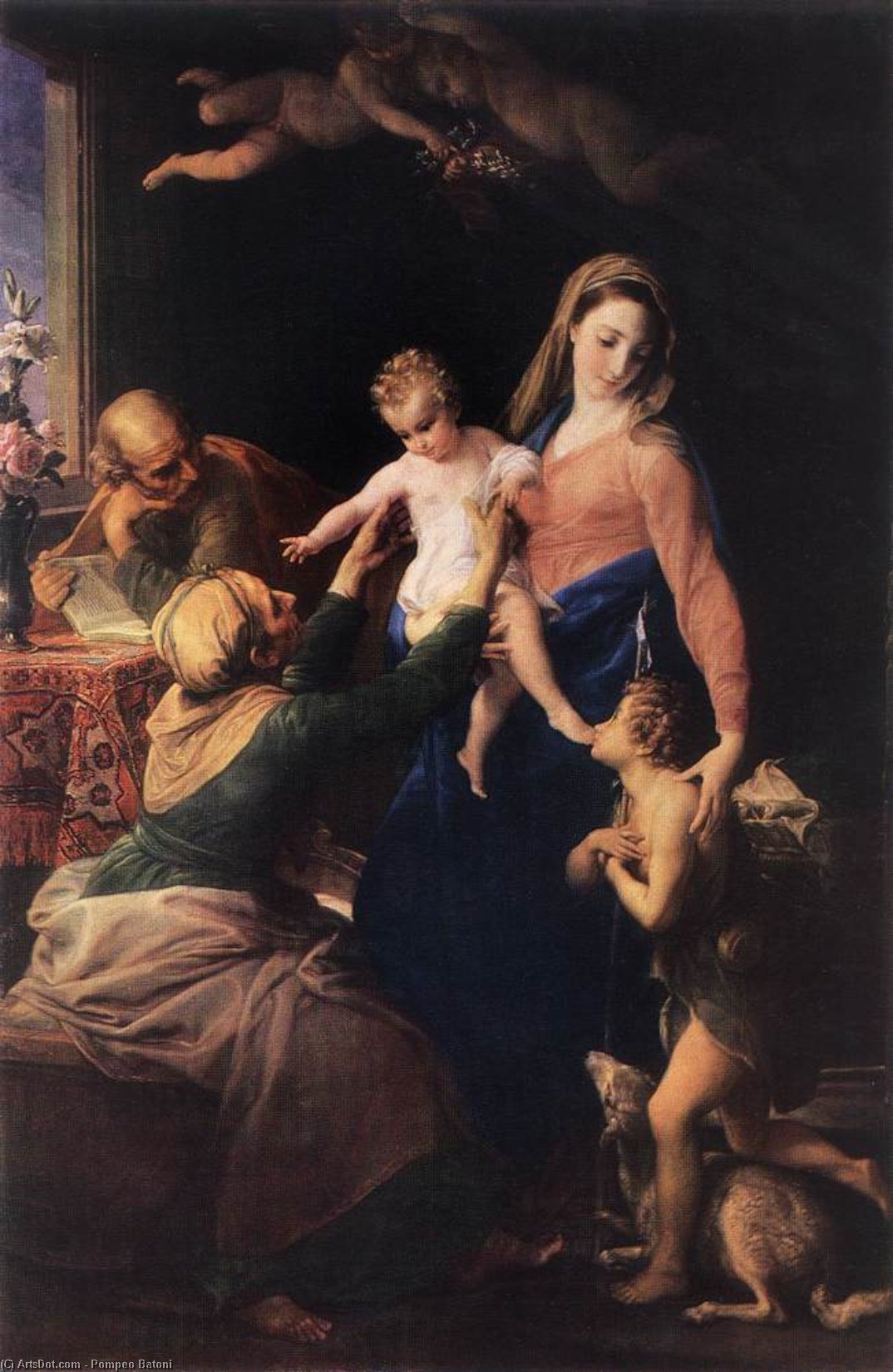
Pompeo Batoni's "Holy Family," painted in 1777, isn't merely a depiction of a biblical scene; it’s an immersive experience of serene beauty and profound familial devotion. This masterpiece, currently residing within the esteemed collection of the State Hermitage Museum in St. Petersburg, offers a captivating glimpse into the artistic sensibilities of late Baroque Italy – a period where religious fervor intertwined seamlessly with classical ideals. Batoni, a pivotal figure bridging the gap between the dramatic intensity of the Baroque and the burgeoning Neoclassicism, masterfully employs light, color, and composition to evoke a sense of timeless peace and spiritual resonance.
The painting immediately draws the eye to the central figures: Mary cradling the infant Jesus, her expression radiating maternal tenderness. Beside her stands Saint Elizabeth, holding her own child, John the Baptist – a poignant representation of lineage and divine grace. The inclusion of two additional figures, subtly positioned in the background, adds depth and narrative complexity, hinting at the broader context of faith and family within the Holy Family’s story. Batoni's skill lies not just in rendering realistic forms but in imbuing them with an almost ethereal quality, as if they exist outside the constraints of ordinary time.
A Symphony of Light and Color – Batoni’s Technique
Batoni was renowned for his masterful use of light—a technique he termed “chiaroscuro,” a dramatic interplay between illumination and shadow. Here, it's particularly evident in the soft, diffused glow that bathes the figures, creating an atmosphere of warmth and intimacy. The rich, velvety textures of the fabrics – Mary’s flowing robes, Elizabeth’s mantle – are rendered with meticulous detail, showcasing Batoni’s exceptional skill as a colorist. He expertly blended warm earth tones—russets, ochres, and browns—with cooler blues and greens to create a harmonious palette that is both visually stunning and emotionally evocative.
The composition itself is carefully orchestrated. The figures are arranged within a shallow space, creating a sense of immediacy and drawing the viewer into the scene. Batoni’s use of pyramidal structure – with Mary and Jesus forming the apex – lends stability and balance to the image, while subtle details, such as the folds in the drapery and the expressions on the faces, contribute to the overall realism and emotional depth.
Symbolism and Historical Context
“Holy Family” is deeply rooted in the artistic conventions of its time. It directly references Raphael’s own “Holy Families,” a cornerstone of Renaissance art, but Batoni elevates the subject matter with his characteristic Baroque flair. The inclusion of Saint Elizabeth symbolizes the Virgin Mary's lineage and her role as a mother figure within the Christian narrative. John the Baptist, holding a scroll bearing the words "I baptize with water, but he who is coming after me will baptize with the Holy Spirit and fire," represents the promise of salvation and divine intervention.
Painted during the late 18th century, “Holy Family” reflects the prevailing religious sentiments of Europe. The Catholic Church was experiencing a period of renewed influence, and art served as a powerful tool for promoting faith and piety. Batoni’s work exemplifies this trend, offering a visually compelling representation of Christian values and family devotion. The painting also speaks to the Grand Tour—the fashionable European journey undertaken by wealthy young men—and Batoni's success was largely due to his ability to cater to the tastes of these travelers, producing works that were both aesthetically pleasing and religiously meaningful.
A Timeless Masterpiece – Reproductions and Beyond
Today, “Holy Family” stands as a testament to Batoni’s artistic genius. High-quality reproductions capture the painting's luminous beauty and emotional depth, making it accessible to a wider audience. When commissioning a reproduction, consider the meticulous hand-painting process employed by artisans who strive to replicate Batoni’s original techniques—the subtle gradations of color, the delicate rendering of fabrics, and the overall sense of serenity that defines this iconic work. Whether displayed in a private home or a public space, “Holy Family” continues to inspire contemplation and evoke a profound appreciation for the enduring power of art.
Related Artworks

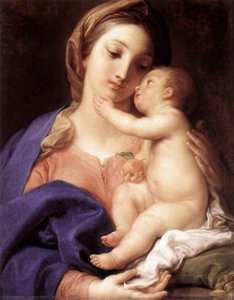
Artist Biography
Early Life and Training
- Born: Lucca, Italy (1708)
- Died: 1787
- Pompeo Batoni moved to Rome in 1727.
- He apprenticed with Agostino Masucci, Sebastiano Conca, and/or Francesco Imperiali.
- His first independent commission came as a result of rains that struck Rome in April 1732.
- The painting "The Ecstasy of Saint Catherine of Siena" illustrates his academic refinement of the late-Baroque style.
Artistic Style and Influences
- Batoni's style drew inspiration from classical antiquity, French Rococo, Bolognese Classicism, and artists such as Nicolas Poussin, Claude Lorrain, and especially Raphael.
- He is considered a precursor of Neoclassicism.
- His work can be found in various museums, including the Pinacoteca di Brera in Milan, Italy.
Notable Works and Commissions
- Virgin and Child with Saints
- A Knight in Rome: Charles Cecil Roberts – A celebrated portrait of a British traveler set against Roman ruins.
- The Triumph of Venice
- Numerous altarpieces for churches in Italy, such as the Museum Duomo in Siena.
- He was in high demand for portraits, particularly by British travelers on the Grand Tour who commissioned standing portraits within antique settings.
Development and Historical Significance
- Batoni became a highly fashionable painter in Rome after his rival, Anton Raphael Mengs, departed for Spain in 1761.
- He befriended Winckelmann and aimed to restrain classicism in his painting.
- His portraits captured the spirit of the Grand Tour era, reflecting the fascination with classical antiquity among European elites.
- Batoni’s ability to blend Baroque techniques with emerging Neoclassical ideals positioned him as a transitional figure in Italian art history.
Legacy
- Pompeo Batoni passed away on February 4, 1787, in Rome.
- He left behind a legacy as one of the most renowned Italian painters of his time.
- His work continues to be admired for its technical skill, elegant compositions, and insightful portrayals of individuals within their historical context.
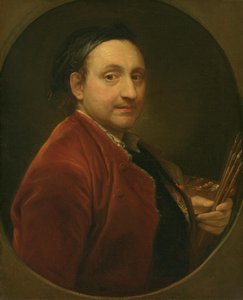
Pompeo Batoni
1708 - 1787 , Italy
Quick Facts
- Artistic Movement Or Style: Neoclassicism
- Artists Who Influenced This Artist:
- Nicolas Poussin
- Claude Lorrain
- Raphael
- Date Of Birth: 1708
- Date Of Death: 1787
- Full Name: Pompeo Batoni
- Nationality: Italian
- Notable Artworks:
- Virgin and Child with Saints
- A Knight in Rome
- The Triumph of Venice
- Place Of Birth (City And Country): Lucca, Italy
Related Articles

The Dramatic Flourish: Exploring the Baroque Movement's Enduring Legacy in Art History
Explore the dramatic world of Baroque art! Discover iconic artists like Caravaggio & Rubens, defining techniques, and its lasting impact on art history. Expert insights for collectors & enthusiasts at ArtsDot.

Baroque Masterpieces: 10 Paintings That Defined an Era |
Journey through the drama & grandeur of Baroque art! Explore 10 masterpieces by Caravaggio, Rembrandt, Rubens & more. Discover stunning oil paintings, rich colors & timeless stories. Find museum-quality reproductions at .

The Visceral Stage: Exploring Dramatic Narratives & Emotional Intensity in Baroque Art
Explore the dramatic world of Baroque art! Discover iconic masters like Caravaggio & Rembrandt, their techniques, and the movement's lasting impact. Expert insights for collectors & enthusiasts at ArtsDot.
Theatricality & Triumph: Baroque Drama in Painting & Sculpture
Explore the dramatic world of Baroque art! Discover its history, defining characteristics, & lasting influence on painting & sculpture. Expert insights into Caravaggio, Zurbarán, and Bernini – plus high-quality reproductions at ArtsDot.

Baroque Drama: Bringing Opulence & Emotion into Contemporary Interiors
Explore the opulent world of Baroque interior design! Discover key elements, modern applications & how to bring dramatic elegance into your home with 's authentic reproductions.