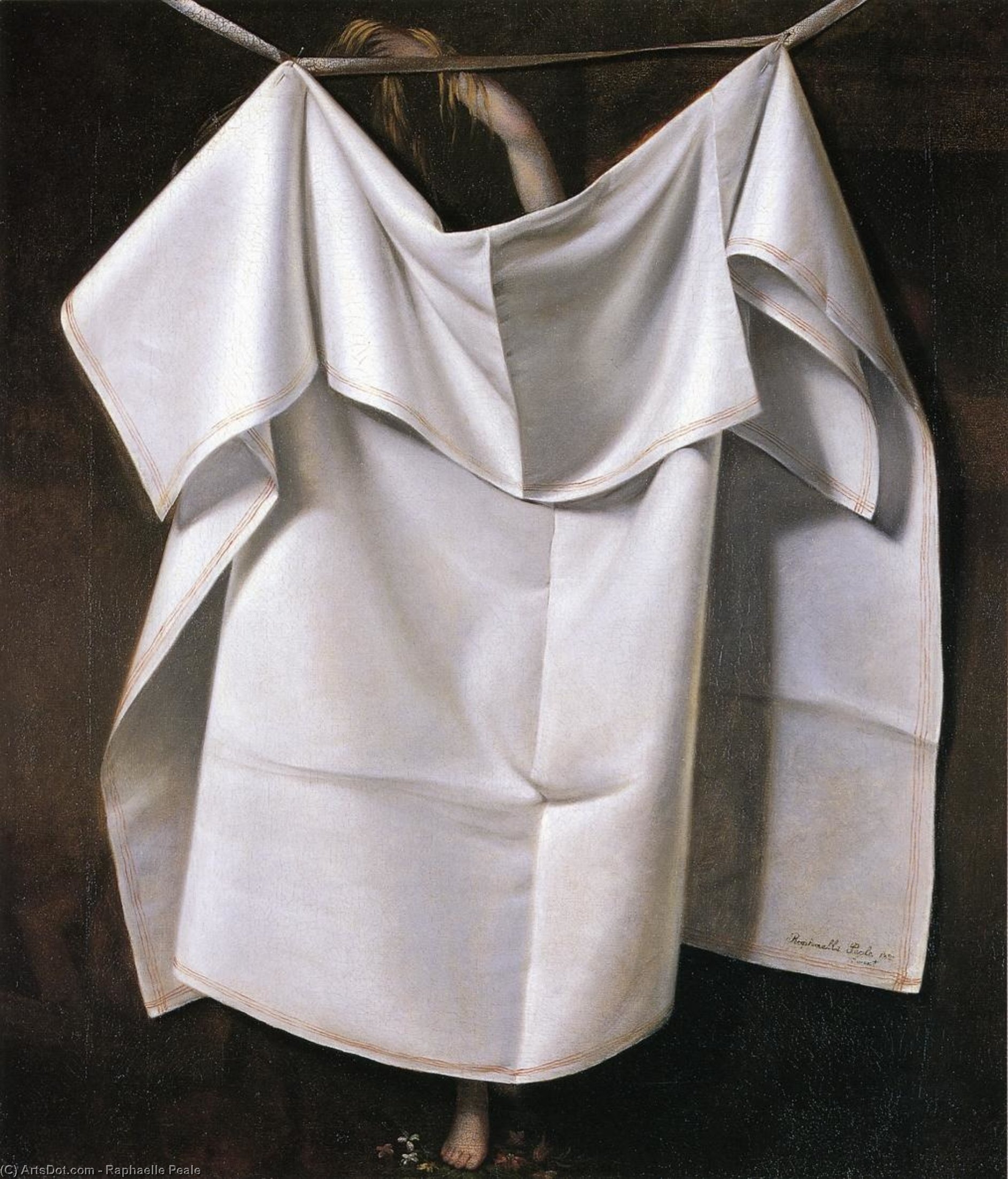
A Moment of Intimacy and Hidden Echoes: Exploring Raphaelle Peale’s “Venus Rising”
Raphaelle Peale's "Venus Rising from the Sea – A Deception," painted in 1822, is far more than a simple depiction of a woman emerging from a bath. It’s a carefully constructed tableau of veiled secrets and layered narratives, a testament to the artist’s skill as both a painter and a subtle manipulator of visual language. The work immediately draws the viewer in with its deceptively simple composition: a partially draped figure, her face obscured by a pristine white towel, hinting at vulnerability and quiet contemplation. Yet, beneath this surface lies a complex web of references – to classical mythology, to Peale’s own family history, and ultimately, to the very nature of artistic representation itself.
The painting's genesis is rooted in the burgeoning interest in neoclassical art during the early 19th century. Peale, a pioneer in American still life painting, deliberately chose to emulate James Barry’s celebrated “Birth of Venus” (1772), a work that had achieved immense popularity through its widespread reproduction as an engraving. By incorporating this iconic image – subtly concealed beneath the towel – Peale wasn't merely copying; he was engaging in a dialogue with art history, challenging viewers to actively participate in deciphering the layers of meaning within his composition. The choice of the white towel itself is significant, evoking notions of modesty and concealment, yet simultaneously suggesting an invitation to peek behind the curtain.
The Technique of Illusion: Trompe L’Oeil and Peale's Mastery
Peale’s technical prowess lies in his masterful execution of *trompe l’oeil*, a technique designed to create the illusion of three-dimensionality on a two-dimensional surface. The meticulous rendering of the towel’s folds, the subtle variations in tone within the white fabric, and the carefully positioned shadows all contribute to this convincing effect. He doesn't simply paint a towel; he paints the *impression* of a towel – its texture, its weight, even the way it drapes across the rack. This heightened realism is further enhanced by the dark background, which serves to amplify the luminosity of the white and create a dramatic contrast that draws the eye directly to the central figure.
Interestingly, recent research conducted by conservator Mary Schafer has revealed an even deeper layer of complexity within the painting. Schafer discovered an earlier, unfinished version hidden beneath the margins – a partial copy of Charles Willson Peale’s 1817 portrait of his son Raphaelle! This concealed image, also partially obscured by the white towel, adds a poignant and almost conspiratorial element to the work, suggesting a familial secret or perhaps even a subtle critique of the artist's own father. It transforms "Venus Rising" from a simple still life into a complex family portrait with an underlying narrative.
Symbolism and Emotional Resonance: A Portrait of Quiet Contemplation
Beyond its technical brilliance and historical references, “Venus Rising” resonates deeply on an emotional level. The partially obscured figure evokes a sense of vulnerability and introspection – a moment of private reflection away from the gaze of others. The title itself, "Venus Rising from the Sea - A Deception," is laden with symbolic weight. Venus, the Roman goddess of love and beauty, suggests themes of desire and sensuality, while “A Deception” hints at hidden truths and obscured realities. The painting invites us to consider the complexities of self-perception, the allure of the unknown, and the ways in which we construct our own narratives about ourselves.
A Legacy of Innovation: Peale’s Place in American Art History
Raphaelle Peale's "Venus Rising from the Sea – A Deception" stands as a pivotal work in American art history, marking a significant departure from the prevailing portraiture styles of the time. His pioneering exploration of still life painting, coupled with his innovative use of *trompe l’oeil* and his subtle engagement with artistic tradition, established him as a true innovator. The painting's enduring appeal lies not only in its technical mastery but also in its ability to provoke thought and invite multiple interpretations – a testament to Peale’s genius as both an artist and a storyteller.