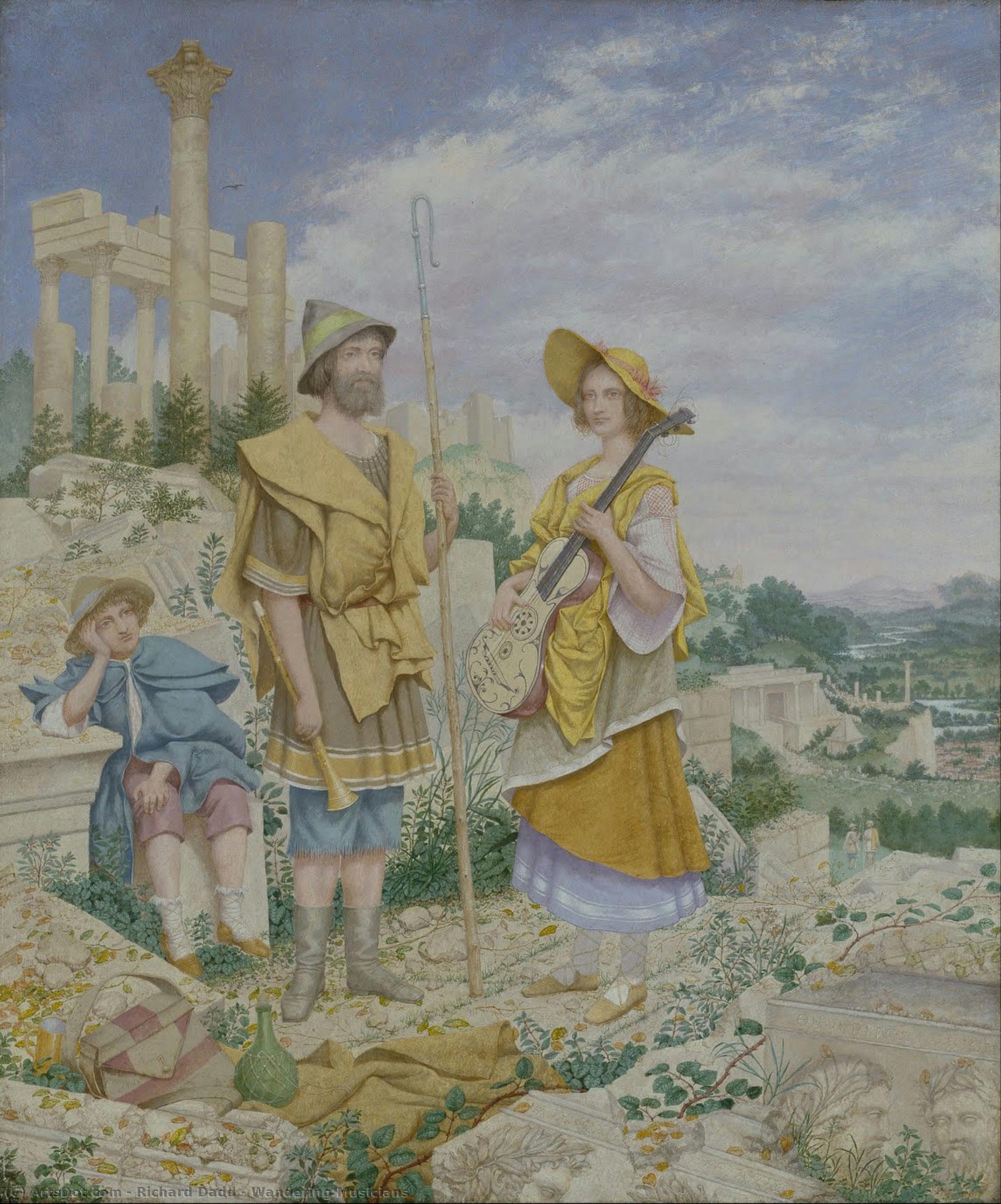
Richard Dadd's 'Wandering Musicians' (1878) depicts serene figures amidst a picturesque landscape, showcasing the artist’s intricate detail and psychological depth.
Richard Dadd (1817-1886): Explore the intricate fairy scenes & Orientalist art of this Victorian painter, whose detailed works were created during his time in hospitals.
Tate Britain
(London, United Kingdom)
Discover modern & contemporary art at Tate Britain! Explore British masterpieces from medieval times to today, amidst stunning architecture and engaging exhibitions. Free admission!
A Visionary’s Descent: Richard Dadd's "Wandering Musicians"
Richard Dadd’s “Wandering Musicians,” painted circa 1878, is not merely a pastoral scene; it’s a poignant window into the mind of an artist grappling with profound psychological turmoil. Created during his extended confinement within the walls of Bethlem and Broadmoor Hospitals – institutions then considered pioneering in the treatment of mental illness – the painting transcends simple representation, becoming a deeply layered exploration of memory, delusion, and the enduring power of artistic creation amidst suffering. The work’s genesis lies in Dadd's 1842 tour of the Levant, an experience that ignited his imagination but ultimately contributed to his descent into madness. He meticulously recreated this journey on canvas, blending recollections with fevered dreams and unsettling visions – a testament to the way memory itself can be reshaped by mental instability.
A Symphony of Detail: Technique and Style
Dadd’s technical mastery is immediately apparent in “Wandering Musicians.” Executed in rich, luminous oil paint on canvas, the scene unfolds with an astonishing level of detail. Every instrument – a lute, a flute, a drum – is rendered with painstaking accuracy, reflecting Dadd's lifelong passion for music and his meticulous observation skills honed during his early artistic training at the Royal Academy. The figures themselves are imbued with a quiet dignity, their postures suggesting a shared moment of contemplation amidst the idyllic landscape. However, closer inspection reveals subtle distortions—a slightly elongated hand, an unnaturally wide-eyed gaze – hinting at the artist’s fractured perception and the unsettling influence of his mental state. The use of color is particularly noteworthy; vibrant greens and blues dominate the scene, creating a sense of serenity and warmth, yet these are punctuated by darker hues that subtly suggest underlying unease and foreboding.
Symbolism and Narrative Echoes
The painting’s narrative is rich with symbolic resonance. The open landscape, bathed in golden light, evokes the classical ideal of Arcadia – a pastoral paradise representing harmony, innocence, and escape from worldly concerns. Yet, this idyllic setting is subtly undermined by the presence of the musicians themselves, their faces obscured and their movements suggesting a detached, almost spectral quality. Some art historians have linked the scene to fragments of Greek mythology, specifically references to shepherds and wandering minstrels, drawing parallels with Theocritus’ pastoral poems – a connection Dadd himself likely appreciated given his interest in classical literature. The broken frieze at the foreground, bearing traces of ancient writing, further reinforces this symbolic link, suggesting a yearning for lost traditions and a sense of timelessness. The inclusion of the bottle hints at a possible reflection on the artist's own struggles with addiction and self-medication during his confinement.
A Portrait of Turmoil: Context and Legacy
Richard Dadd’s life is inextricably intertwined with “Wandering Musicians.” His descent into mental illness, marked by periods of lucidity interspersed with violent outbursts and delusional episodes, profoundly shaped his artistic output. The painting was created during a particularly challenging period in his confinement at Broadmoor Hospital, where he endured isolation and limited access to creative outlets. Despite these circumstances, Dadd continued to produce works of extraordinary beauty and complexity – a testament to the indomitable spirit of an artist driven by an inner compulsion. “Wandering Musicians” stands as both a poignant self-portrait—a glimpse into the mind of a man struggling with his demons—and a remarkable achievement of artistic skill and emotional depth. It’s a haunting reminder that even in the darkest corners of human experience, creativity can flourish, offering solace, expression, and ultimately, a fragile connection to beauty and meaning. Today, reproductions of this evocative work continue to captivate viewers, inviting contemplation on the complexities of the human psyche and the enduring power of art to transcend suffering.