A Haunting Echo of History: The Power of Propaganda
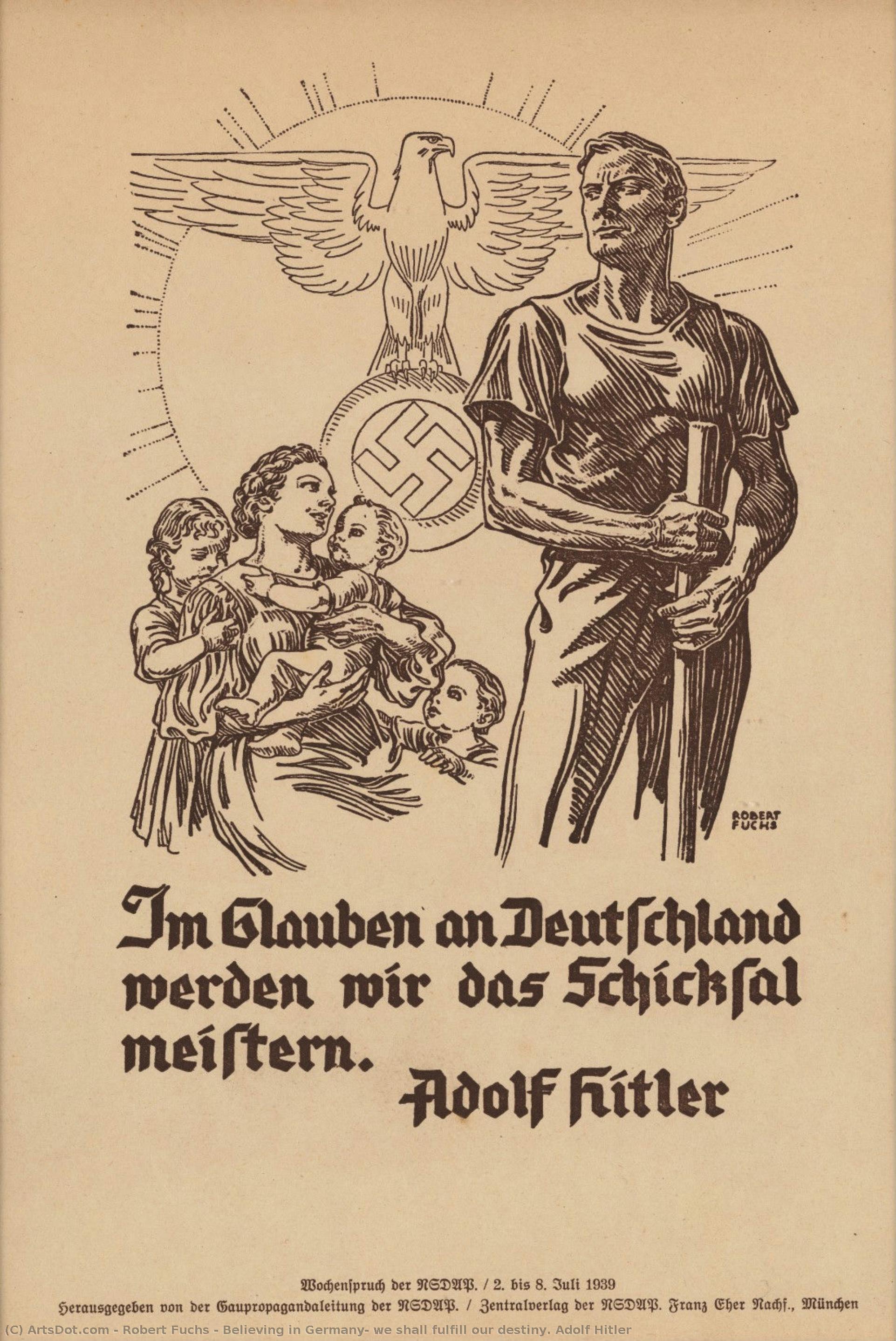
In the vast, often turbulent gallery of human history, few artifacts possess the visceral, unsettling power of political propaganda. The 1939 poster, Believing in Germany, we shall fulfill our destiny, serves as a chilling window into the psychological landscape of World War II. This piece is not merely an image but a calculated instrument of mobilization, designed to stir the soul and command the will of a nation. As an object of historical study, it captures a moment when art was weaponized to reshape reality, using the visual language of duty, sacrifice, and nationalistic fervor to bind a population to a singular, devastating cause.
The composition is masterfully, if ruthlessly, structured to direct the viewer's gaze toward a central, authoritative figure. Adolf Hitler is depicted not as a distant dictator, but as a paternal presence, surrounded by children who represent the idealized future of the German state. This juxtaposition of leadership and innocence is a hallmark of the era's propaganda technique, aiming to soften the harsh realities of war with the promise of domestic stability and generational continuity. Above this scene, the heavy, dominating presence of the swastika looms, acting as both a celestial crown and an inescapable shadow that binds the figures beneath its weight.
Symbolism and the Language of Control
Every element within this work is saturated with symbolic intent, creating a narrative that seeks to justify destiny through ideology. The inclusion of a pale blue dove—a universal symbol of peace—is particularly poignant; in this context, it feels twisted, representing a peace achieved only through total victory and the imposition of order. The children, rendered in a simplified, almost ethereal style with white clothing, embody purity and the untainted potential of the next generation, making them the emotional anchors of the piece. They are the stakes for which the war is being fought.
The color palette reinforces this sense of somber gravity. Dominated by muted browns, blacks, and deep greys, the work avoids the vibrancy of life, opting instead for a tonal range that suggests strength, permanence, and the grit of the earth. The starkness of the lines and the lack of soft shadows create a rigid, angular aesthetic that mirrors the uncompromising nature of the ideology it promotes. It is a visual manifestation of control, where every shape and shade is meticulously placed to leave no room for doubt or dissent.
Technique and the Aesthetic of Mobilization
From a technical perspective, the poster utilizes a style reminiscent of woodcut or linocut printing, characterized by sharp, decisive lines and a limited but impactful tonal range. This method was historically favored for its ability to produce high-contrast, easily reproducible images that could be plastered across city walls and public squares, ensuring the message reached every level of society. The flat lighting and shallow perspective strip away the complexities of the real world, presenting instead an idealized, two-dimensional reality that is easy to digest and impossible to ignore.
For the collector or the historian, a high-quality reproduction of this work offers more than just a decorative element; it provides a profound opportunity for contemplation. To display such a piece is to engage with the heavy weight of the past. It serves as a stark reminder of how easily the tools of art can be used to manipulate emotion and alter the course of civilization. Whether viewed through the lens of graphic design history or as a somber relic of 20th-century conflict, this poster remains an indelible, haunting masterpiece of political communication.