A Vision of Divine Judgment: The Surrealist Majesty of Dalí
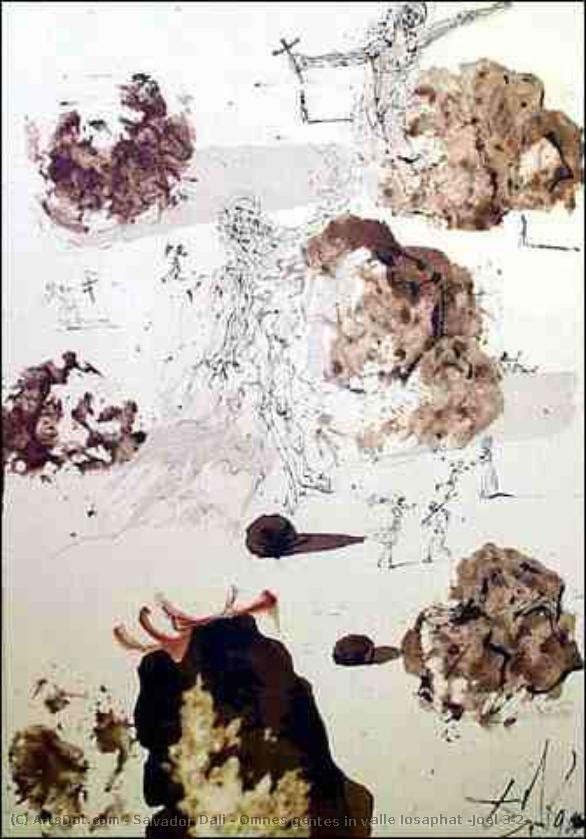
In the vast, labyrinthine landscape of Salvador Dalí’s Biblia Sacra series, few works command the viewer's attention with such unsettling intensity as Omnes gentes in valle Iosaphat (Joel 3:2). Created between 1964 and 1967, this masterpiece serves as a profound window into the artist's late-period exploration of spirituality and the subconscious. Dalí does not merely illustrate a biblical verse; he orchestrates a cosmic event. The painting plunges us into a dreamlike realm where the boundaries between the earthly and the divine dissolve, leaving the viewer to grapple with themes of retribution, mortality, and the weight of human responsibility. It is an evocative piece that transcends its religious origins to become a universal meditation on the moment of reckoning.
The composition is a masterclass in tension and atmospheric depth. At the heart of this surrealist vision lies a colossal bull, rendered in grounded, earthy tones that anchor the swirling chaos above. This central figure acts as a totem of primal strength and impending doom, its presence felt through a heavy, palpable weight. Above this terrestrial force, Dalí paints an amorphous expanse of browns and tans—a celestial turbulence that suggests a sky in upheaval. The interplay of delicate, precise lines against spontaneous, energetic splashes creates a visual rhythm that mirrors the very essence of the biblical prophecy: a sudden, inescapable shift in the cosmic order.
Technique and the Alchemy of Gouache
To achieve such a hauntingly luminous effect, Dalí turned to gouache, a medium capable of extraordinary opacity and light-catching brilliance. His technique in this work is a deliberate study in contrasts. On one hand, we see his legendary meticulous draftsmanship, where forms are rendered with a surgical precision that lends them an eerie, hyper-real quality. On the other, Dalí introduces disruptive streaks and textured surfaces that shatter conventional perspective. This duality is essential to the painting's emotional impact; it represents the struggle between the structured laws of the universe and the chaotic, unpredictable nature of the human soul.
For the discerning collector or interior designer, this artwork offers a profound sense of movement and texture. The way the light seems to emanate from within the layers of gouache creates a multidimensional experience that changes as one moves around the piece. It is not a static image but a living, breathing entity. Incorporating a high-quality reproduction of such a work into a curated space provides more than just decoration; it introduces a focal point of intellectual and emotional depth, inviting guests to linger and contemplate the mysteries hidden within its layers.
A Legacy of Symbolism and Spiritual Depth
Every element in Omnes gentes in valle Iosaphat is steeped in symbolic significance. The bull, often a symbol of fertility and power, is here recontextualized as an omen of the final judgment. The swirling, nebulous heavens suggest a realm where time has lost its rigidity—a hallmark of Dalí’s surrealist philosophy. By referencing Joel 3:2, Dalí connects the viewer to an ancient narrative of justice, yet he strips away the traditional iconography of religious art to replace it with a visceral, psychological landscape. The result is a work that feels both ancient and avant-garde.
Owning or displaying a reproduction of this piece allows for a continuous dialogue with Dalí’s genius. It is an ideal selection for those who appreciate art that challenges the intellect and stirs the spirit. Whether placed in a quiet study, a grand gallery, or a sophisticated living space, this painting acts as a portal to the subconscious, reminding us of the beauty found in the most turbulent of visions. It remains a cornerstone of 20th-century art, offering an enduring inspiration for anyone moved by the intersection of faith, fear, and the infinite imagination.