A Window into the Pastoral Soul
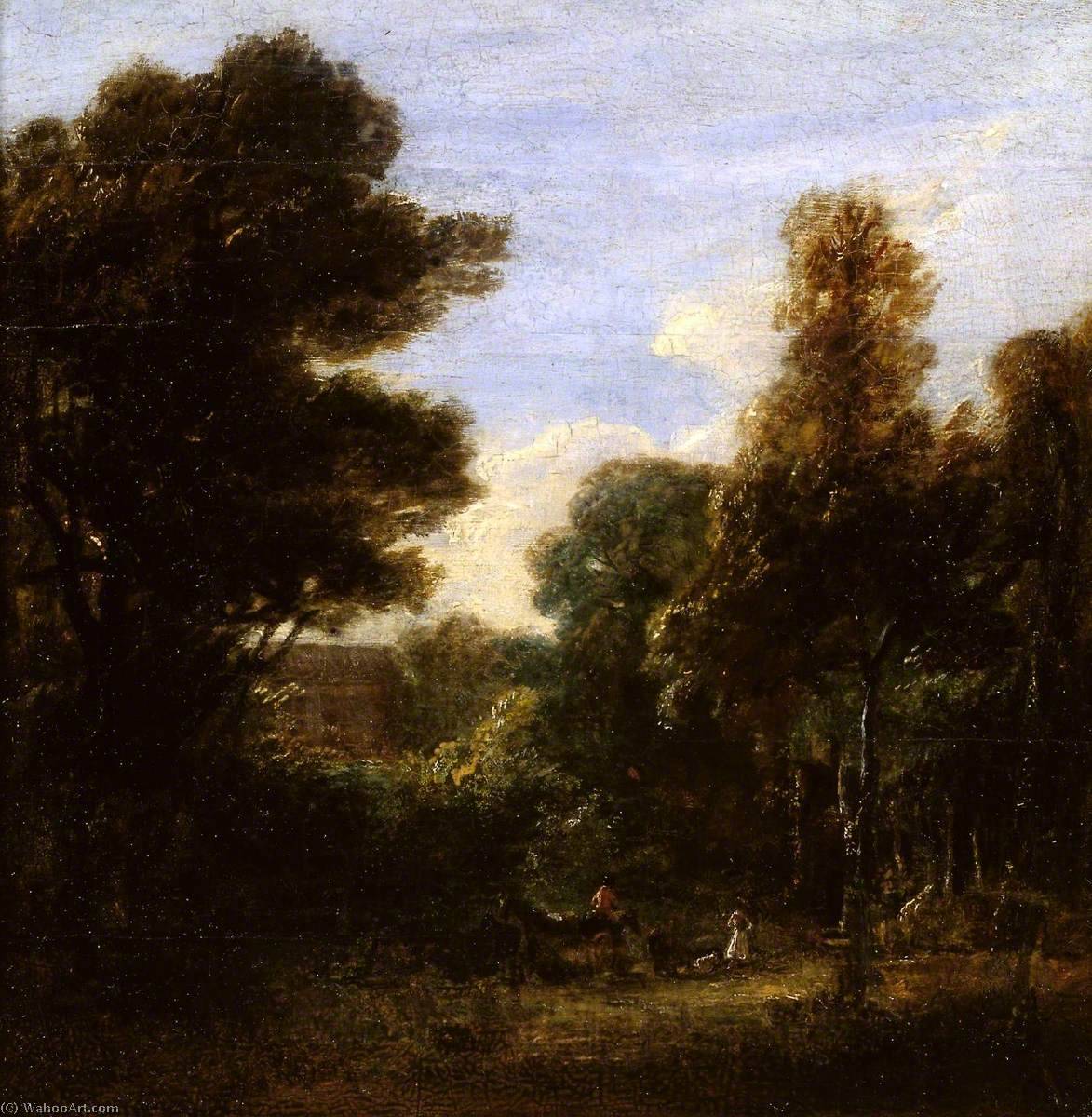
In the quietude of A Woody Landscape, painted in 1822, we are invited to step into a world where time seems to slow to the rhythm of nature itself. Sir David Wilkie, a master of capturing the profound beauty found in the everyday, presents us with a serene rural scene that transcends mere topography. The composition is anchored by dense, majestic trees that flank a central clearing, acting as natural sentinels that frame a soft, sun-dappled meadow. Within this clearing, the subtle presence of figures and grazing sheep evokes a sense of timeless pastoral harmony. It is not merely a depiction of land, but an invitation to experience the atmospheric hush of an overcast morning or the golden, diffused light of a late afternoon, where the boundary between the earth and the sky feels beautifully blurred.
The technique employed in this work speaks to the burgeoning Romantic spirit of the early nineteenth century. Utilizing oil on canvas, Wilkie employs a painterly approach characterized by visible, expressive brushstrokes that lend the piece a tactile, living quality. Rather than relying on sharp, clinical outlines, the artist uses organic shapes and layered textures to build depth. The perspective is masterfully flattened through the use of atmospheric haze, creating a sense of vastness despite the intimate scale of the work. This soft-focus approach allows the viewer’s eye to wander through the muted earth tones, occasionally catching the delicate highlights of light blue and pale yellow that dance within the sky, much like the fleeting impressions of a dream.
The Resonance of Light and Tradition
Beyond its aesthetic charm, A Woody Landscape carries a deep symbolic weight, embodying the Romantic era's reverence for the connection between humanity and the natural world. The low horizon line emphasizes an expansive, breathing sky, suggesting that while the figures are grounded in their daily labors, they exist under the infinite gaze of the heavens. There is a profound sense of tranquility and stability in this composition; the vertical strength of the trees provides a structural permanence that contrasts with the ephemeral nature of the light and the movement of the animals. For the collector or interior designer, this piece offers more than just decoration; it provides an emotional anchor.
Integrating such a masterpiece into a contemporary space allows for a sophisticated interplay between history and modernity. The artwork’s palette of soft greens, browns, and muted blues serves as a versatile foundation for various interior styles, from the understated elegance of a classic study to the organic warmth of a modern living room. It acts as a focal point that inspires contemplation, bringing a sense of peace and historical depth to any environment. To possess a reproduction of this caliber is to hold a fragment of Scotland's artistic heritage—a piece that continues to whisper the quiet, enduring stories of the countryside to all who pause to look.