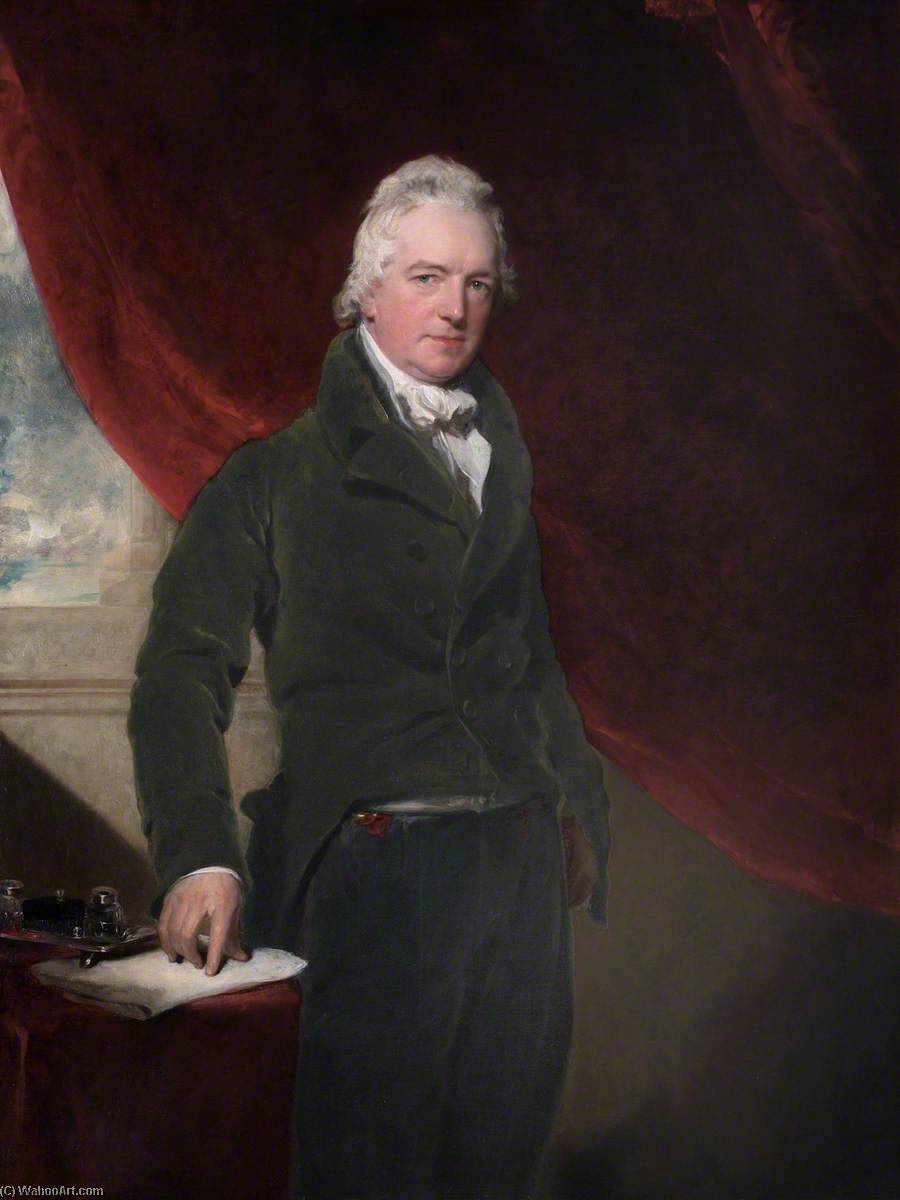
A Portrait of Regency Precision: John Abernethy by Thomas Lawrence
This meticulously rendered portrait of John Abernethy, executed in 1820 by the esteemed Sir Thomas Lawrence, offers a captivating glimpse into the world of early 19th-century surgery and the burgeoning respectability afforded to medical professionals. The painting transcends a simple likeness; it’s a carefully constructed tableau that speaks volumes about Abernethy's character, his profession, and the artistic sensibilities of the Regency period. Lawrence, renowned for his ability to capture both physical appearance and inner temperament, has created an image imbued with quiet dignity and intellectual seriousness.
- Subject Matter: The central figure is John Abernethy himself, a prominent surgeon during a time when medical practice was undergoing significant transformation. His attire – the dark coat, crisp white shirt, and high collar – immediately establishes his status as a man of authority and learning.
- Technical Mastery: Lawrence’s oil on canvas technique is flawlessly executed. The brushwork is precise yet subtly nuanced, allowing for an astonishing level of detail in Abernethy's features, the texture of his clothing, and even the folds of the red curtain that serves as a dramatic backdrop.
- Compositional Elements: The stark contrast between Abernethy’s dark garments and the vibrant red curtain immediately draws the viewer’s eye to the subject. This strategic use of color not only creates depth but also elevates Abernethy's importance within the composition, positioning him as the focal point of the scene.
The Regency Context: Lawrence and the Rise of Portraiture
Sir Thomas Lawrence’s career flourished during a period of immense social and artistic change in England – the Regency era (1811-1820). This was an age of opulent patronage, fueled by the wealth generated from trade and empire. Portraiture became increasingly popular amongst the wealthy elite, transforming into a sophisticated art form rather than merely a means of recording likenesses. Lawrence himself was at the forefront of this movement, commissioned to paint portraits of prominent figures including royalty, politicians, and military leaders. His work reflects not only his technical skill but also his understanding of the social conventions and aspirations of the time.
The inclusion of the book in Abernethy’s hand is particularly significant. It subtly reinforces his role as a learned professional, suggesting an engagement with scholarly pursuits alongside his practical surgical skills. This detail adds layers of meaning to the portrait, hinting at the intellectual foundations upon which modern medicine was being built.
Symbolism and Emotional Impact
Beyond its technical brilliance, the painting possesses a quiet emotional resonance. Abernethy’s expression – serious yet thoughtful – conveys a sense of dedication and responsibility. The formality of his pose and attire speaks to the professional standards expected of him, while the overall composition evokes a feeling of stability and confidence. Lawrence skillfully avoids sentimentality, presenting a portrait that is both dignified and subtly compelling.
The red curtain, a recurring motif in Lawrence’s work, adds an element of theatricality, elevating the scene beyond a simple depiction of a surgeon to something approaching a carefully staged tableau vivant – a living picture. This technique was frequently employed by Lawrence to create a sense of grandeur and importance around his subjects.
Dimensions & Authenticity
This exceptional reproduction faithfully captures the original painting’s dimensions: 140 x 109 cm. The meticulous attention to detail, achieved through Lawrence's masterful technique, ensures that this artwork will be a stunning addition to any collection or interior space. A hand-painted reproduction offers the unparalleled quality and authenticity of the original, allowing you to experience the full impact of Lawrence’s artistic vision.