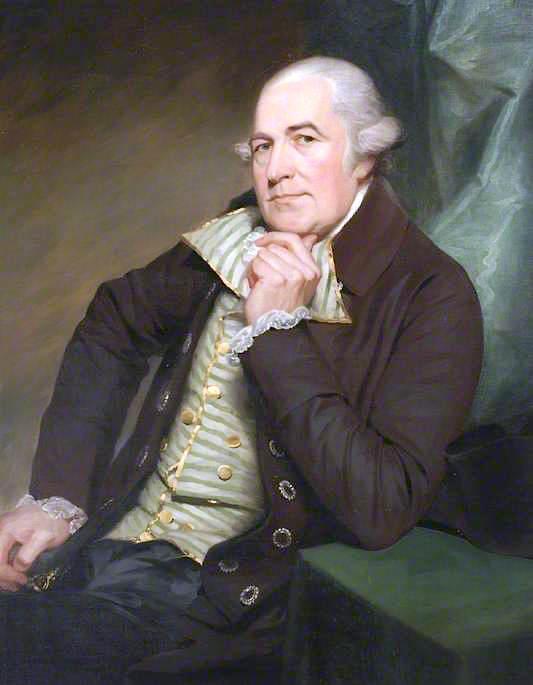
George Maltby, Esq.: A Portrait of Dignified Authority
Sir William Beechey’s depiction of George Maltby, Esq., completed circa 1782, stands as a quintessential example of late Georgian portraiture—a genre defined by its meticulous realism and unwavering commitment to conveying social status. More than just a likeness, the painting embodies the ideals of aristocratic refinement prevalent during the reign of George III, capturing not merely appearance but also character and bearing.
The artwork’s composition centers on Maltby himself, positioned slightly off-center to the right within a formal interior setting—likely a drawing room. A chair serves as grounding element behind him, reinforcing the sense of dignified repose characteristic of aristocratic portraits. Beechey skillfully employs geometric shapes – particularly the rectangular frame of the chair – to establish visual stability and guide the viewer’s gaze.
Beechey’s masterful technique utilizes oil paint on canvas, demonstrating a blending brushstroke approach that achieves remarkable smoothness and luminosity. Subtle gradations within the color palette—ranging from earthy browns and greens forming the backdrop to warmer yellows highlighting Maltby's vest—create depth and realism. Glazes were likely employed to subtly enhance tonal variations, adding nuance and richness to the overall visual experience.
Color Palette & Light
The subdued color scheme reflects the aesthetic sensibilities of the time, prioritizing muted tones that convey elegance and restraint. Dominant hues include browns and greens—suggestive of wealth and cultivated taste—contrasting with the vibrant yellow of Maltby’s waistcoat, which draws attention to his status as a gentleman of considerable means. The diffused natural light illuminates Maltby's face and upper torso, casting gentle shadows that contribute to the painting’s dramatic depth.
Symbolism & Emotional Resonance
Beyond its visual beauty, “George Maltby, Esq.” carries symbolic weight. Maltby’s confident posture and direct gaze communicate authority and self-assurance—qualities highly valued in aristocratic society. The attire—a waistcoat adorned with yellow silk—represents wealth and social standing, reinforcing the portrait's message of prestige and accomplishment. Beechey’s careful attention to detail captures not only Maltby’s physical appearance but also his inner character, conveying a sense of dignified composure.
Historical Context & Artistic Style
Painted during the Georgian era (1714-1830), “George Maltby, Esq.” exemplifies the neoclassical style that dominated British art at the time. Influenced by artists like Johann Zoffany and Sir Joshua Reynolds, Beechey adhered to conventions established by Reynolds—emphasizing idealized beauty and conveying moral virtue through carefully crafted compositions. The painting’s flatness contributes to its timeless appeal, resisting the illusionistic techniques of earlier Renaissance masters.
Materials & Technique Details
The artwork is executed in oil paint on canvas, utilizing meticulous blending brushstrokes to achieve exceptional textural realism. Subtle variations in surface sheen—particularly noticeable in Maltby's skin tones—enhance the painting’s tactile quality. The artist’s skillful manipulation of light and shadow creates a captivating interplay of illumination and darkness, drawing attention to key elements within the composition.