The Final Gaze: A Soul Unveiled
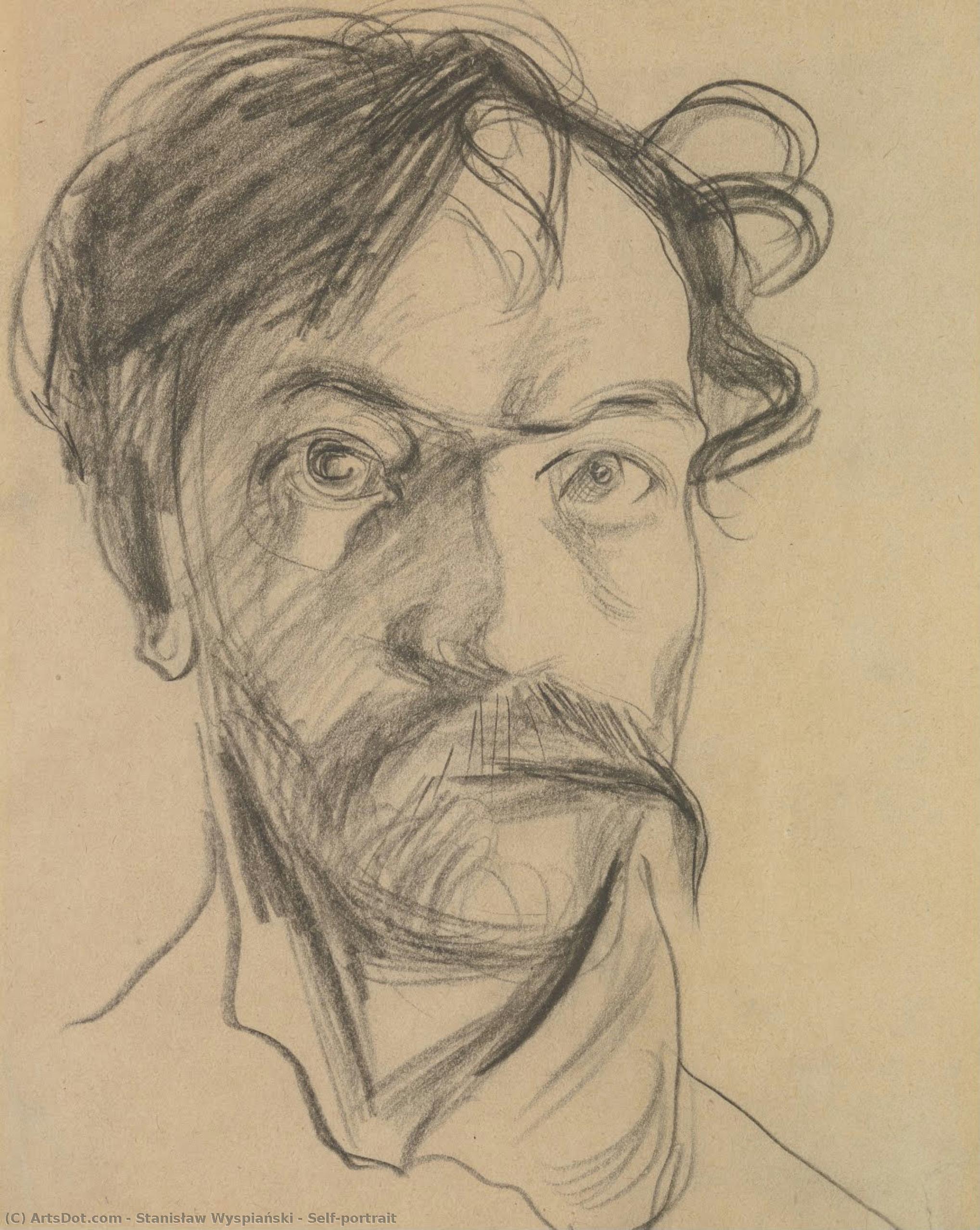
In the twilight of his short but incandescent life, Stanisław Wyspiański produced a work that transcends the boundaries of mere portraiture to become a profound psychological document. Created perhaps only months before his untimely death in 1907, this Self-portrait is far more than a study of a face; it is an intimate confrontation with mortality. As the artist stood at the threshold of his own end, he turned his gaze inward, capturing not just his physical likeness, but the very disintegration of his being. The drawing serves as a haunting testament to a man who, despite facing the dissolution of his physical form, maintained a spiritual intensity that continues to pierce through the decades.
The composition is strikingly intimate, utilizing a tight crop that forces the viewer into an inescapable encounter with the artist's features. There is no background to provide sanctuary or context; there is only the face, emerging from the shadows of the paper. Through a masterful use of Expressionist principles, Wyspiański eschews the polished smoothness of academic realism in favor of a raw, visceral energy. The lines are thick, gestural, and unapologetically heavy, carving out the contours of his visage with an urgency that suggests a race against time. This technique creates a sense of movement and instability, as if the subject is caught in a moment of profound metamorphosis.
Technique and the Language of Line
Executed primarily with graphite pencils on paper, the artwork relies on the subtle yet powerful interplay of light and shadow to build form. The artist employs varying line weights to create a tactile, almost rugged surface that mirrors the internal turbulence of his subject. The lighting, appearing to descend from above, casts deep, dramatic shadows across the planes of the face, accentuating the hollows of the eyes and the structural strength of the brow. This chiaroscuro effect does not merely provide three-dimensional depth; it serves a symbolic purpose, highlighting the tension between the fading physical shell and the enduring light of the intellect.
The texture of the drawing is achieved through meticulous yet spontaneous shading, where every stroke feels heavy with intention. The angularity of the shapes and the somewhat distorted proportions contribute to an atmosphere of unease and introspection. For the collector or lover of fine art, this piece represents a pinnacle of Polish Symbolism, where the technical mastery of the pencil is used to bridge the gap between the visible world and the unseen emotional landscape. It is a work that demands attention, offering a depth of character that rewards repeated observation.
A Legacy for the Modern Collector
For interior designers and curators of meaningful spaces, this self-portrait offers an unparalleled opportunity to introduce a piece of profound historical and emotional weight. Its monochromatic palette makes it a versatile yet commanding presence in any sophisticated setting, capable of anchoring a room with its somber elegance and intellectual gravity. It is a work that speaks to the themes of resilience, identity, and the human condition—making it an ideal selection for those who seek art that provokes thought and stirs the soul.
Owning a high-quality reproduction of this masterpiece allows one to bring the spirit of the Young Poland movement into a contemporary environment. It is not merely a decoration, but a conversation piece that invites contemplation on the nature of creativity and the enduring power of the human spirit even in the face of decay. To display this work is to honor the legacy of a polymath who saw the beauty in the struggle and the light within the darkness.