Takehisa Yumeji (1884-1934) was a celebrated Japanese poet & painter of the Taisho period, renowned for his Nihonga bijin illustrations – beautiful women and girls. Explore his romantic style, book covers, postcards & influence on modern Japanese art
Experience tranquility & beauty at Fukuda Art Museum in Kyoto! Explore Japanese realism with stunning prints inspired by masters like Uemura Tsune & Murai Sadakatsu – find serenity & artistic inspiration.
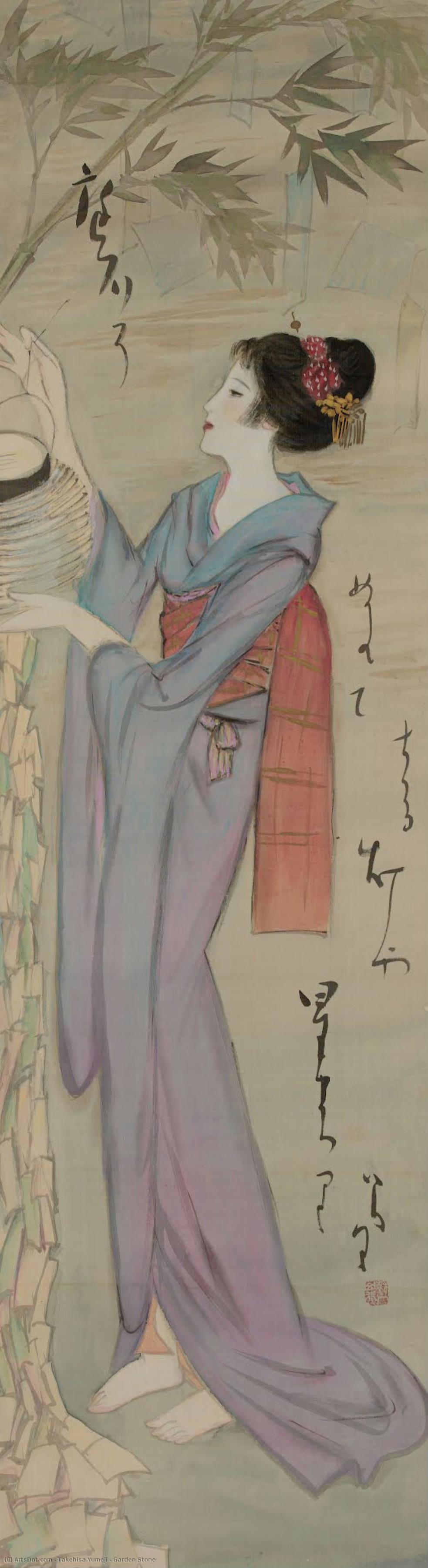
Skillful calligraphy of Yumeji’s famous haiku “Niwaishi ni nuretechiru hiya hoshi matsuri” is scattered across the screen. The “hoshi matsuri” (star festival) denotes the Tanabata festival. The court ceremony associated with a Chinese folklore where the stars Vega and Altair, representing Orihime and Hikoboshi, cross the Milky Way to meet once a year became popular among general public in the Edo Period. This eventually developed into a custom to decorate bamboo grass with strips of fancy papers to wish for improvement of calligraphy and sewing skills. The haiku describes how garden rocks that have been splashed with water to cool down the atmosphere are glowing in the lamplight. This romantic scene also reminds us of a starry night sky. A young woman with a paper lantern walks up to the eaves to light up the decorated bamboo as dusk is falling. Although her figure is depicted unrealistically out of proportion, she is undeniably immensely beautiful. She is standing in a single layered kimono which is so thin that the red undergarment is showing through, and her kimono sleeves are pulled back. Yumeji disclosed his particularity in drawing hands and feet by saying, “Painters such as Utamaro and Shunsho draw women’s hands and feet terribly small to hide them. They did not know how much hands and feet express the person’s emotion.” (‘Kihen dansho’ “Bijutsu to Bungei 10” November 1917). Indeed the woman’s hands that lift the paper lantern and her bare plump feet are drawn lively and relatively large for her slender figure in this work.