The Soul’s Palette: Deconstructing “Hard in Soft” by Wassily Kandinsky
Wassily Kandinsky's "Hard in Soft," painted around 1927 during his pivotal period at the Bauhaus, isn’t merely a painting; it’s an architectural exploration of emotion rendered in color and form. Born amidst the intellectual ferment of early 20th-century Germany, this work represents a crucial bridge between Kandinsky's earlier Symbolist roots and his groundbreaking embrace of abstract art. It’s a piece that invites not just observation but deep contemplation, revealing layers of meaning woven into its deceptively simple composition.
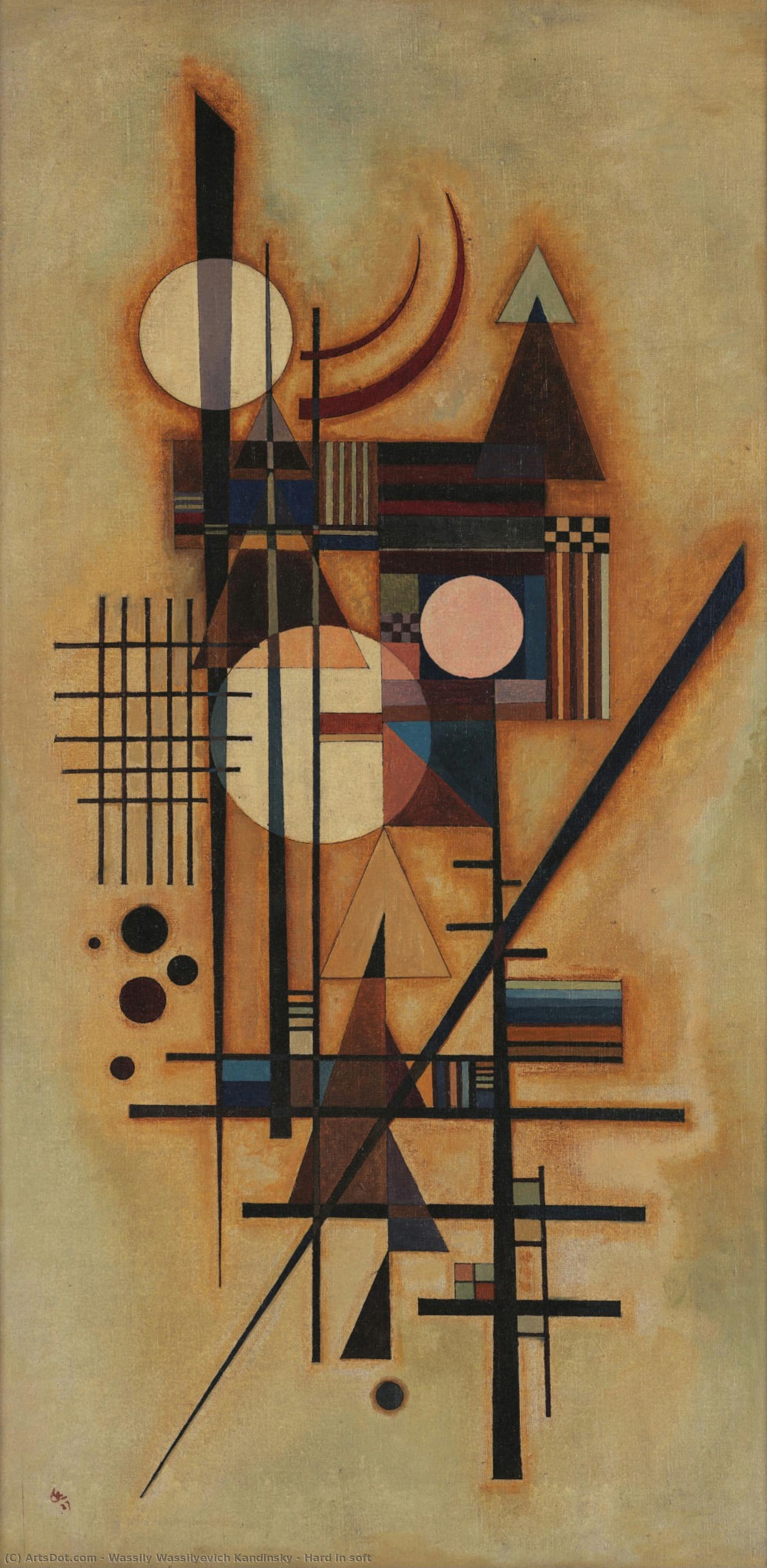
The painting immediately commands attention with its dynamic interplay of geometric shapes – circles, triangles, and lines – arranged within a predominantly blue and orange palette. These aren't static forms; they pulsate with an internal energy, suggesting movement and vibration. The central element, a large, milky-white circle bisected by a sharp-angled triangle, acts as a visual anchor, drawing the eye while simultaneously creating tension. This duality – “hard” and “soft,” angularity and circularity – is not merely aesthetic; it reflects Kandinsky’s core belief that art could directly evoke spiritual experience through the manipulation of color and form.
Bauhaus Roots and Spiritual Intent
Kandinsky's time at the Bauhaus, a revolutionary school of design in Weimar, profoundly shaped his artistic approach. The Bauhaus emphasized unity of art, craft, and technology, encouraging artists to explore new materials and techniques while retaining a focus on functional beauty. “Hard in Soft” embodies this spirit, utilizing bold colors and precise geometric forms – elements characteristic of the Bauhaus aesthetic – yet pushing beyond mere functionality towards a deeper expressive purpose. It’s a testament to Kandinsky's belief that art could transcend representation and communicate directly with the soul.
The painting’s creation coincided with a period of intense personal and artistic exploration for Kandinsky. He was grappling with questions about the relationship between color, music, and spirituality – concepts he would elaborate upon in his seminal 1926 treatise, “Concerning the Spiritual in Art.” The title itself, "Hard in Soft," hints at this central preoccupation: a simultaneous acknowledgment of opposing forces—the tangible and the ethereal, the concrete and the abstract—that contribute to the richness of human experience. It’s as if Kandinsky is attempting to capture the very essence of this dynamic interplay within a single visual composition.
Decoding the Symbolism
Beyond its formal qualities, “Hard in Soft” is rich with symbolic meaning. The circles, often associated with wholeness and unity, suggest a striving for harmony and completeness. The triangles, frequently representing spiritual aspiration or divine energy, point upwards towards a higher realm. The contrasting colors – the warm orange symbolizing vitality and passion, and the cool blue evoking tranquility and introspection – further amplify this sense of internal conflict and resolution.
Notably, the painting’s composition evokes a feeling of movement—a subtle but persistent flow from bottom to top. This directional quality mirrors Kandinsky's concept of “spiritual rhythm,” where color and form interact to create an emotional resonance within the viewer. The careful balance between these elements suggests that true beauty lies not in static perfection, but in the dynamic tension between opposing forces.
A Legacy of Abstract Expression
“Hard in Soft” stands as a pivotal work in Kandinsky’s oeuvre and a cornerstone of abstract expressionism. It demonstrates his mastery of color theory, geometric composition, and his profound understanding of the power of art to evoke emotion and spiritual experience. Reproductions of this piece offer a unique opportunity to engage with a seminal moment in modern art history—a glimpse into the mind of an artist who fundamentally altered our perception of what painting could be.