The Mocking of Ceres: A Baroque Dance of Power and Discontent
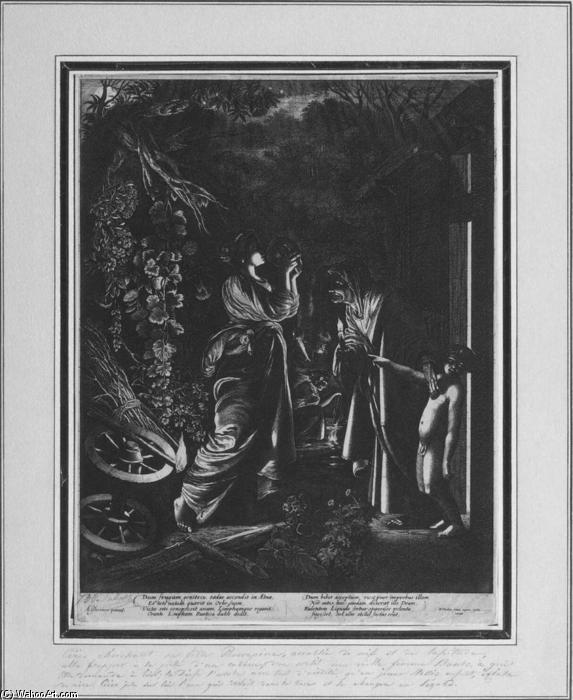
Wenceslaus Hollar’s “Stellion Insulting Ceres,” etched in 1646, is not merely a depiction of a classical myth; it's a meticulously crafted tableau brimming with psychological tension and subtle commentary on the precarious balance of power. Within the confines of the Hermitage Museum’s collection, this work transcends its subject matter to become a potent meditation on ambition, defiance, and the inherent vulnerability of authority. Hollar, a master of the Baroque era, elevates the narrative beyond simple illustration, transforming it into a complex visual argument rendered with astonishing detail and a masterful command of etching technique.
The scene itself is immediately arresting: Ceres, the Roman goddess of agriculture and harvest, sits regally upon a mound of grain – a symbol of her dominion over abundance. Yet, she’s not basking in triumph; instead, she appears besieged by Stellion, a youthful figure who aggressively confronts her with a pointed gesture. The composition isn't one of straightforward combat, but rather a carefully orchestrated dance of challenge and resistance. Hollar employs dramatic lighting – pools of shadow contrasting sharply with illuminated areas – to heighten the sense of drama and emphasize the figures’ postures. Notice how Ceres maintains an air of dignified composure despite the directness of Stellion’s attack; her gaze is fixed, resolute, while Stellion embodies youthful impudence and a blatant disregard for established order.
A Masterclass in Baroque Etching
Hollar's skill as an engraver is immediately apparent. The etching showcases his extraordinary ability to render texture and form with remarkable precision. The intricate details of the grain pile, the folds of Ceres’ robes, and even the individual strands of Stellion’s hair are rendered with painstaking accuracy. This level of detail wasn’t simply for aesthetic effect; it served to amplify the sense of realism and immediacy within the scene. The use of *cross-hatching*, a technique fundamental to etching, creates a rich tapestry of tones and shadows, adding depth and volume to the figures and background elements. Furthermore, Hollar expertly manipulated the line quality – varying the thickness and pressure applied to the metal plate to create subtle shifts in value and texture, contributing significantly to the overall atmospheric effect.
The choice of medium itself is significant. Etching, a subtractive process involving acid biting into a metal plate, allowed Hollar to achieve an unparalleled level of detail and tonal control. It was particularly well-suited for depicting complex scenes with intricate patterns and textures – qualities that are abundantly present in “Stellion Insulting Ceres.” The result is a work that feels both meticulously crafted and remarkably alive.
Myth, Power, and the Seeds of Rebellion
The myth underpinning this etching—the story of Stellion’s audacious insult to Ceres – provides a framework for interpreting the artwork's deeper meanings. Stellion, often identified as a young satyr or mischievous god, represents youthful rebellion and a challenge to established authority. His act of defiance is not presented as heroic; rather, it’s depicted with a certain impudence, suggesting a disregard for tradition and social norms. Ceres, on the other hand, embodies the established order – the stability and prosperity that are threatened by such challenges.
However, Hollar doesn't offer a simplistic moral judgment. The scene is imbued with ambiguity; it’s not clear whether Stellion’s actions are entirely justified or simply foolish. The etching subtly suggests that even established power can be vulnerable to disruption and that youthful defiance, while potentially disruptive, may also hold the seeds of progress. It's a nuanced portrayal of power dynamics, reflecting the turbulent political and social climate of 17th-century Europe.
A Timeless Resonance: Symbolism and Emotional Impact
Beyond its historical context, “Stellion Insulting Ceres” resonates with timeless themes of conflict, ambition, and the struggle for dominance. The image’s enduring appeal lies in its ability to evoke a range of emotions – from admiration for Hollar's technical mastery to contemplation on the complexities of human interaction. The scene’s inherent tension—the clash between established authority and youthful rebellion—continues to captivate viewers centuries after it was created.
Reproductions of this artwork offer an exceptional opportunity to bring its intricate details and evocative atmosphere into any interior space. The rich tonal range and dramatic lighting create a focal point that commands attention, while the subtle symbolism invites ongoing interpretation. Whether displayed in a grand salon or a more intimate setting, “Stellion Insulting Ceres” remains a powerful testament to Hollar’s artistic genius and a captivating window into the complexities of human nature.