 Ver en contexto
 Enviar
 Compartir
 Detalles

 Descargar
 Similares
 Radiografía
 Presentación de diapositivas
A Young Woman and Her Little Boy
 Oil On Panel
- Mannerism
 1540
1540- Renaissance
 135.0 x 111.0 cm
 Ver más
Reproducción al óleo hecha a mano
Óleo sobre lienzo pintado a mano en el tamaño y marco de su elección, realizado por encargo por nuestros artistas. ( Comprar impresión Comprar imagen)




P118B $10

P118H $10

P118W $10

P438Z $10

P508JH $12

P508YH $12

P805H $10

P805Z $10

P919BZ $10

P919G $10

P919XJ $10

P959ZH $10

P968JZ $12

W106C $8

W218G $10

W218JH $8

W218Y $10

W307PJ $10

W316G $10

W316PJ $8

W316Y $10

W398PJ $8

W4111J $10

W500HY $15

W500JH $15

W692G $12

W849H $8

W940BG $15

W953PJ $8




Elija entre nuestros tamaños predefinidos que respetan las proporciones originales de la obra.

Puede ingresar sus propias dimensiones para adaptarse a un marco o espacio específico. Si el tamaño seleccionado no coincide con las proporciones de la imagen original, recortaremos la obra o extenderemos la pintura con elementos adicionales pintados a mano. Se le enviará una maqueta digital para su aprobación antes de comenzar la producción.
Tenga en cuenta que la vista previa en pantalla no refleja el recorte o la extensión reales. Solo la maqueta mostrará con precisión la composición final.
Si bien existen tamaños personalizados, recomendamos seleccionar una dimensión de la lista predefinida para preservar las proporciones originales.
Tras realizar el pedido, el equipo de ArtsDot.com enviará un correo electrónico al cliente para solicitar instrucciones y proporcionarle una vista previa del boceto.
Envío a todo el mundo () en 3-4 semanas en lugar de las 5 semanas estándar. (25 agosto). Sin comprometer la calidad.

Envío exprés gratuito a todo el mundo

Lienzo de lino de alta calidad

Seguro de envío total

Garantía de reembolso de impuestos aduaneros

Garantía de fidelidad cromática exacta

Política de devolución de 60 días (solo por defectos)

Garantía de devolución del 100% del dinero

Descuento por cantidad
 La opción de vidrio solo está disponible en tamaños inferiores a 110 cm.

A Young Woman and Her Little Boy
Técnica de reproducción
Dimensiones de la reproducción
-


Precio total final
$ 263
Descripción de la obra
A Vision of Florentine Elegance
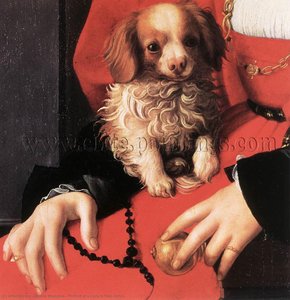
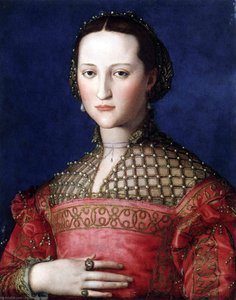
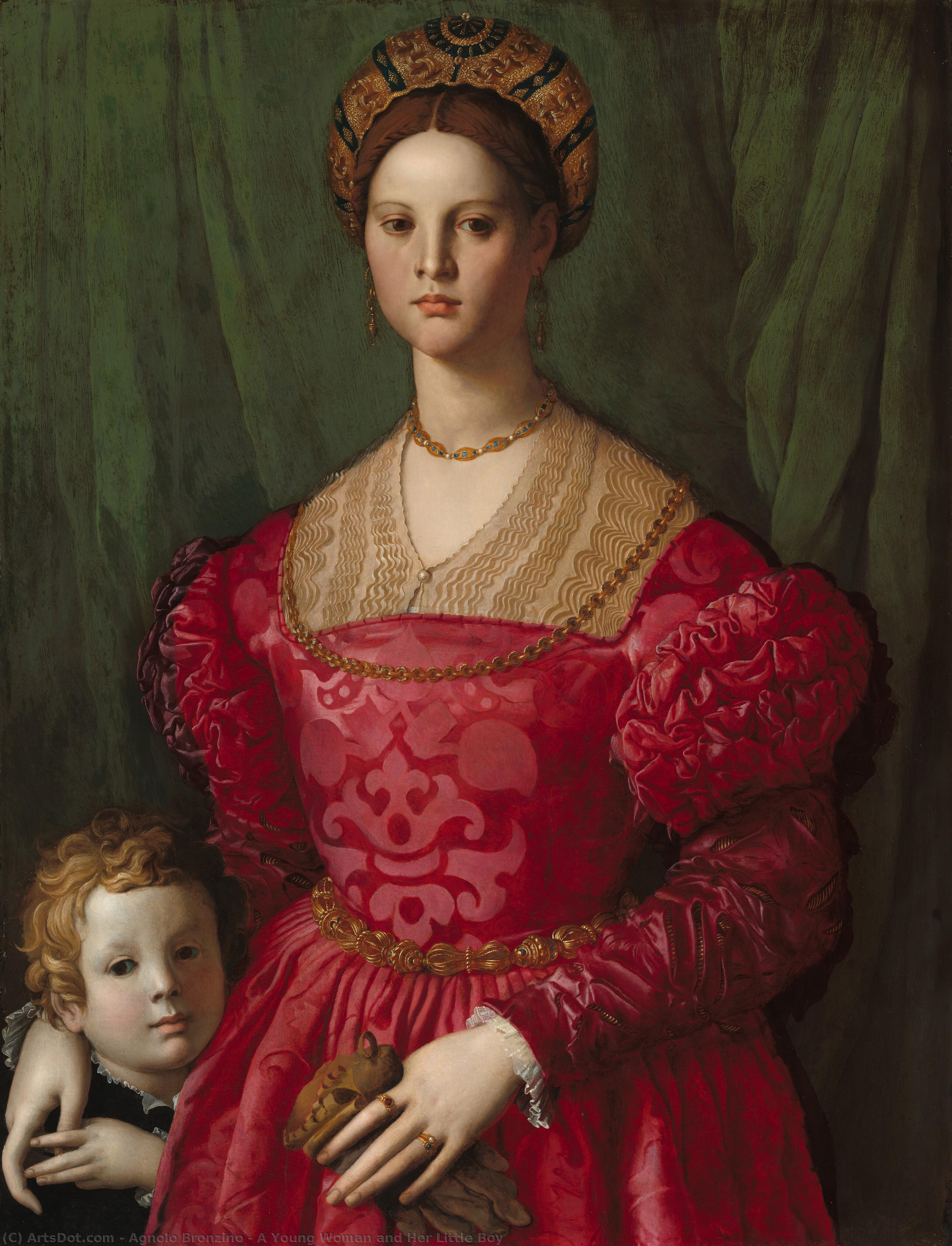
In the grand tradition of the Italian Renaissance, few works capture the intersection of maternal tenderness and aristocratic poise as exquisitely as Agnolo Bronzino’s A Young Woman and Her Little Boy. Painted around 1540, this masterpiece serves as a breathtaking window into the sophisticated world of the Florentine Mannerist court. The portrait presents a striking duo: a woman of commanding presence, draped in a sumptuous crimson-red brocade dress, and a young boy who rests near her side, his small hand reaching up to connect with hers. There is an immediate, magnetic pull to the composition, as the subjects gaze directly at the viewer with a serene, almost porcelain-like stillness that defines the era's aesthetic ideals.
The artistry of Bronzino is nothing short of virtuosic. As a master of Mannerism, he moves away from the soft, atmospheric shadows of his predecessors to embrace a style characterized by sharp clarity, polished surfaces, and an almost sculptural precision. The texture of the woman’s gown—rich with gold embroidery and intricate slashes in the sleeves—is rendered with such meticulous detail that one can almost feel the weight of the heavy fabric. Her skin possesses a luminous, marble-like quality, a hallmark of Bronzino’s technique, which lends the figures an air of eternal, frozen perfection. This cool, controlled execution is balanced by the vibrant contrast of the emerald-green curtain behind them, creating a chromatic depth that breathes life into the vertical panel.
Symbolism and the Language of Status
Every element within this portrait serves as a silent narrator of social standing and familial legacy. The woman’s attire is a deliberate display of wealth and power; her turban, densely embroidered with gold, and the heavy gold chains resting against her throat and chest, signal her high-ranking status within the Medici-era social hierarchy. Even the brown leather glove held in her left hand acts as a subtle symbol of refinement and nobility. Through these carefully curated details, Bronzino does more than capture a likeness; he constructs an icon of prestige.
Yet, beneath this layer of opulent artifice lies a profound emotional resonance. The physical connection between the mother and child—her hand resting protectively on his shoulder—softens the rigid formality of the courtly portrait. This tender gesture introduces a human element to the otherwise austere setting, suggesting a narrative of lineage and continuity. For the collector or the lover of fine art, this piece offers a rare duality: it is both a rigorous study of 16th-century fashion and a timeless meditation on the bond between generations.
An Inspiration for the Modern Interior
For interior designers and connoisseurs of classical beauty, a high-quality reproduction of this work offers an unparalleled opportunity to introduce a sense of historical gravity and sophisticated drama to a space. The bold palette of crimson, gold, and emerald provides a commanding focal point that complements both traditional period rooms and contemporary minimalist settings. Because the painting possesses such a strong verticality and structured composition, it functions beautifully as a statement piece in a gallery wall or as a standalone anchor in a formal study.
Owning a reproduction of Bronzino’s work is not merely about decorating a wall; it is about inviting the refined elegance of the Florentine Renaissance into the modern home. The painting’s ability to evoke feelings of stability, luxury, and quiet contemplation makes it an enduring choice for those seeking to surround themselves with art that possesses both intellectual depth and aesthetic splendor.
Obras relacionadas
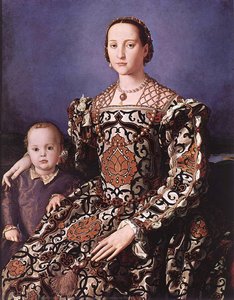
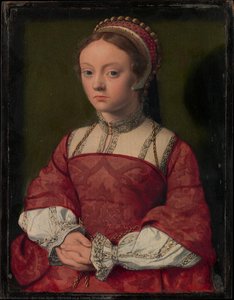
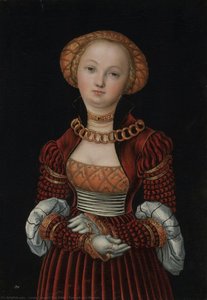
Biografía del artista
Primeros años y formación
Agnolo di Cosimo, conocido como Bronzino, nació en Florencia, Italia, el 17 de noviembre de 1503. Era hijo de un carnicero y comenzó su formación artística con Raffaellino del Garbo, seguido por un aprendizaje con Pontormo, un destacado pintor manierista.Estilo artístico e influencias
El estilo de Bronzino se caracteriza por figuras elegantes, calmadas y reservadas, a menudo carentes de la agitación y emoción que se encuentran en las obras de su maestro, Pontormo. Sus retratos, particularmente los de la élite florentina, son reconocidos por su minuciosa atención al detalle y han influido en el retrato cortesano europeo durante siglos.Obras destacadas
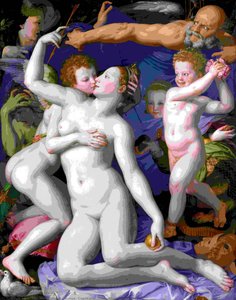
- Venus, Cupido, Falsedad y Tiempo (c. 1544-45), ahora en la Galería Nacional de Londres
- Retratos de Cosimo I de' Medici y su esposa Eleonora di Toledo, que muestran la maestría de Bronzino en el retrato manierista
- Retratos idealizados de los poetas Dante (c. 1530, ahora en Washington, D.C.) y Petrarca
Legado y vida posterior
Bronzino se convirtió en el pintor oficial de la corte del duque de Toscana y permaneció en esta posición durante la mayor parte de su carrera. Fue miembro fundador de la Accademia delle Arti del Disegno en Florencia en 1563. Bronzino falleció el 23 de noviembre de 1572, en Florencia.- Vea más obras de Agnolo Bronzino en https://ArtsDot.com/@/agnolo_bronzino
- Explore el movimiento artístico barroco florentino y su influencia en el arte occidental en https://ArtsDot.com/@@/a@d3cpvx
- Descubra más sobre el movimiento artístico del Renacimiento italiano y su impacto en el arte occidental en /es/art/show/art-d3cpud-es/
Influencia y Evolución Artística
Bronzino, influenciado inicialmente por Pontormo y el manierismo temprano, desarrolló un estilo distintivo caracterizado por la frialdad emocional y una elegancia formal. Su obra evolucionó hacia una mayor claridad y precisión en los detalles, aunque mantuvo su enfoque en la representación idealizada de sus sujetos. Su habilidad para capturar la esencia del poder y la sofisticación cortesana lo convirtió en el retratista preferido de la familia Medici y otras figuras prominentes de la época. Su influencia se extendió por toda Europa, marcando una etapa importante en la historia del retrato cortesano.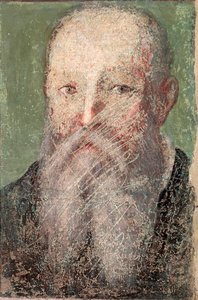
Agnolo Bronzino
1503 - 1572 , Italia
Datos clave
- Artistas Que Influyeron:
- Pontormo
- Raffaellino del Garbo
- Estilo Artístico: Manierismo
- Fecha De Fallecimiento: 23 de noviembre de 1572
- Fecha De Nacimiento: 17 de noviembre de 1503
- Influencia En Artistas: Escuela florentina, retrato cortesano
- Lugar De Nacimiento: Florencia, Italia
- Nacionalidad: Italiana
- Nombre Completo: Agnolo Bronzino
- Obras Notables:
- Venus, Cupido y el Tiempo
- Retratos de Cosimo I
- Retrato de Dante
- Retrato de Petrarca
Artículos relacionados
Golden Glow: How to Use Metallic Gold Artworks to Elevate Your Home Decor with Timeless Luxury
Discover how to elevate your home with the timeless elegance of metallic gold artworks. From sculptural metal pieces to gilded oil paintings, learn expert interior design tips for integrating luxurious gold accents into your space with sophistication and grace.
The Allure of Gold in Art History: Symbolism, Technique & Cultural Significance
Explore the rich history of gold in art! Discover symbolism, techniques & cultural significance from ancient civilizations to Klimt's masterpieces. Expert insights for collectors at ArtsDot.

Elegancia en el Arte: 10 Obras Maestras para un Hogar Sofisticado |
Descubre 10 obras maestras que definen la elegancia en el arte clásico. Explora la historia de artistas como Monet y Renoir, sus técnicas y paletas sofisticadas. Encuentra reproducciones de arte de museo para un hogar refinado en .

Crimson Threads of Narrative: Exploring Symbolism & Representation in Artworks Featuring the Red Dress
Explore the rich symbolism of the red dress in art history! From ancient power displays to iconic portraits like Cézanne’s 'Madame Cezanne', discover the cultural and artistic significance behind this captivating color. Expert analysis & insights.

Oro en el Arte: Los 10 Cuadros Más Famosos con Hoja de Oro | ArtsDot
Descubre los 10 cuadros más famosos con hoja de oro, desde Klimt hasta el arte bizantino. Explora la historia, técnica y belleza de estas obras maestras doradas. Reproducciones de arte exclusivas en ArtsDot.com.