 Ver en contexto
 Enviar
 Compartir
 Detalles

 Descargar
 Similares
 Radiografía
 Presentación de diapositivas
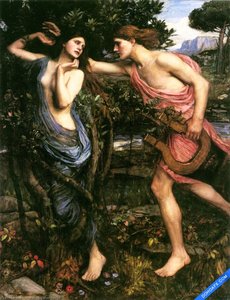
Apollon et Daphné


 Ver más
Reproducción al óleo hecha a mano
Óleo sobre lienzo pintado a mano en el tamaño y marco de su elección, realizado por encargo por nuestros artistas. ( Comprar impresión Comprar imagen)




P118B $10

P118H $10

P118W $10

P438Z $10

P508JH $12

P508YH $12

P805H $10

P805Z $10

P919BZ $10

P919G $10

P919XJ $10

P959ZH $10

P968JZ $12

W106C $8

W218G $10

W218JH $8

W218Y $10

W307PJ $10

W316G $10

W316PJ $8

W316Y $10

W398PJ $8

W4111J $10

W500HY $15

W500JH $15

W692G $12

W849H $8

W940BG $15

W953PJ $8




Elija entre nuestros tamaños predefinidos que respetan las proporciones originales de la obra.

Puede ingresar sus propias dimensiones para adaptarse a un marco o espacio específico. Si el tamaño seleccionado no coincide con las proporciones de la imagen original, recortaremos la obra o extenderemos la pintura con elementos adicionales pintados a mano. Se le enviará una maqueta digital para su aprobación antes de comenzar la producción.
Tenga en cuenta que la vista previa en pantalla no refleja el recorte o la extensión reales. Solo la maqueta mostrará con precisión la composición final.
Si bien existen tamaños personalizados, recomendamos seleccionar una dimensión de la lista predefinida para preservar las proporciones originales.
Tras realizar el pedido, el equipo de ArtsDot.com enviará un correo electrónico al cliente para solicitar instrucciones y proporcionarle una vista previa del boceto.
Envío a todo el mundo () en 3-4 semanas en lugar de las 5 semanas estándar. (27 agosto). Sin comprometer la calidad.

Envío exprés gratuito a todo el mundo

Lienzo de lino de alta calidad

Seguro de envío total

Garantía de reembolso de impuestos aduaneros

Garantía de fidelidad cromática exacta

Política de devolución de 60 días (solo por defectos)

Garantía de devolución del 100% del dinero

Descuento por cantidad
 La opción de vidrio solo está disponible en tamaños inferiores a 110 cm.

Apollon et Daphné
Técnica de reproducción
Dimensiones de la reproducción
-


Precio total final
$ 288
Descripción de la obra
A Dance of Desire and Transformation: Francesco Albani’s “Apollo and Daphne”
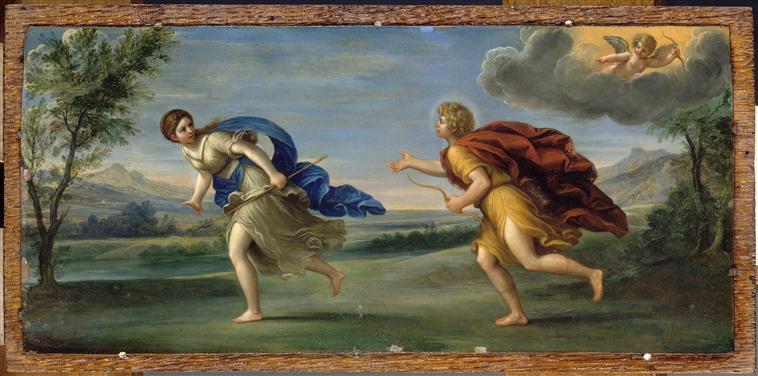
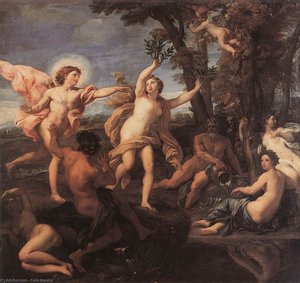
Francesco Albani's "Apollo and Daphne," painted circa 1640-1650, is more than just a mythological scene; it’s a vibrant distillation of Baroque drama, a testament to the artist’s mastery of light, movement, and emotional resonance. The painting captures a pivotal moment from Greek mythology – the pursuit of Apollo by Daphne, a nymph who, fearing his unwanted advances, transforms into a laurel tree. Albani doesn't simply depict the narrative; he embodies it with an intensity that draws the viewer directly into the heart of this timeless tale of desire, flight, and ultimately, acceptance.
Albani’s style is deeply rooted in the traditions of Roman painting while simultaneously embracing the dynamism and heightened emotion characteristic of the Baroque period. He skillfully blends classical composition with a dramatic use of chiaroscuro – the interplay of light and shadow – to create a palpable sense of urgency and movement. The figures are not static; they’re caught mid-stride, Apollo in a powerful, athletic pose, Daphne fleeing with desperate grace. This isn't a serene depiction of gods and nymphs; it’s a scene brimming with raw emotion, a chase fueled by both desire and terror.
A Symphony of Color and Form
The color palette is remarkably restrained yet powerfully effective. Earthy greens dominate the landscape, grounding the scene in a sense of naturalism, while browns and tans provide a subtle foundation for the figures’ clothing. Apollo's crimson cloak – a bold splash of vibrant red – immediately draws the eye, symbolizing his passionate pursuit. Daphne, conversely, is rendered in softer shades of white and blue, reflecting her transformation and her desperate attempt to escape. The artist masterfully uses color not just to represent reality but also to convey mood and emotion.
Albani’s technique showcases a remarkable understanding of line and shape. The flowing lines that define the drapery and foliage create a sense of movement, mirroring Daphne's flight. Curves are prevalent throughout the composition – in the graceful folds of Apollo’s cloak, the undulating branches of the trees, and even the subtle curves of the landscape itself. These organic forms contrast sharply with the more angular shapes of distant mountains, contributing to the painting’s overall sense of dynamism. The brushstrokes themselves are carefully considered, suggesting both texture and depth – rougher strokes for the ground and rocks, smoother ones for the figures' skin.
Symbolism Woven into a Myth
Beyond its narrative power, “Apollo and Daphne” is rich in symbolic meaning. The laurel tree, of course, represents Daphne’s transformation and her ultimate escape from Apollo’s unwanted attention. It becomes a symbol of resilience, beauty, and an acceptance of her fate. Apollo's pursuit embodies the relentless nature of desire, while Daphne’s flight speaks to the fear of vulnerability and the instinct for self-preservation. The inclusion of angels in the upper right corner adds another layer of interpretation, suggesting divine intervention or perhaps a commentary on the consequences of unchecked ambition.
The painting's emotional impact is profound. It evokes feelings of urgency, desperation, and even regret. We witness Daphne’s frantic flight, her terror at being pursued by a god. Apollo’s stance suggests a mixture of determination and perhaps a hint of sorrow – he desires her, yet his pursuit ultimately leads to her transformation. The scene resonates with universal themes of love, loss, and the struggle between desire and freedom.
A Masterpiece of Baroque Art
“Apollo and Daphne” is a quintessential example of Baroque art—a period defined by its dramatic intensity, emotional depth, and masterful use of light and shadow. Albani’s ability to seamlessly blend classical composition with Baroque dynamism results in a work that is both visually stunning and emotionally compelling. Reproductions of this painting capture the essence of its original power, offering a glimpse into a world of myth, desire, and transformation—a timeless testament to the enduring legacy of Francesco Albani.
Obras relacionadas

Biografía del artista
Albani Francesco, también conocido como l'albane, fue un destacado pintor italiano nacido en 1578 y activo hasta su muerte en 1660. Fue una figura clave en el desarrollo de la pintura barroca en Italia, particularmente en Roma.
Primeros años y formación
Francesco Albani nació en Bolonia, Italia, en una familia de artistas. Su padre, Daniele Albani, era pintor, y su tío, Giovanni Paolo Cavagna, fue un artista renombrado. La formación temprana de Francesco tuvo lugar en el estudio de Denzio Ferrari, donde aprendió los fundamentos de la pintura. Más tarde, se trasladó a Roma para estudiar bajo la guía de Guidobaldo Gandolfi.Carrera artística
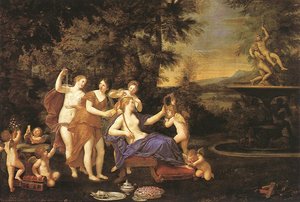
La carrera artística de Albani estuvo marcada por su estilo único, que fusionaba elementos del arte barroco y el clásico. Era conocido por sus hermosas y delicadas representaciones de escenas mitológicas y bíblicas. Una de sus obras más famosas es El Tocador de Venus, una pintura que exhibe su habilidad para capturar la belleza de la forma humana. Algunas de las obras notables de Albani incluyen:- El Bautismo de Cristo, una pintura que demuestra su capacidad para transmitir emoción y drama.
- San Sebastián, una obra que resalta su maestría con la luz y la sombra.
- La Virgen y el Niño con San Juan Bautista, una pintura que muestra su habilidad para capturar los matices de la expresión humana.
Influencia y legado
La influencia de Albani en el desarrollo de la pintura barroca en Italia fue significativa. Fue uno de los primeros artistas en introducir el uso del claroscuro, una técnica que enfatiza el contraste entre la luz y la oscuridad. Su obra también tuvo un impacto en el desarrollo de la pintura paisajística, ya que a menudo incorporaba paisajes naturales en sus composiciones. Hoy en día, las pinturas de Albani se pueden encontrar en varios museos, incluido el Museo del Louvre en París, donde está expuesto su El Tocador de Venus. Su obra también ha sido presentada en ArtsDot.com, donde los entusiastas del arte pueden aprender más sobre su vida y logros artísticos.Conclusión
Francesco Albani fue un pintor talentoso que dejó una marca indeleble en el mundo del arte. Su estilo único, que fusionaba elementos del arte barroco y clásico, continúa inspirando a artistas hoy en día. A través de su obra, podemos apreciar la belleza y el drama de la forma humana, así como la importancia de la luz y la sombra para crear una sensación de profundidad y emoción. Para más información sobre la vida y obra de Albani, visite ArtsDot.com o consulte su biografía en Wikipedia.
Francesco Albani (L'Albano)
1578 - 1660 , Italia
Artículos relacionados

Drama Barroca: Llevando la Grandeza y la Emoción a los Interiores Contemporáneos
Descubre cómo el drama y la grandeza del arte barroco pueden transformar tus interiores. Guía experta, inspiración y reproducciones de alta calidad en .

The Dramatic Flourish: Exploring the Baroque Movement's Enduring Legacy in Art History
Explore the dramatic world of Baroque art! Discover iconic artists like Caravaggio & Rubens, defining techniques, and its lasting impact on art history. Expert insights for collectors & enthusiasts at ArtsDot.

Barroco Sublime: 10 Obras Maestras que Definieron una Época |
Descubre las 10 obras maestras del Barroco que marcaron una época. Caravaggio, Bernini y Velázquez cobran vida en . Reproducciones de arte de calidad museo para decorar tu hogar con elegancia. ¡Explora la colección online!

The Visceral Stage: Exploring Dramatic Narratives & Emotional Intensity in Baroque Art
Explore the dramatic world of Baroque art! Discover iconic masters like Caravaggio & Rembrandt, their techniques, and the movement's lasting impact. Expert insights for collectors & enthusiasts at ArtsDot.
Echoes of Olympus: Mythological Narratives in Western Art Through the Ages
Explore the captivating history of mythological narratives in Western art! From ancient Greece to modern masterpieces, discover iconic artworks & symbolism. Expert analysis and high-quality reproductions at ArtsDot.