

 Ver en contexto
 Enviar
 Compartir
 Detalles

 Descargar
 Similares
 Radiografía
 Presentación de diapositivas
Français Christ en croix
 Early Netherlandish Renaissance
 1444
1444- Renaissance
 25.0 x 18.0 cm
 Museo del Louvre
 Ver más
Reproducción al óleo hecha a mano
Óleo sobre lienzo pintado a mano en el tamaño y marco de su elección, realizado por encargo por nuestros artistas. ( Comprar impresión Comprar imagen)




P118B $10

P118H $10

P118W $10

P438Z $10

P508JH $12

P508YH $12

P805H $10

P805Z $10

P919BZ $10

P919G $10

P919XJ $10

P959ZH $10

P968JZ $12

W106C $8

W218G $10

W218JH $8

W218Y $10

W307PJ $10

W316G $10

W316PJ $8

W316Y $10

W398PJ $8

W4111J $10

W500HY $15

W500JH $15

W692G $12

W849H $8

W940BG $15

W953PJ $8




Elija entre nuestros tamaños predefinidos que respetan las proporciones originales de la obra.

Puede ingresar sus propias dimensiones para adaptarse a un marco o espacio específico. Si el tamaño seleccionado no coincide con las proporciones de la imagen original, recortaremos la obra o extenderemos la pintura con elementos adicionales pintados a mano. Se le enviará una maqueta digital para su aprobación antes de comenzar la producción.
Tenga en cuenta que la vista previa en pantalla no refleja el recorte o la extensión reales. Solo la maqueta mostrará con precisión la composición final.
Si bien existen tamaños personalizados, recomendamos seleccionar una dimensión de la lista predefinida para preservar las proporciones originales.
Tras realizar el pedido, el equipo de ArtsDot.com enviará un correo electrónico al cliente para solicitar instrucciones y proporcionarle una vista previa del boceto.
Envío a todo el mundo () en 3-4 semanas en lugar de las 5 semanas estándar. (7 septiembre). Sin comprometer la calidad.

Envío exprés gratuito a todo el mundo

Lienzo de lino de alta calidad

Seguro de envío total

Garantía de reembolso de impuestos aduaneros

Garantía de fidelidad cromática exacta

Política de devolución de 100 días (solo por defectos)

Garantía de devolución del 100% del dinero

Descuento por cantidad
 La opción de vidrio solo está disponible en tamaños inferiores a 110 cm.

Français Christ en croix
Técnica de reproducción
Dimensiones de la reproducción
-


Precio total final
$ 263
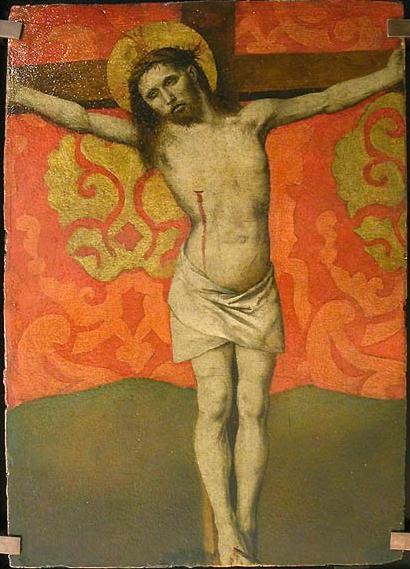
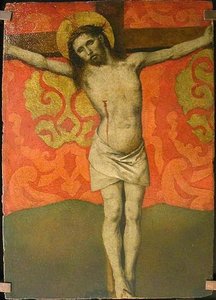
The Agony of the Divine: A Masterpiece of Devotion
In the quiet, profound stillness of Barthélemy d’Eyck’s Français Christ en croix, we are invited to witness one of the most visceral moments in Christian iconography. Created around 1444, this intimate work serves as a window into the soul of the Early Netherlandish period, where the boundaries between the earthly and the divine were blurred through meticulous detail and profound empathy. The painting captures the Crucifixion not merely as a historical event, but as an eternal, breathing moment of sacrifice. As Jesus hangs from the cross, his arms outstretched in a gesture that is simultaneously one of surrender and immense physical suffering, the viewer is drawn into a deep, meditative state. The artist’s ability to render the weight of the body and the raw reality of the wounds creates a sense of presence that is almost tactile, making the spiritual struggle feel intensely human.
The technical brilliance of d’Eyck is on full display in this composition, showcasing the revolutionary oil techniques that were defining the Northern Renaissance. Through the masterful use of light and shadow, the artist breathes life into the flesh, capturing the pallor of skin under duance and the subtle glisten of blood. The cross itself acts as a powerful structural element, spanning the width of the frame to anchor the composition and emphasize the vastness of the tragedy. Surrounding the central figure, the presence of secondary figures—witnesses to this cosmic event—adds layers of narrative complexity. These onlookers, rendered with the same precision as the Christ figure, provide a human mirror to the viewer's own grief, grounding the divine agony in a shared, recognizable reality.
For the discerning collector or interior designer, this piece offers more than just aesthetic beauty; it provides a profound emotional anchor for any space. The Français Christ en croix is a work of deep symbolism, where every drop of blood and every shadow carries weight, inviting contemplation and quiet reflection. Whether placed in a private study, a chapel-like library, or a curated gallery wall, a high-quality reproduction of this masterpiece brings an atmosphere of timelessness and reverence. It is a piece that demands attention not through loudness, but through its hauntingly beautiful ability to evoke empathy, making it an incomparable choice for those who seek art that speaks to the enduring strength of the human spirit and the sanctity of faith.
Obras relacionadas
Biografía del artista
The Silent Collaborator of Renaissance Vision
In the luminous tapestry of the Early Netherlandish period, certain names shine with an undeniable brilliance, while others linger in the soft shadows of history, their contributions felt through the profound beauty they left behind. Barthélemy d’Eyck is precisely such a figure—a master whose understated genius helped shape the visual language of the fifteenth century. Born around 1420 in the Netherlands, d’Eyck emerged during an era of unprecedented artistic revolution, a time when the mastery of oil painting was beginning to unlock new realms of realism and light. Though often overshadowed by the monumental legacies of Jan van Eyck and Rogier van der Weyden, d’Eyck’s hand is woven into some of the most significant artistic achievements of his age, acting as a vital bridge between the meticulous traditions of the North and the burgeoning courts of France and Burgundy.
The early life of d’Eyck remains shrouded in a certain historical mist, yet the traces of his training suggest a lineage of excellence. It is widely believed by scholars that he honed his formidable skills within the workshop of Jan van Eyck in Dijon. This apprenticeship would have been transformative, providing him with access to the revolutionary techniques of oil glazing—a method that allowed for an almost supernatural luminosity and a breathtaking attention to textural detail. Through this lineage, d’Eyk inherited a dedication to the microscopic observation of the world, a trait that would later define his ability to render the weight of fabric, the glint of metal, and the profound psychological depth of the human countenance.
A Legacy Written in Gold and Ink
While much of d’Eyck's work is identified through stylistic attribution rather than explicit signatures, his presence is most vibrantly felt in the delicate world of illuminated manuscripts. He is frequently recognized as the Master of René of Anjou, a title that speaks to his role as a premier chronicler of the soul for one of the era's most influential patrons. His work on the London Hours of René of Anjou stands as a testament to his ability to marry grand narrative with intimate emotion. In these miniature masterpieces, d’Eyck did not merely decorate parchment; he breathed life into the pages, capturing the turbulent personal history and the spiritual reflections of his patron with an emotional resonance that few of his contemporaries could match.
Beyond the confines of manuscripts, d’Eyck's prowess extended to monumental panel paintings. His ability to manipulate light and shadow—leading some to associate him with the Master of the Shadows—is evident in works that demand a meditative gaze. Consider the following hallmarks of his artistic output:
- Still Life with Books in a Niche (1442-1445): A breathtaking display of perspective and texture, where the artist invites the viewer into a quiet, scholarly sanctuary, rendering every edge of paper and grain of wood with startling clarity.
- Français Christ en croix: An intimate and visceral exploration of the Crucifixion, where the boundaries between the earthly and the divine blur through a profound sense of empathy and physical realism.
- Portraiture: His ability to capture the psychological complexities of his subjects, imbuing even the most formal portraits with a sense of living, breathing presence.
The Enduring Echo of a Master
The historical significance of Barthélemy d’Eyck lies in his role as a silent architect of the Northern Renaissance. He was an artist of movement and transition, working across the landscapes of France, Burgundy, and the Netherlands, carrying the technical innovations of the Flemish masters into new territories. His work represents a moment in art history where the meticulousness of the medieval tradition met the burgeoning humanism of the Renaissance, creating a style that was both deeply symbolic and strikingly real.
Though his life ended after 1470, leaving behind a legacy that is often reconstructed through the careful study of anonymous masterpieces, his impact remains indelible. To look upon a work attributed to d’Eyck is to witness the dawn of a new way of seeing—a way that finds the infinite within the infinitesimal and the divine within the details of our everyday world. He remains a vital, if quiet, cornerstone of the Netherlandish tradition, reminding us that true greatness often resides in the subtle, masterful strokes that define the edges of history.
barthélemy d'eyck
1420 - 1475 , Netherlands
Datos clave
- Artistic Movement Or Style: Early Netherlandish
- Artists Or Movements Influenced By This Artist: ['Renaissance Painting']
- Artists Who Influenced This Artist: ['Jan van Eyck']
- Date Of Death: 1475
- Full Name: barthélemy d'Eyck
- Nationality: Dutch
- Notable Artworks:
- Still Life with Books in a Niche
- Holy Family
- Portrait of a Man
- Place Of Birth: Netherlands
Artículos relacionados
Fra Angelico: Las 25 Obras Maestras del Renacimiento para Decorar con Arte y Fe
Descubre las 25 obras maestras de Fra Angelico, el pintor renacentista que llenó el arte sacro de luz y fe. Explora su técnica, simbolismo y belleza en frescos e iconos. Encuentra reproducciones de alta calidad para decorar tu hogar con ArtsDot.com.

Los 10 Maestros del Primitivo Flamenco: Obras que Definen un Arte Inigualable | ArtsDot
Descubre los 10 imprescindibles del Primitivo Flamenco: Jan van Eyck, Robert Campin y más. Explora la historia, simbolismo y técnica de estas obras maestras renacentistas tempranas. Encuentra reproducciones de arte de museo en ArtsDot.com.
Jan Gossart: Bridging Netherlandish Realism & Renaissance Humanism – A Comprehensive Exploration
Explore the captivating world of Jan Gossart, a pivotal figure bridging Netherlandish realism & Renaissance humanism. Discover his masterpieces, patronage, and lasting influence – an essential guide for discerning art collectors.
Henri Edmond Cross: A Pioneer of Neo-Impressionism & the Divisionist Aesthetic
Explore the life & art of Henri Edmond Cross, a pivotal Neo-Impressionist painter. Discover his innovative divisionist technique, political affiliations, and lasting influence on modern art movements like Fauvism. Learn about key works & legacy.
Los 25 Tesoros del Museo Británico: Arte, Historia y Decoración Excepcional
Descubre los 25 tesoros del Museo Británico: desde la Piedra Rosetta hasta obras de Rembrandt y Van Gogh. Explora su historia, técnica y significado. Reproducciones de arte exclusivas en ArtsDot.com para decorar tu hogar con elegancia.