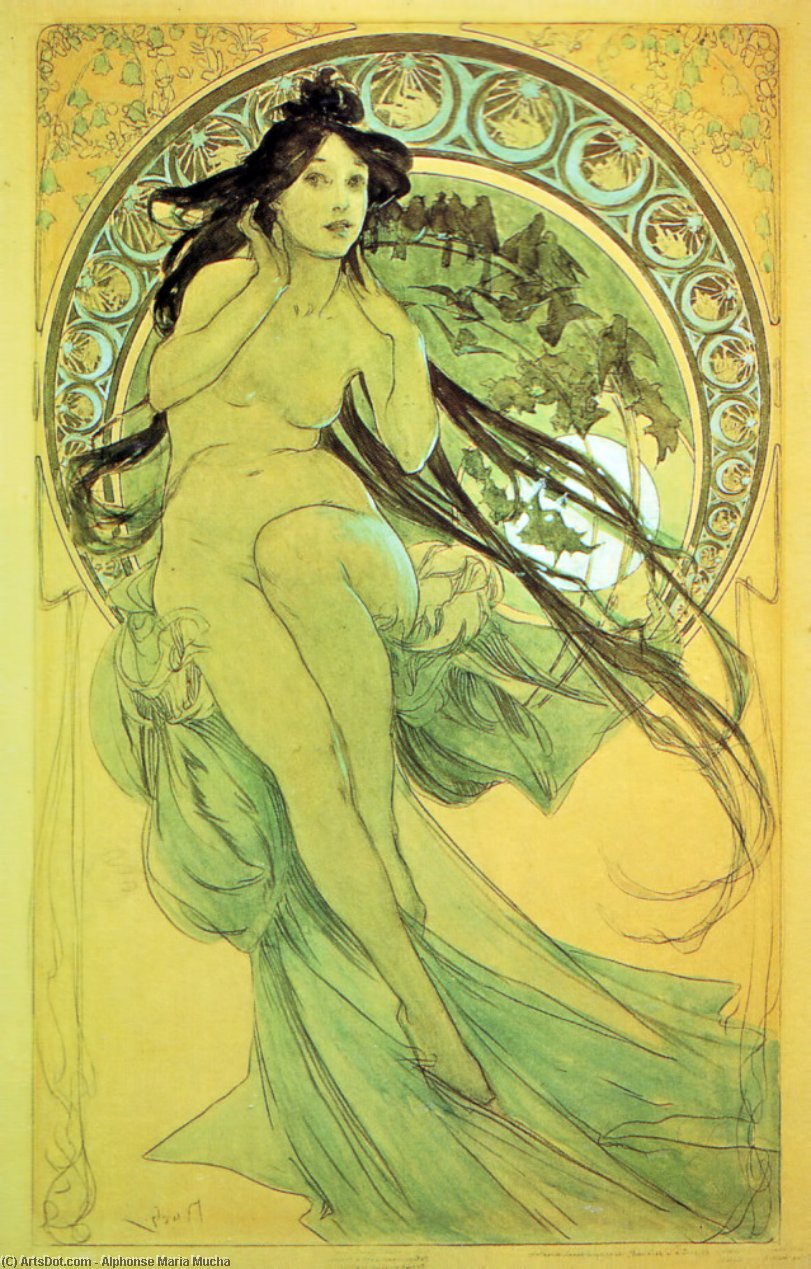
A Study in Graceful Movement: Mucha’s ‘Study for Music’
Alphonse Maria Mucha's “Study for Music,” a captivating work brimming with the hallmarks of his signature Art Nouveau style, invites us into a world where decorative elegance intertwines seamlessly with profound emotional resonance. This painting, though shrouded in some mystery regarding its precise creation date and dimensions – details currently unavailable to us – offers a potent glimpse into Mucha’s artistic process and his enduring fascination with idealized beauty and the evocative power of music itself. The image depicts a woman seated thoughtfully, her posture radiating both serenity and an underlying current of contemplation. Her flowing green dress, rendered in delicate brushstrokes, seems to ripple with movement, echoing the very ‘music’ for which the piece is named. The warm yellow background isn't merely a backdrop; it acts as a luminous embrace, intensifying the colors and contributing significantly to the painting’s overall atmosphere of quiet contemplation.
The Art Nouveau Vision: Mucha’s Influences and Techniques
Born in Brno, Czech Republic, in 1860, Alphonse Maria Mucha developed a unique artistic voice that would become synonymous with Art Nouveau. Rejecting the rigid academic traditions he encountered at the Academy of Fine Arts in Prague, Mucha embraced a more organic approach, heavily influenced by artists like Pierre-Auguste Renoir and Gustave Moreau. His work is characterized by its deliberate use of flowing lines, intricate ornamentation, and a profound appreciation for natural forms – particularly those found in flora and fauna. Notice the careful rendering of the woman’s drapery; it's not simply fabric but an extension of her form, imbued with a sense of movement and almost liquid grace. Mucha’s technique involved layering thin glazes of color, building up depth and luminosity that is characteristic of his most celebrated works. The subtle gradations in tone, particularly around the figure’s face and hands, contribute to the painting's ethereal quality.
Symbolism and Narrative within the Scene
Beyond its purely aesthetic qualities, “Study for Music” hints at deeper symbolic meanings. The presence of the other figures – a man in the background and two birds – adds layers of narrative complexity. The woman’s pose, with her legs crossed and head slightly tilted, suggests an act of listening, absorbed in the music she hears or perhaps composing it herself. The birds, frequently recurring motifs in Mucha's work, often represent freedom, inspiration, and the connection between humanity and nature. The necklace she wears could be interpreted as a symbol of adornment, but also potentially represents a link to tradition or heritage – themes prevalent in Mucha’s exploration of Czech identity through his art. The overall composition feels deliberately balanced, creating a sense of harmony and tranquility.
A Legacy of Beauty: Mucha's Impact and the Reproduction
Alphonse Maria Mucha’s influence on the Art Nouveau movement is undeniable, and “Study for Music” stands as a testament to his artistic genius. His work continues to inspire artists and designers today, demonstrating the enduring power of beauty, elegance, and emotional expression. ArtsDot.com offers a meticulously crafted hand-painted reproduction of this remarkable piece, allowing you to bring its captivating charm into your home or office. Each reproduction is created using archival quality materials and traditional techniques, ensuring that it faithfully captures the original’s delicate details and luminous color palette. This isn't just a print; it’s an investment in art history – a tangible connection to one of the most significant figures of the Art Nouveau era.