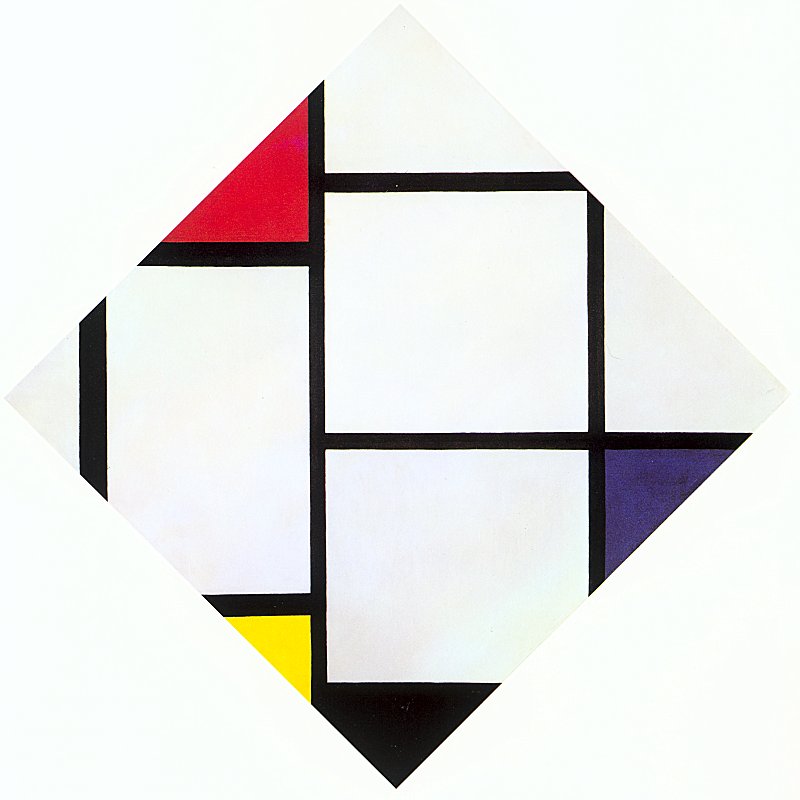
A Universe in Geometry: Deconstructing Piet Mondrian’s ‘25 Lozenge Composition with Red, Gray, Blue, Yellow, and Black’
Piet Mondrian's ‘25 Lozenge Composition with Red, Gray, Blue, Yellow, and Black’ is not merely a painting; it is a visual manifesto. Emerging from the crucible of early 20th-century artistic experimentation, this work embodies the core tenets of Neoplasticism – an aesthetic philosophy that sought to distill reality down to its most fundamental components: straight lines, primary colors, and a harmonious balance achieved through asymmetrical arrangements. To gaze upon it is to enter a world stripped bare of representational pretense, a realm where color and form exist in pure, unadulterated expression.
The Genesis of an Aesthetic Revolution
Born from Mondrian’s profound spiritual quest and his engagement with the burgeoning avant-garde scene in Paris, particularly Cubism, Neoplasticism represented a radical departure from traditional artistic concerns. Mondrian wasn't simply interested in *what* he painted, but *how*. He believed that by reducing art to its essential elements, he could express universal harmonies and reveal underlying spiritual truths. The move towards abstraction was not arbitrary; it was a deliberate process of elimination, shedding the superfluous to arrive at a purer form of visual communication. His earlier explorations in landscapes and Impressionism served as crucial stepping stones, gradually leading him away from depicting the external world toward constructing an internal one governed by logic and balance. The lozenge format itself – a diamond shape rotated within the square canvas – was a deliberate choice, rejecting the conventional rectangular frame and introducing a dynamic tension that further destabilizes any sense of static order.
A Symphony of Lines and Color
The composition is deceptively simple yet profoundly complex. Black lines, precise and unwavering, carve out a grid-like structure across the canvas, defining rectangles and squares of varying sizes. Within these geometric boundaries reside blocks of primary colors – red, yellow, and blue – alongside areas of white, gray, and black. There’s no blending, no shading, no attempt to mimic naturalistic light or texture. Each color is applied flatly, boldly asserting its presence within the composition. This deliberate lack of modulation creates a sense of clarity and intellectual rigor. The arrangement isn't symmetrical; instead, Mondrian masterfully employs an asymmetrical balance, creating visual interest and preventing the work from feeling rigid or predictable. The eye dances across the canvas, guided by the interplay of lines and colors, constantly seeking equilibrium within the deliberate imbalance.
Beyond the Visual: Symbolism and Emotional Resonance
While seemingly devoid of subject matter in the traditional sense, ‘25 Lozenge Composition’ is rich with symbolic meaning. The horizontal and vertical lines are often interpreted as representing opposing forces – masculine and feminine, static and dynamic – striving for harmony. The primary colors, unmixed and pure, symbolize fundamental energies and universal truths. Mondrian believed that through this reduction to essentials, he could transcend the particular and access a realm of spiritual universality. The emotional impact is one of serene order, intellectual clarity, and quiet contemplation. It’s not a painting designed to evoke dramatic passion or narrative storytelling; rather, it invites viewers to engage in a meditative experience, to find peace within its carefully constructed geometry, and to contemplate the underlying principles that govern our world. The enduring appeal of Mondrian's work lies in its ability to offer a sense of calm amidst chaos, a visual sanctuary in an increasingly complex world.
Technical Considerations: Mastering Minimalism
Mondrian’s technique was characterized by meticulous precision and unwavering dedication to his aesthetic vision. He employed oil paints on canvas with painstaking care, applying them thinly and evenly across the surface. The absence of brushstrokes is deliberate; Mondrian sought to eliminate any visible marks of artistic intervention, believing that they obscured the purity of form and color. Instead, he achieved a smooth, matte finish through careful layering and blending techniques—though these were minimized to achieve maximum impact.
The black lines defining the grid are executed with exceptional accuracy, utilizing brushes of consistent size and pressure. These lines are straight and unwavering, reflecting Mondrian’s commitment to geometric abstraction. The orientation of the lines contributes significantly to the overall balance of the composition, creating a dynamic tension that underscores the underlying harmony.
The color blocks—red, yellow, blue—are applied flatly without blending or shading. Each color is presented in its purest form, maximizing its visual intensity and conveying its symbolic significance. Mondrian’s meticulous attention to detail ensured that every element of the painting served a specific purpose within his broader conceptual framework.
Historical Context: Embracing De Stijl
‘25 Lozenge Composition’ emerged from the influential artistic movement known as De Stijl (The Style), founded by Mondrian and Theo van Doesburg in 1917. This movement championed a radical simplification of art, advocating for the use of only geometric forms—primarily squares and rectangles—and primary colors—red, yellow, and blue—along with black and white. De Stijl’s aesthetic principles were rooted in spiritual philosophy, reflecting Mondrian's belief that art could express universal harmonies and transcend earthly concerns.
Influenced by Cubism’s fragmentation of form and Cézanne’s exploration of spatial relationships, Mondrian sought to synthesize these approaches into a new visual language. He rejected representational imagery altogether, prioritizing abstraction as a means of conveying spiritual truth. De Stijl's impact extended beyond painting, influencing architecture, design, and typography—establishing a distinctive aesthetic that continues to inspire artists and designers today.
Mondrian’s unwavering dedication to his artistic vision solidified his legacy as one of the most important figures in modern art. His uncompromising pursuit of geometric purity and color harmony remains relevant to contemporary discussions about aesthetics and visual communication, demonstrating the enduring power of minimalist abstraction.