 Ver en contexto
 Enviar
 Compartir
 Detalles

 Descargar
 Similares
 Radiografía
 Presentación de diapositivas
Still life


 Ver más
Reproducción al óleo hecha a mano
Óleo sobre lienzo pintado a mano en el tamaño y marco de su elección, realizado por encargo por nuestros artistas. ( Comprar impresión Comprar imagen)




































Elija entre nuestros tamaños predefinidos que respetan las proporciones originales de la obra.

Puede ingresar sus propias dimensiones para adaptarse a un marco o espacio específico. Si el tamaño seleccionado no coincide con las proporciones de la imagen original, recortaremos la obra o extenderemos la pintura con elementos adicionales pintados a mano. Se le enviará una maqueta digital para su aprobación antes de comenzar la producción.
Tenga en cuenta que la vista previa en pantalla no refleja el recorte o la extensión reales. Solo la maqueta mostrará con precisión la composición final.
Si bien existen tamaños personalizados, recomendamos seleccionar una dimensión de la lista predefinida para preservar las proporciones originales.
Tras realizar el pedido, el equipo de ArtsDot.com enviará un correo electrónico al cliente para solicitar instrucciones y proporcionarle una vista previa del boceto.
Envío a todo el mundo () en 3-4 semanas en lugar de las 5 semanas estándar. (26 agosto). Sin comprometer la calidad.

Envío exprés gratuito a todo el mundo

Lienzo de lino de alta calidad

Seguro de envío total

Garantía de reembolso de impuestos aduaneros

Garantía de fidelidad cromática exacta

Política de devolución de 60 días (solo por defectos)

Garantía de devolución del 100% del dinero

Descuento por cantidad
 La opción de vidrio solo está disponible en tamaños inferiores a 110 cm.

Still life
Técnica de reproducción
Dimensiones de la reproducción
-


Precio total final
$ 263
Descripción de la obra
A Still Life Reverie: Exploring Francisco Zurbarán’s Quiet Majesty
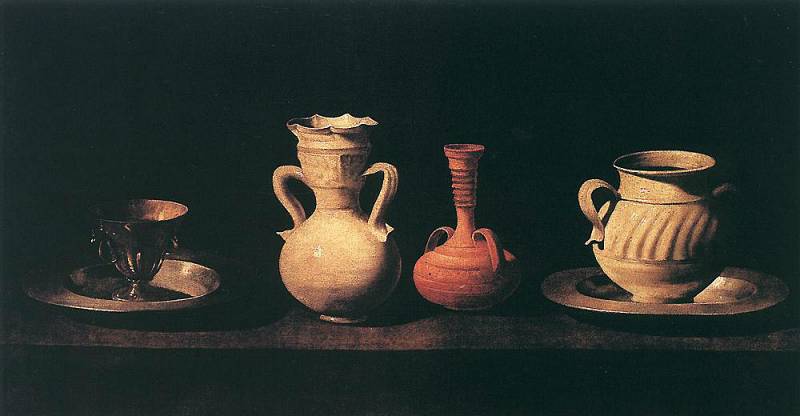
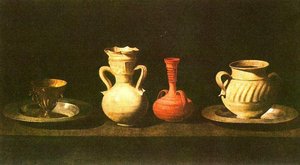
The photograph captures a masterful distillation of Baroque artistry—a single still life painting by Francisco de Zurbarán, executed sometime around 1630-1640. It's not an explosion of color or movement; rather, it’s a profound meditation on form and texture, achieved through Zurbaran’s unwavering dedication to realism and imbued with a palpable sense of spiritual contemplation. The image itself serves as a window into the artist’s world and invites us to consider the enduring power of understated beauty.The Composition & Visual Harmony
Zurbarán's approach is characterized by meticulous balance. He arranges a selection of earthenware vessels—primarily jugs and cups—upon a dark, almost obsidian surface. This deliberate simplicity isn’t merely aesthetic; it underscores the artist’s intention to elevate the commonplace into something transcendent. The horizontal orientation emphasizes stability and calm, mirroring the stillness that pervades the scene. Each vessel is positioned with careful consideration, creating a visual rhythm that guides the eye across the frame without overwhelming it. The symmetry reinforces this feeling of equilibrium, reflecting Zurbarán's belief in order and harmony as expressions of divine grace.Technique & Material Mastery: Oil Paint on Canvas
The painting’s impact stems directly from Zurbarán’s unparalleled skill with oil paint—a medium favored during the Spanish Golden Age for its ability to capture subtle nuances of light and texture. He employed a technique known as *sfumato*, blurring edges and softening contours to create an illusion of depth and atmosphere. This masterful manipulation of pigment allows for an astonishing level of detail, particularly evident in the depiction of the earthenware’s surface. The artist painstakingly rendered the rough, pitted textures of the vessels, conveying not just visual accuracy but also a tactile sensation that transports the viewer into the studio alongside Zurbarán. Layers upon layers of translucent glaze build up to create luminous highlights and deepen the shadows, enhancing the painting's dramatic effect despite its muted palette.Historical Context & Spiritual Significance
Zurbarán’s work emerged during a period marked by intense religious fervor—the Counter-Reformation—and reflects the Catholic Church’s desire for art that instilled piety and moral virtue. Still lifes like this were frequently employed as didactic devices, intended to inspire viewers with reflections on mortality and the importance of faith. The dark background serves as a foil to the pale earthenware, emphasizing their luminosity and highlighting the artist's preoccupation with spiritual themes. Beyond its religious symbolism, however, the painting speaks to a broader humanist concern for capturing the beauty inherent in everyday life—a testament to Zurbarán’s belief that God dwells within even the simplest of creations.Emotional Resonance & Artistic Legacy
The photograph captures not just an image but also an emotion—a quiet reverence for stillness and contemplation. Viewing this piece evokes a feeling of serenity, prompting us to consider the profound impact of visual art on our inner lives. Zurbarán’s legacy extends far beyond his technical prowess; he established himself as one of the foremost painters of his time, influencing generations of artists who followed him. His unwavering commitment to realism combined with an exquisite sensitivity to light and texture continues to inspire admiration and awe—a testament to the enduring power of art to transcend temporal boundaries and communicate timeless truths about beauty and spirituality.Obras relacionadas
Biografía del artista
vida temprana y formación
francisco de zurbarán, un destacado pintor español, nació en 1598 en Extremadura, España. Su viaje artístico comenzó bajo la guía de alejandro de la mina, pero fue su tiempo con alonso de najera quien verdaderamente moldeó su estilo barroco.carrera artística y obras notables
La obra de Zurbarán se caracteriza por el uso dramático de la luz y la sombra, una técnica conocida como tenebrismo. Esto puede verse en el sudario de Santa Verónica, un cuadro que muestra su maestría sobre el medio. *- La Inmaculada Concepción (c. 1635), un ejemplo primario del trabajo temprano de Zurbarán, se encuentra ahora en el Museo de Bellas Artes, Bilbao.
- El Águila Divina (c. 1640), un poderoso símbolo de devoción religiosa, forma parte de la colección del Metropolitan Museum of Art.
- El tema apócrifo de la aparición de la Virgen a San Juan, otra pieza notable, demuestra su capacidad para equilibrar la luz y la oscuridad.
legado e influencia
La influencia de Zurbarán en el barroco español es innegable. Su uso del claroscuro ha inspirado a generaciones de artistas. El círculo de Francisco de Zurbarán, un grupo de artistas influenciado por su obra, continuó ampliando los límites del tenebrismo. * puntos clave: * Activo en Sevilla, España, desde 1614. * Conocido por la iluminación dramática y la intensa profundidad emocional. * Influyó en numerosos pintores barrocos españoles.conclusión
El legado de Francisco Zurbarán es un testimonio del poder perdurable del arte barroco. Su innovador uso de la luz y la sombra ha dejado una marca indeleble en el mundo del arte, inspirando a innumerables artistas y consolidando su lugar en la historia. * lectura adicional: * [https://ArtsDot.com/@/francisco-zurbaran](https://ArtsDot.com/@/francisco-zurbaran) - explore más obras de Zurbarán en ArtsDot. * [https://wikipedia.org/wiki/francisco_de_zurbarán](https://wikipedia.org/wiki/francisco_de_zurbarán) - profundice en la vida y las influencias del artista.
Francisco de Zurbarán
1598 - 1664 , España
Datos clave
- Artistas Que Influyeron:
- Alejandro de la Mina
- Alonso de Najera
- Juan Sánchez Cotán
- Estilo Artístico: Barroco
- Fecha De Muerte: 1664
- Fecha De Nacimiento: 1598
- Influencia En Artistas: Círculo de Zurbarán
- Lugar De Nacimiento: Fuente de Cantos, España
- Nacionalidad: Española
- Nombre Completo: Francisco de Zurbarán
- Obras Notables:
- Inmaculada Concepción
- Agnus Dei
- Sudario de Santa Verónica
Artículos relacionados
The Golden Age Reforged: Dramatic Realism & Religious Zeal in Spanish Baroque Art
Explore the dramatic world of Spanish Baroque art! Discover masters like Zurbarán & the powerful influence of religious zeal on painting techniques – a guide for collectors and enthusiasts.
Francisco de Zurbarán: Mysticism, Realism & the Golden Age of Spanish Painting
Explore the captivating world of Francisco de Zurbarán, a master of Spanish Baroque painting. Discover his dramatic tenebrism, religious masterpieces like 'La Porciúncula,' and lasting influence on art history.

Los 10 Maestros del Siglo de Oro Holandés: Arte, Historia y Decoración Exclusiva
Descubre los 10 imprescindibles del Siglo de Oro Holandés: Rembrandt, Vermeer y más. Explora la historia, técnica y belleza de estos lienzos clásicos. Encuentra reproducciones de arte exclusivas para decorar tu hogar en .

Reflejos de una Época Dorada: La Pintura Barroca Holandesa y la Innovación Cultural
Descubra la riqueza y el detalle de la pintura barroca holandesa del Siglo de Oro. Explore las obras maestras de Rembrandt, Vermeer y otros artistas clave. Análisis experto e historia cultural.
The Enduring Appeal of Still Life: A Historical & Contemporary Exploration
Explore the rich history & symbolism of still life painting with ArtsDot. Discover masterpieces from the Dutch Golden Age, learn about vanitas art, and find expert guidance for collecting timeless artworks.