 Ver en contexto
 Enviar
 Compartir
 Detalles

 Descargar
 Similares
 Radiografía
 Presentación de diapositivas
 Stats
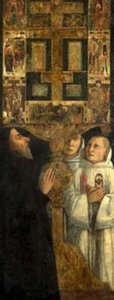
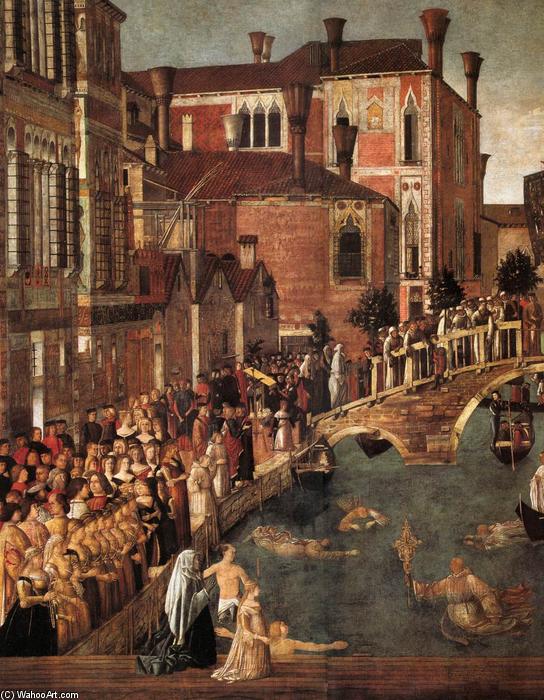
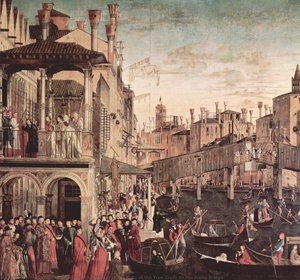
StatsMiracle of the Cross at the Bridge of San Lorenzo (detail)


 Ver más
Giclée / Impresión de arte
Impresiones giclée o en lienzo de calidad de museo con producción rápida y opciones de acabado flexibles. ( Comprar pintura hecha a mano Switch to Digital Image)




P118B $10

P118H $10

P118W $10

P438Z $10

P508JH $12

P508YH $12

P805H $10

P805Z $10

P919BZ $10

P919G $10

P919XJ $10

P959ZH $10

P968JZ $12

W106C $8

W218G $10

W218JH $8

W218Y $10

W307PJ $10

W316G $10

W316PJ $8

W316Y $10

W398PJ $8

W4111J $10

W500HY $15

W500JH $15

W692G $12

W849H $8

W940BG $15

W953PJ $8




Elija entre nuestros tamaños predefinidos que respetan las proporciones originales de la obra.

Puede introducir sus propias dimensiones para adaptarse a un marco o espacio específico. Si el tamaño seleccionado no coincide con las proporciones de la imagen original, recortaremos la obra de arte o extenderemos la imagen con un borde con efecto espejo o de color sólido. Se enviará una maqueta digital para su aprobación antes de que comience la producción.
Tenga en cuenta que la vista previa en pantalla no refleja el recorte o la extensión real. Solo la maqueta mostrará con precisión la composición final.
Aunque existen tamaños personalizados, recomendamos seleccionar una dimensión de la lista predefinida para preservar las proporciones originales.
Envío a todo el mundo () en 2 semanas en lugar de las 4/5 semanas estándar. (8 septiembre)

Envío exprés gratuito a todo el mundo

Lienzo de lino de alta calidad

Seguro de envío total

Garantía de reembolso de impuestos aduaneros

Garantía de fidelidad cromática exacta

Política de devolución de 100 días (solo por defectos)

Garantía de devolución del 100% del dinero

Descuento por cantidad
 La opción de vidrio solo está disponible en tamaños inferiores a 110 cm.

Miracle of the Cross at the Bridge of San Lorenzo (detail)
Giclée / Impresión de arte
Dimensiones de la reproducción
-


Precio total final
$ 62
A Venetian Drama Painted in Light and Sorrow
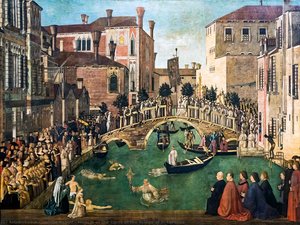
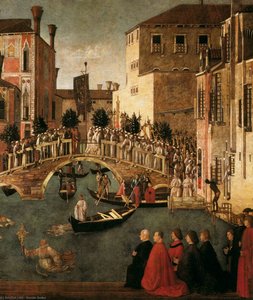
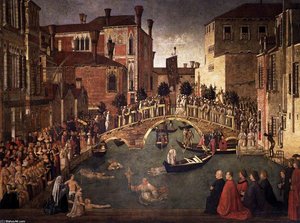
Gentile Bellini’s “Miracle of the Cross at the Bridge of S. Lorenzo,” completed around 1500, isn't merely a depiction of a historical event; it’s a profound meditation on faith, mortality, and the vibrant pulse of Renaissance Venice. This monumental tempera painting, now residing in the Gallerie dell’Accademia, transports us to a bustling canal scene, dominated by the dramatic rescue of a fragment of the Holy Cross – an event that resonated deeply within the city's religious life.
The painting unfolds against the backdrop of the Bridge of San Lorenzo, a crucial artery in Venice’s intricate network of waterways. Bellini masterfully captures the chaotic energy of the scene: figures jostle for position, boats navigate the canal, and the air is thick with both curiosity and grief. The composition is remarkably complex, layering numerous individuals into a single, dynamic space – a testament to Bellini's skill in creating a sense of depth and movement within a crowded setting. The artist’s attention to detail extends beyond the figures themselves; he meticulously renders the architecture of Venice, showcasing its distinctive inverted cone chimneys and the bustling activity along the fondamenta.
The Historical Context: Faith and Miracle
To understand “Miracle of the Cross,” one must delve into the fervent religious atmosphere of 15th-century Venice. The relic of the True Cross was a source of immense devotion, and its annual procession – known as the *Miracolo della Croce* – drew massive crowds. The event itself involved a staged ‘fall’ of the relic into the canal, followed by a miraculous recovery, symbolizing divine intervention and the power of faith. Bellini's painting isn’t simply a record of this spectacle; it’s an embodiment of its significance for the Venetian people.
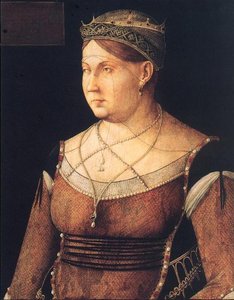
The commission itself was deeply rooted in the city’s social fabric. The *Scuola Grande di San Giovanni Evangelista*, one of Venice’s most influential confraternities, commissioned the series of paintings to commemorate the relic's arrival in 1369. Bellini’s contribution, alongside other prominent artists, underscored the importance of this religious artifact and its role in shaping Venetian identity. The inclusion of figures like Caterina Cornaro, a queen of Cyprus, further highlights the painting’s connection to Venice’s complex network of political and cultural alliances.
A Masterclass in Technique: Light, Color, and Detail
Bellini's technique is characterized by a remarkable blend of Early Netherlandish influence – particularly evident in the meticulous detail and atmospheric perspective – with the vibrant colors and dynamic compositions typical of Venetian painting. He employs *impasto*—thickly applied paint—to create textural richness, especially in the building facades and clothing folds, lending a tactile quality to the scene. The use of glazing—thin layers of translucent color—builds up luminosity and depth, capturing the play of light on water and surfaces.
The painting’s palette is dominated by warm earth tones – ochres, siennas, and reds – creating a sense of realism and historical context. However, Bellini doesn't shy away from using brighter colors to draw attention to key figures and moments within the composition. The dramatic lighting—a combination of natural daylight and reflected light—further enhances the painting’s emotional impact, casting shadows that heighten the sense of drama and sorrow.
Symbolism and Emotional Resonance
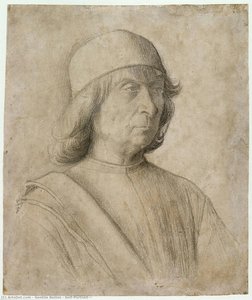
Beyond its historical and artistic merits, “Miracle of the Cross” is rich in symbolism. The floating bodies represent the devastating effects of the plague that ravaged Venice during the 15th century – a poignant reminder of mortality and suffering. The gathering crowd reflects both grief and curiosity, capturing the complex emotions associated with such a momentous event. Bellini’s self-portrait within the composition adds a layer of personal reflection, inviting us to contemplate the artist's own place within this dramatic narrative.
Ultimately, “Miracle of the Cross at the Bridge of S. Lorenzo” is more than just a painting; it’s a window into the soul of Renaissance Venice – a city grappling with faith, mortality, and the enduring power of human belief. It remains a powerful testament to Bellini's artistic genius and his ability to capture both the grandeur and the sorrow of the Venetian experience.
Obras relacionadas
Biografía del artista
Gentile Bellini: Un Maestro Veneciano del Renacimiento
- Nacido: Venecia, Italia (1429)
- Fallecido: 1507
Vida Temprana y Desarrollo Artístico
Gentile Bellini provenía de una destacada familia de pintores en Venecia. Su padre, Jacopo Bellini, era un artista establecido conocido por ser pionero en el uso de la pintura al óleo, mientras que su hermano menor, Giovanni Bellini, se convertiría más tarde en uno de los maestros venecianos más celebrados. Gentile recibió su formación artística inicial dentro del taller de su padre, dominando las técnicas de la pintura al óleo—un medio relativamente nuevo en aquel momento. Su primera obra firmada, El Bienaventurado Lorenzo Giustinian (1445), se erige como una de las pinturas al óleo más antiguas que aún existen en Venecia y ahora se encuentra alojada en el Museo de la Academia. Desde temprana edad, Gentile demostró un talento notable para el retrato, ganándose rápidamente reconocimiento y asegurando su posición como artista oficial de retratos de los Doges de Venecia.
Estilo Artístico e Influencias
El estilo artístico de Gentile Bellini fue moldeado por varias influencias clave. Las ricas tradiciones del Imperio Bizantino jugaron un papel importante, junto con la exposición a la cultura otomana tras su visita a Constantinopla en 1479. Este viaje, realizado por solicitud del sultán Mehmed II, demostró ser fundamental para dar forma a sus obras posteriores. Su retrato de Mehmed II, que ahora reside en la Galería Nacional de Londres, ejemplifica esta influencia. Las composiciones de Bellini se caracterizan a menudo por su grandeza, presentando escenas a gran escala pobladas con numerosas figuras—una característica común en sus encargos para las Scuole Grandi (cofradías importantes) de Venecia.
- Influencia Bizantina: Evidente en las figuras estilizadas y las paletas de colores ricos.
- Influencia Otomana: Se observa en las representaciones de la vida cortesana otomana y la arquitectura, como lo demuestra su retrato de Mehmed II.
- Tradición Veneciana: Una continuación de las prácticas artísticas venecianas, particularmente en el retrato y las pinturas narrativas a gran escala.
Obras Notables y Legado
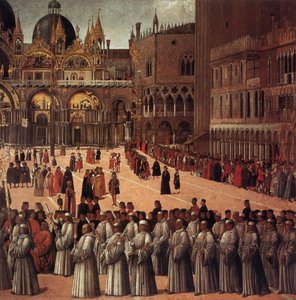
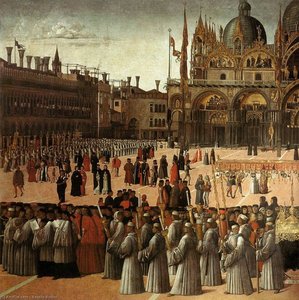
Entre las obras más celebradas de Gentile Bellini se encuentran La Procesión de la Santa Cruz en Piazza San Marco (1496) y El Milagro de la Santa Cruz en el Puente de S. Lorenzo (c. 1500). La última pintura es particularmente notable por incluir un autorretrato junto con el de su hermano, Giovanni Bellini. Las contribuciones artísticas de Gentile se extendieron más allá de las pinturas individuales; es reconocido como uno de los fundadores de la tradición orientalista en el arte occidental—un movimiento caracterizado por representaciones de culturas y entornos orientales.
- La Procesión de la Santa Cruz en Piazza San Marco (1496): Una obra monumental que representa una procesión religiosa, mostrando su capacidad para retratar grandes multitudes y detalles intrincados.
- El Milagro de la Santa Cruz en el Puente de S. Lorenzo (c. 1500): Presenta un autorretrato junto con su hermano Giovanni, ofreciendo información sobre su relación y colaboración artística.
Significado Histórico
El legado de Gentile Bellini se basa en su uso pionero de la pintura al óleo en la pintura veneciana y su importante contribución al desarrollo del arte orientalista. Su capacidad para combinar las tradiciones artísticas venecianas con influencias del Imperio Bizantino y la cultura otomana resultó en un estilo único y convincente que resonó en toda Europa. Si bien a menudo eclipsado por su hermano Giovanni, el trabajo de Gentile Bellini ahora se reconoce como un capítulo esencial en la historia de la pintura occidental—un testimonio de su habilidad, talento e intercambio cultural.

Gentile Bellini
1429 - 1507 , Italia
Datos clave
- Artistas Influyentes:
- Gentile da Fabriano
- Imperio Bizantino
- Fecha De Muerte: 1507
- Fecha De Nacimiento: 1429
- Influenciado Por:
- Giorgione
- Tiziano
- Lugar De Nacimiento: Venecia, Italia
- Movimiento Artístico: Pintura veneciana, Orientalismo
- Nacionalidad: Italiana
- Nombre Completo: Gentile Bellini
- Obras Notables:
- Bienaventurado Lorenzo Giustinian
- Procesión de la Cruz
- Milagro de la Cruz
Artículos relacionados

El Óleo sobre Lienzo: Historia, Técnica y la Persistencia de un Medio Artístico Atemporal
Descubre la historia y técnica del óleo sobre lienzo. Explora reproducciones fieles hechas a mano, personalización artística y consejos de expertos con ArtsDot. ¡Colecciona arte con confianza!
La Luz Dorada de la Innovación: Explorando el Renacimiento Veneciano (1430–1580)
Descubra la riqueza y el esplendor del Renacimiento veneciano con ArtsDot. Explore las obras maestras de Tiziano, Giorgione y Tintoretto. Análisis experto, historia detallada e información para coleccionistas.

The Enduring Power of Painting: A Historical & Contemporary Exploration of Form and Emotion
Explore the rich history & enduring techniques of oil painting with ArtsDot. Discover masterpieces, learn about art collecting, and find authentic handmade reproductions crafted by skilled artists.

The Enduring Legacy of Oil on Canvas: Technique, History & Aesthetic Impact
Explore the rich history & techniques of oil painting – from Renaissance masters to Impressionism. Discover pigments, layering methods, and why this timeless medium endures. Expert insights for artists & art enthusiasts.

El Legado Duradero del Óleo sobre Lienzo: Técnica, Historia y Práctica Contemporánea
Descubre la historia y técnica del óleo sobre lienzo. Explora reproducciones fieles hechas a mano, personalización artística y consejos de expertos con .