 Ver en contexto
 Enviar
 Compartir
 Detalles

 Descargar
 Similares
 Radiografía
 Presentación de diapositivas
The Wedding


 Ver más
Giclée / Impresión de arte
Impresiones giclée o en lienzo de calidad de museo con producción rápida y opciones de acabado flexibles. ( Comprar pintura hecha a mano Comprar imagen)




P118B $10

P118H $10

P118W $10

P438Z $10

P508JH $12

P508YH $12

P805H $10

P805Z $10

P919BZ $10

P919G $10

P919XJ $10

P959ZH $10

P968JZ $12

W106C $8

W218G $10

W218JH $8

W218Y $10

W307PJ $10

W316G $10

W316PJ $8

W316Y $10

W398PJ $8

W4111J $10

W500HY $15

W500JH $15

W692G $12

W849H $8

W940BG $15

W953PJ $8




Elija entre nuestros tamaños predefinidos que respetan las proporciones originales de la obra.

Puede introducir sus propias dimensiones para adaptarse a un marco o espacio específico. Si el tamaño seleccionado no coincide con las proporciones de la imagen original, recortaremos la obra de arte o extenderemos la imagen con un borde con efecto espejo o de color sólido. Se enviará una maqueta digital para su aprobación antes de que comience la producción.
Tenga en cuenta que la vista previa en pantalla no refleja el recorte o la extensión real. Solo la maqueta mostrará con precisión la composición final.
Aunque existen tamaños personalizados, recomendamos seleccionar una dimensión de la lista predefinida para preservar las proporciones originales.
Envío a todo el mundo () en 2 semanas en lugar de las 4/5 semanas estándar. (27 agosto)

Envío exprés gratuito a todo el mundo

Lienzo de lino de alta calidad

Seguro de envío total

Garantía de reembolso de impuestos aduaneros

Garantía de fidelidad cromática exacta

Política de devolución de 60 días (solo por defectos)

Garantía de devolución del 100% del dinero

Descuento por cantidad
 La opción de vidrio solo está disponible en tamaños inferiores a 110 cm.

The Wedding
Giclée / Impresión de arte
Dimensiones de la reproducción
-


Precio total final
$ 62
A Glimpse of Celebration: “The Wedding” by Henri Rousseau
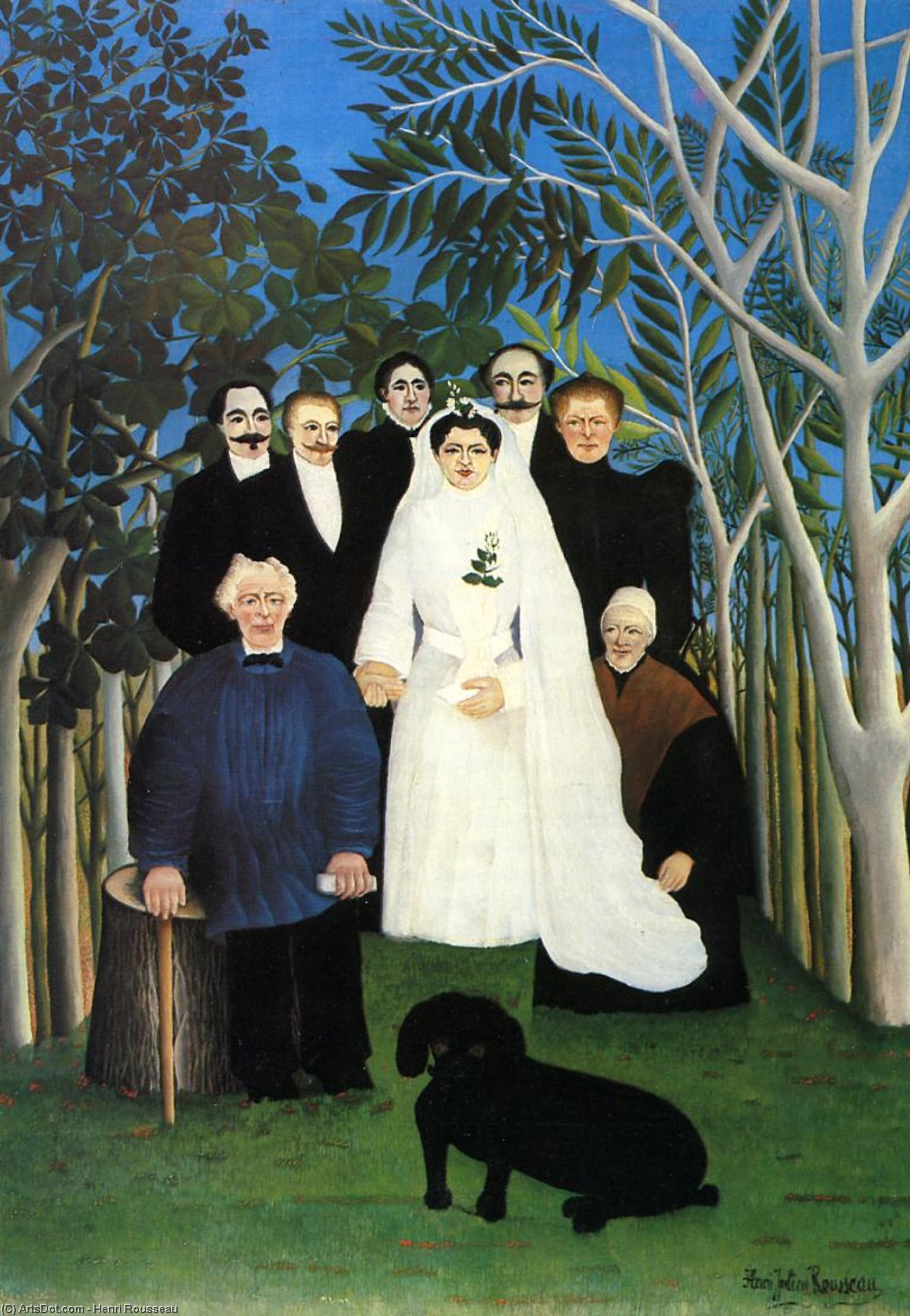
Within the evocative world crafted by Henri Rousseau – affectionately known as "Le Douanier," or the customs officer – resides “The Wedding,” a captivating tableau that transcends mere representation to embody a potent blend of naive charm, symbolic depth, and an undeniable sense of joyous community. Painted in 1904, this artwork isn’t simply a depiction of a wedding; it's a portal into a dreamlike realm where the familiar rituals of union are rendered with a captivating simplicity, echoing the artist’s distinctive style and offering a poignant reflection on human connection.
Rousseau’s artistic journey was anything but conventional. A toll collector by trade, he pursued his passion for painting only after reaching middle age, largely self-taught and drawing inspiration from botanical gardens, illustrated magazines, and the vibrant atmosphere of the Jardin des Plantes in Paris. This unconventional path resulted in a style characterized by flattened perspectives, simplified forms, and an exuberant palette—a deliberate rejection of academic realism in favor of a deeply personal and imaginative vision. “The Wedding” is a prime example of this approach; figures are presented on a single plane, lines are bold and graphic, and colors – predominantly blues and greens punctuated by the bright whites of bridal attire – radiate with an almost childlike intensity.
Decoding the Naive Narrative
At first glance, “The Wedding” appears straightforward: a central couple, presumably the bride and groom, stand amidst a group of figures engaged in celebration. However, closer observation reveals layers of symbolic meaning woven into Rousseau’s deliberate simplification. The composition is remarkably balanced, with the central pair anchoring the scene while surrounding individuals contribute to an atmosphere of warmth and shared joy. Notice the subtle gestures – a hand offered in greeting, a smile exchanged—that suggest genuine connection and camaraderie. The stylized landscape backdrop, rendered with broad brushstrokes and a lack of precise detail, further enhances the painting’s dreamlike quality, transporting the viewer into a world where time seems to slow and emotions run freely.
Rousseau's signature “primitive” style is particularly evident in the treatment of light and shadow. There’s an evenness to the illumination, suggesting an outdoor setting bathed in a diffuse, almost ethereal glow. Perspective is largely absent; figures are placed on a single plane, creating a sense of immediacy and intimacy. This deliberate flattening of space contributes significantly to the painting's overall naive aesthetic, inviting us to focus not on realistic representation but on the emotional core of the scene.
A Window into Rousseau’s World
The historical context surrounding “The Wedding” is crucial to understanding its significance. Painted in 1904, it reflects a burgeoning interest in non-Western art and folklore—a fascination that profoundly influenced many artists of the time. Rousseau's work, with its emphasis on exotic subjects and dreamlike imagery, can be seen as a precursor to movements like Surrealism, anticipating the exploration of the subconscious and the blurring of reality and fantasy. The painting’s reception during his lifetime was mixed; initially ridiculed for its unconventional style, it gradually gained recognition as a unique expression of artistic vision.
The influence of Henri Rousseau extends far beyond the art world. His work continues to resonate with audiences today, offering a glimpse into a world where imagination reigns supreme and the simple joys of human connection are celebrated with unrestrained enthusiasm. “The Wedding” stands as a testament to the power of artistic vision—a captivating reminder that beauty can be found in the most unexpected places, rendered with honesty, sincerity, and an unwavering belief in the transformative potential of art.
Obras relacionadas
Biografía del artista
Henri Julien Félix Rousseau: Una Vida en el Arte
Primeros Años y Orígenes
- Nacido el 21 de mayo de 1844, en Laval, Francia, Henri Julien Félix Rousseau llevó una vida poco convencional antes de convertirse en un reconocido artista.
- Sus primeros años estuvieron marcados por circunstancias modestas; su padre era sastre y Rousseau mismo trabajó varios trabajos durante su juventud.
- Recibió cierta educación formal, mostrando aptitud para dibujar, pero finalmente se dedicó a una carrera como recaudador de impuestos – ganándose el apodo “Le Douanier” (el oficial aduanero).
- Rousseau sirvió en el ejército durante cuatro años antes de asentarse en su puesto en el octroi de París, cobrando impuestos sobre los bienes que entraban en la ciudad.
Desarrollo Artístico y Estilo
- Rousseau fue mayormente auto-enseñado como artista, comenzando a pintar seriamente en sus primeros cuarenta años después de recibir ánimo de un amigo.
- Su estilo se caracteriza por su calidad naïve o primitiva, marcada por perspectivas planas, formas simplificadas y colores vibrantes, a menudo irrealistas.
- Se inspiró en jardines botánicos, revistas ilustradas y visitas al Jardin des Plantes de París, en lugar de la observación directa de la naturaleza.
- Los cuadros de Rousseau a menudo presentan escenas exuberantes de selva, animales exóticos, retratos y representaciones de la vida cotidiana, todo ello representado con un sentido único de asombro e imaginación.
Influencias y Contexto Artístico
- Si bien fue mayormente auto-enseñado, Rousseau estaba consciente de los movimientos artísticos de su tiempo – Impresionismo y Postimpresionismo – pero desarrolló un estilo personal distintivo que lo diferenciaba.
- Admiró a artistas como Eugène Delacroix y se inspiró en su uso del color y la temática exótica.
- El trabajo de Rousseau predice y anticipa aspectos del Surrealismo y otros movimientos vanguardistas de principios del siglo XX.
Obras Maestras y Logros
- Algunas de las pinturas más celebradas de Rousseau incluyen:
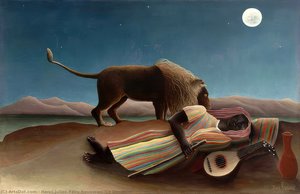
- La Gitana Dormida (1897) – una representación onírica de una mujer dormida en un entorno de selva.
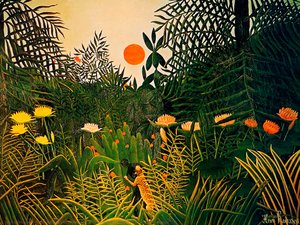
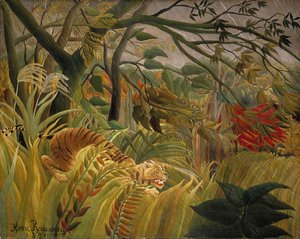
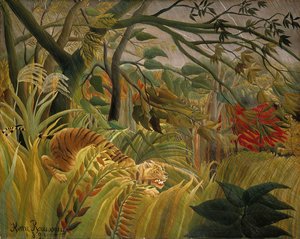
- Tigre en Tormenta Tropical (Sorprendido!) (1891) – que muestra su uso dramático del color y la composición.
- Autorretrato (1890) - Un retrato formal mostrando al artista con una paleta y pinceles.
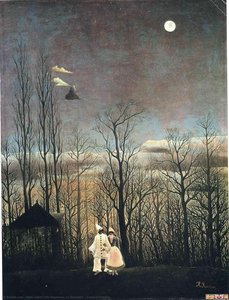
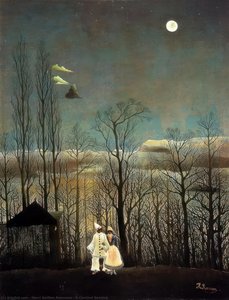
- La Noche del Carnaval (1886) – capturando una escena festiva con detalles intrincados.
- Exhibió regularmente en el Salon des Indépendants, ganando reconocimiento entre otros artistas y atrayendo gradualmente la atención crítica.
Significado Histórico y Legado
- Inicialmente ridiculizado por muchos críticos por su estilo poco convencional, el trabajo de Rousseau finalmente ganó apreciación como una expresión única de visión artística.
- Se convirtió en inspiración para varios artistas destacados, incluido Pablo Picasso y otros miembros del movimiento vanguardista.
- En 1908, Picasso organizó “Le Banquet Rousseau”, un evento conmemorativo honrando al artista y reconociendo su influencia.
- Las pinturas de Rousseau siguen cautivando a los públicos hoy en día con su calidad onírica, colores vibrantes y temática imaginativa.
- Su obra es un testimonio del poder de la autoexpresión y el atractivo perdurable del arte naïf.
Muerte y Reconocimiento Póstumo
- Henri Rousseau murió el 2 de septiembre de 1910, en París.
- Su legado continuó creciendo después de su muerte, consolidando su lugar como una figura significativa en la historia del arte moderno.
- Hoy en día, sus obras se exhiben en importantes museos de todo el mundo y continúan inspirando a artistas y amantes del arte por igual.
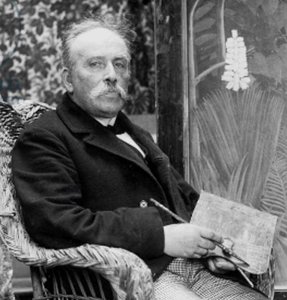
Henri Julien Félix Rousseau (Le Douanier)
1844 - 1910 , Francia
Datos clave
- Artistic Movement Or Style: Postimpresionismo, Naïve
- Artists Or Movements Influenced By This Artist: ['Surrealismo']
- Artists Who Influenced This Artist: ['Delacroix']
- Date Of Birth: 21 de mayo de 1844
- Date Of Death: 2 de septiembre de 1910
- Full Name: Henri Julien Félix Rousseau
- Nationality: Francés
- Notable Artworks:
- Dormir en el Desierto
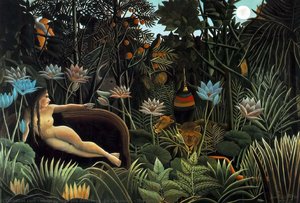
- El Sueño
- Noche de Carnaval
- Place Of Birth: Laval, Francia
Artículos relacionados
¿Recuerdos de Boda que no Aburren: Eleva tu Decoración con Arte Personalizado?
Eleva tu boda con arte personalizado. Descubre inspiración, tendencias y consejos expertos para una decoración nupcial inolvidable. te ayuda a crear recuerdos únicos.
Amor en Lienzo: 7 Estilos Románticos para tu Retrato de Boda Perfecto
Encuentra el retrato de boda perfecto que capture tu amor eterno. Explora estilos únicos y encarga una obra maestra personalizada con . ¡Regalos inolvidables!
10 Ideas Creativas para Obras de Arte Personalizadas en Bodas que Aún No Habías Considerado
Descubre 10 ideas creativas para obras de arte personalizadas en tu boda. Regalos únicos y recuerdos inolvidables creados por artistas expertos. ¡Encuentra el toque perfecto!
Eterna tu Amor: Pinturas Personalizadas para Bodas Inolvidables y un Legado Artístico
Crea un recuerdo eterno con una pintura de boda personalizada. te ofrece artistas expertos y obras únicas para celebrar tu amor. ¡Regalos inolvidables!
¿Convierte Su Foto Favorita en Arte Atemporal? Guía Paso a Paso para un Recuerdo Único
Transforma tus fotos en obras de arte atemporales con expertos. Guía paso a paso para crear cuadros personalizados únicos y memorables. ¡Descubre el regalo perfecto!