 Ver en contexto
 Enviar
 Compartir
 Detalles

 Descargar
 Similares
 Radiografía
 Presentación de diapositivas
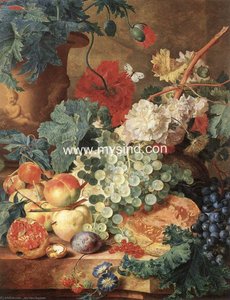
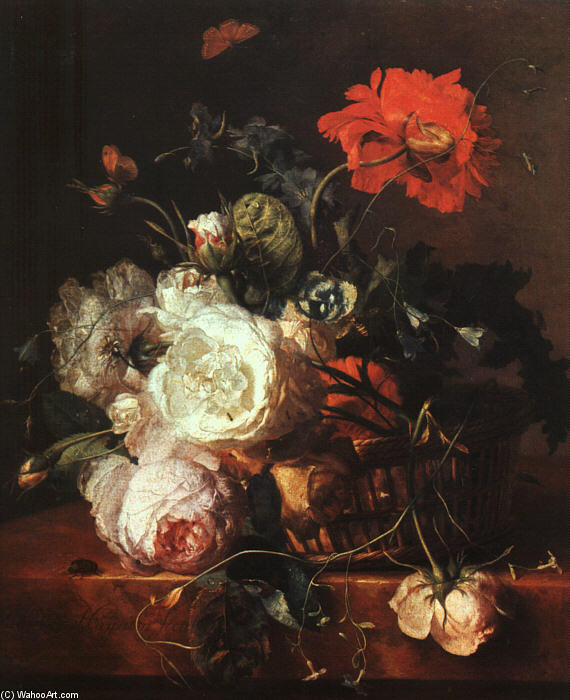
Basket of Flowers


 Ver más
Reproducción al óleo hecha a mano
Óleo sobre lienzo pintado a mano en el tamaño y marco de su elección, realizado por encargo por nuestros artistas. ( Comprar impresión Comprar imagen)




P118B $10

P118H $10

P118W $10

P438Z $10

P508JH $12

P508YH $12

P805H $10

P805Z $10

P919BZ $10

P919G $10

P919XJ $10

P959ZH $10

P968JZ $12

W106C $8

W218G $10

W218JH $8

W218Y $10

W307PJ $10

W316G $10

W316PJ $8

W316Y $10

W398PJ $8

W4111J $10

W500HY $15

W500JH $15

W692G $12

W849H $8

W940BG $15

W953PJ $8




Elija entre nuestros tamaños predefinidos que respetan las proporciones originales de la obra.

Puede ingresar sus propias dimensiones para adaptarse a un marco o espacio específico. Si el tamaño seleccionado no coincide con las proporciones de la imagen original, recortaremos la obra o extenderemos la pintura con elementos adicionales pintados a mano. Se le enviará una maqueta digital para su aprobación antes de comenzar la producción.
Tenga en cuenta que la vista previa en pantalla no refleja el recorte o la extensión reales. Solo la maqueta mostrará con precisión la composición final.
Si bien existen tamaños personalizados, recomendamos seleccionar una dimensión de la lista predefinida para preservar las proporciones originales.
Tras realizar el pedido, el equipo de ArtsDot.com enviará un correo electrónico al cliente para solicitar instrucciones y proporcionarle una vista previa del boceto.
Envío a todo el mundo () en 3-4 semanas en lugar de las 5 semanas estándar. (23 agosto). Sin comprometer la calidad.

Envío exprés gratuito a todo el mundo

Lienzo de lino de alta calidad

Seguro de envío total

Garantía de reembolso de impuestos aduaneros

Garantía de fidelidad cromática exacta

Política de devolución de 60 días (solo por defectos)

Garantía de devolución del 100% del dinero

Descuento por cantidad
 La opción de vidrio solo está disponible en tamaños inferiores a 110 cm.

Basket of Flowers
Técnica de reproducción
Dimensiones de la reproducción
-


Precio total final
$ 263
Descripción de la obra
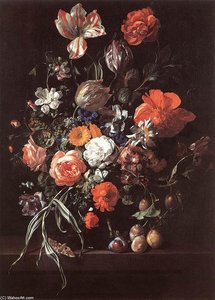
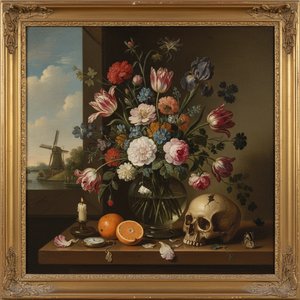
A Symphony of Color and Light: Jan van Huysum’s “Basket of Flowers”
Jan van Huysum's "Basket of Flowers," housed at the Alte Pinakothek in Munich, Germany, stands as a testament to the zenith of Dutch Baroque artistry—a captivating exploration of botanical beauty rendered with unparalleled precision. Completed around 1730-1749, this oil on panel masterpiece transcends mere representation; it’s an immersive experience designed to evoke the sensory richness of a summer garden at its peak bloom.The Artist's Vision: Huysum and the Pursuit of Naturalism
Jan van Huysum (1682-1749) emerged from a lineage steeped in artistic tradition—his father, Justus van Huysum the Elder, was himself a celebrated flower painter—establishing him within a milieu acutely attuned to scientific observation alongside aesthetic excellence. Unlike many artists of his era who favored idealized landscapes or mythological subjects, Van Huysum dedicated his considerable talent to meticulously documenting and celebrating the natural world. He wasn’t simply copying what he saw; he sought to capture its essence, striving for an illusionistic depth that mirrored reality itself. This commitment to realism distinguishes him from contemporaries like Rembrandt and Rubens, who prioritized dramatic lighting and expressive brushstrokes.Technical Mastery: Huysum's Delicate Brushwork
The painting’s remarkable quality stems from Van Huysum’s masterful technique. He employed a layering process known as glazing—applying thin translucent washes of color over underlying layers—to achieve luminous effects and subtle tonal variations. This painstaking method allowed him to capture the velvety texture of petals, the glistening droplets of dew, and the shimmering reflections on leaves with astonishing accuracy. Furthermore, Van Huysum’s meticulous attention to detail extended beyond mere visual representation; he painstakingly rendered individual stems, thorns, and insect wings, demonstrating an unwavering dedication to capturing every nuance of form.Symbolism Within Beauty: Flowers as Vessels of Emotion
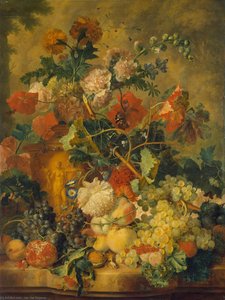
Beyond its technical brilliance, “Basket of Flowers” resonates with profound symbolic meaning. Flowers have long served as emblems of love, purity, and rebirth in Western art—themes powerfully conveyed by Van Huysum’s selection of blooms. Roses symbolize passion and devotion, lilies represent innocence and spiritual grace, while tulips embody prosperity and springtime renewal. The artist's careful arrangement contributes to a harmonious composition that speaks to the viewer's emotions, inviting contemplation on themes of beauty, fragility, and the cyclical rhythms of nature.Historical Context: Baroque Still Life in Munich
The Alte Pinakothek’s collection reflects the broader artistic currents of the Baroque period—a time characterized by grandeur, ornamentation, and a fervent belief in reason alongside religious fervor. Van Huysum's work aligns perfectly with this aesthetic sensibility, embodying the Baroque ideal of capturing beauty through meticulous observation and skillful illusionism. It stands as an enduring reminder of Amsterdam’s position at the forefront of European artistic innovation during its golden age—a legacy that continues to inspire artists and collectors alike.Further Exploration: Related Artists & Inspirations
To delve deeper into the artistic landscape surrounding Jan van Huysum, consider examining the works of contemporaries like Jacob Rembrandt Harmensz Onderdonck and Johann Georg Baumgartner – masters who similarly embraced botanical realism and explored similar themes of beauty and contemplation. Also, explore the influence of Flemish Baroque sculpture, particularly works by Petrus Paulus Rubens and Antoine Van Dyck, which shared a commitment to portraying idealized forms and conveying emotional depth. Finally, consider visiting the Bonnefanten Museum in Maastricht to admire Jan van Kessel’s stunning floral still lifes – an artist who similarly championed scientific accuracy alongside artistic elegance.Obras relacionadas

Biografía del artista
Jan van Huysum (1682–1749): A Master of Floral Illusion
Jan van Huysum, a name synonymous with the exquisite flower paintings of the Dutch Golden Age, was born in Amsterdam on April 15, 1682. He wasn’t simply a painter of blooms; he was a master of illusion, capable of rendering petals and droplets with such breathtaking realism that viewers felt they could almost inhale their fragrance. Born into an artistic family—his father, Justus van Huysum the Elder, was also a respected flower painter, and his brothers Jacob and Michiel followed suit—Jan’s path seemed predetermined. However, he wasn't immediately drawn to floral subjects. Early in his career, he experimented with landscapes, described as “conventional and arcadian,” but it was within the delicate world of still life that his true genius blossomed.
The foundation of Van Huysum’s artistic education was laid by his father, a formative experience that instilled in him not only technical skill but also an understanding of the art market. Amsterdam during this period thrived as a center for commerce and culture, fostering a demand for luxurious and decorative paintings like those depicting lavish floral arrangements. This environment shaped Van Huysum’s approach; he wasn’t merely replicating nature, but crafting idealized visions of beauty intended to delight and impress. His earliest dated work is completed in 1717 and now residing in the Louvre, already revealing a remarkable maturity and attention to detail, hinting at the mastery that was to come.
The Art of Detail: Technique and Style
What truly sets Van Huysum apart is his unparalleled technique. He employed smooth, glossy brushstrokes, building up layers of paint to create an almost enamel-like surface that enhanced the richness and vibrancy of his colors. But it wasn’t just about color; it was about light—the way it played across petals, illuminated water droplets clinging to leaves, and created a sense of depth and volume. He possessed an extraordinary eye for detail, meticulously capturing the textures of every flower, fruit, and leaf with astonishing precision. Stories circulated that he could paint details like ants and dew drops so realistically they were visible without magnification—a testament to his dedication and skill.
His compositions are characterized by a refined elegance and balance. Unlike some of his contemporaries who favored crowded, overflowing arrangements, he consistently avoided imbalance or over-composition. His later works became more elaborate, certainly, but always maintained a sense of harmony and grace. He often incorporated elements of fantasy into his work, particularly in his landscapes which featured imaginary scenes with classical architectural details and motionless trees. These weren’t attempts at topographical accuracy, but rather evocative settings designed to showcase the beauty of the flowers they contained.
A Flourishing Reputation: Major Works and Legacy
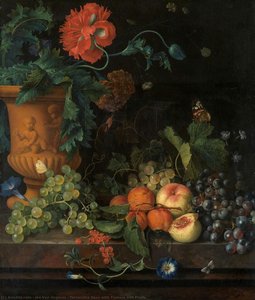
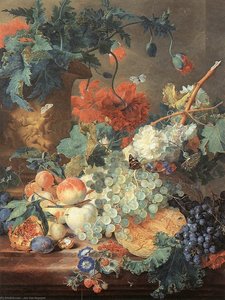
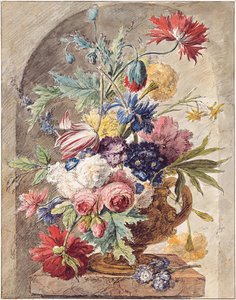
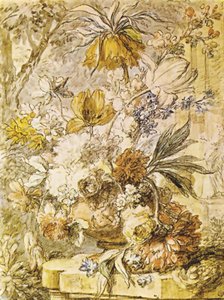
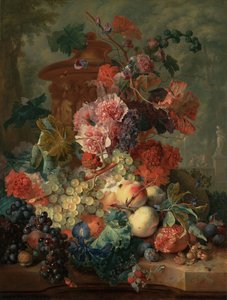
Throughout his lifetime, Jan van Huysum enjoyed considerable acclaim and financial success. His paintings were highly sought after by collectors, and he commanded high prices for his work. Today, his masterpieces can be found in prestigious museums around the world, including the Louvre in Paris, the National Gallery in London, and collections in Berlin and Amsterdam. Among his most celebrated works are Terracotta Vase with Flowers and Fruits, a stunning display of color and texture; Flowers and Fruits, showcasing his mastery of composition; and Bouquet of Flowers in an Urn, a testament to his ability to capture the ephemeral beauty of nature.
Van Huysum’s influence extended beyond his own time, inspiring generations of artists. Painters like Jan van Os and Johannes de Bosch clearly demonstrate his impact on subsequent floral still life traditions. He represents the pinnacle of Dutch Golden Age flower painting, a period defined by its meticulous observation of nature and its celebration of beauty. His legacy isn't simply about the numerous paintings he created, but also about the enduring appeal of his style—a style that continues to inspire artists and captivate audiences today. His work remains a powerful reminder of the artistry and skill required to transform fleeting moments of natural beauty into timeless works of art.
Family Connections & Artistic Lineage
- Justus van Huysum the Elder (1659–1716): Jan’s father, a prolific painter of flower pieces and decorative schemes.
- Jacob van Huysum (1688–1740): Jan's brother, also a notable artist specializing in botanical illustrations.
- Justus van Huysum the Younger (1685-1707): Another of Jan’s brothers who pursued painting but died young.
- Michiel van Huysum (1703–1777): A half-brother, also a flower painter.
- Francina Margaretha van Huysum: Jan’s daughter, who assisted him in his work and was herself a skilled flower painter.
The Van Huysum family represents a remarkable artistic lineage, contributing significantly to the rich tapestry of Dutch Golden Age painting. Jan, however, stands out as the most celebrated member, leaving an indelible mark on the history of art with his exquisite and enduring floral masterpieces.
Jan Van Huysum
1682 - 1749 , Países Bajos
Datos clave
- Artistic Movement Or Style: Dutch Golden Age, Still life
- Artists Or Movements Influenced By This Artist: ['Justus van Huysum']
- Artists Who Influenced This Artist:
- Jan van Os
- Johannes de Bosch
- Date Of Birth: April 15, 1682
- Date Of Death: February 8, 1749
- Full Name: Jan van Huysum
- Nationality: Dutch
- Notable Artworks:
- Terracotta Vase with Flowers
- Flowers and Fruits
- Bouquet of Flowers in an Urn
- Place Of Birth: Amsterdam, Netherlands
Artículos relacionados

Los 10 Maestros del Siglo de Oro Holandés: Arte, Historia y Decoración Exclusiva
Descubre los 10 imprescindibles del Siglo de Oro Holandés: Rembrandt, Vermeer y más. Explora la historia, técnica y belleza de estos lienzos clásicos. Encuentra reproducciones de arte exclusivas para decorar tu hogar en .

Rembrandt van Rijn: Las 25 Obras Maestras que Definen un Genio | Arte, Historia y Decoración
Descubre las 25 obras maestras de Rembrandt van Rijn, el genio del barroco holandés. Explora su historia, técnica y simbolismo en retratos icónicos como 'La Ronda Nocturna'. Encuentra reproducciones de arte exclusivas para decorar tu hogar con ArtsDot.com.
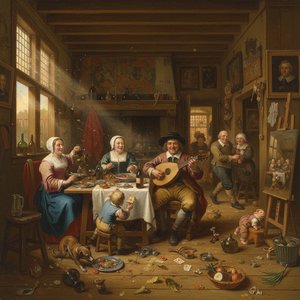
Jan Steen: A Master of Dutch Genre Painting & the Golden Age
Explore the life & art of Jan Steen, a leading Dutch Golden Age painter renowned for his humorous genre scenes & insightful social commentary. Discover his techniques, legacy, and collecting tips.
Jan Jansz Wijnants: A Study in Dutch Golden Age Still Life & Floral Transience
Explore the captivating world of Jan Wijnants and Dutch Golden Age still life painting. Discover symbolism, masterful techniques & lasting influence on floral art history. Learn more!

Reflejos de una Época Dorada: La Pintura Barroca Holandesa y la Innovación Cultural
Descubra la riqueza y el detalle de la pintura barroca holandesa del Siglo de Oro. Explore las obras maestras de Rembrandt, Vermeer y otros artistas clave. Análisis experto e historia cultural.