 Ver en contexto
 Enviar
 Compartir
 Detalles

 Descargar
 Similares
 Radiografía
 Presentación de diapositivas
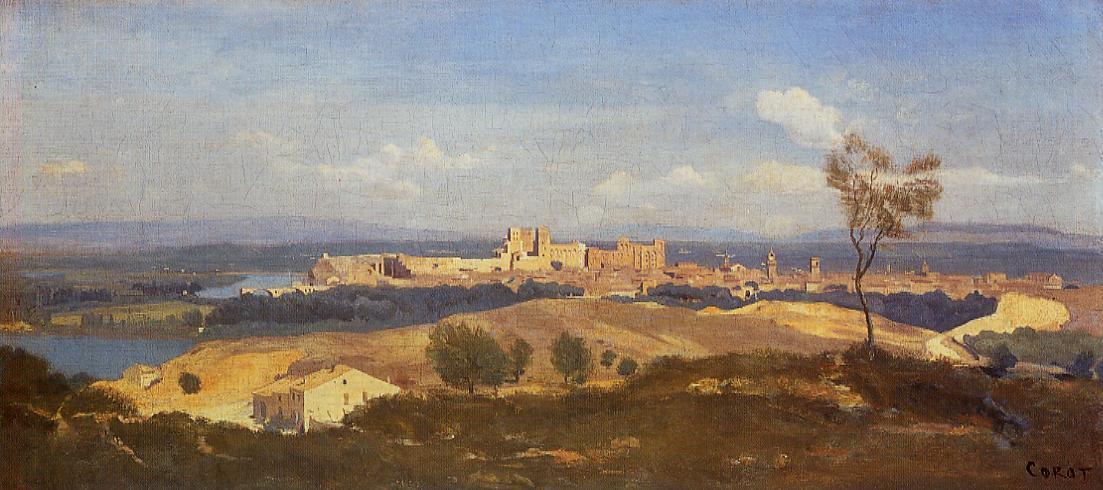
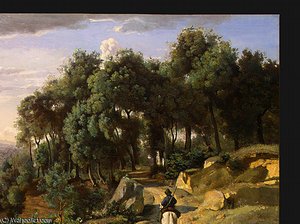
Avignon Seen from Villenueve-les-Avignon

 Ver más
Giclée / Impresión de arte
Impresiones giclée o en lienzo de calidad de museo con producción rápida y opciones de acabado flexibles. ( Comprar pintura hecha a mano Comprar imagen)




P118B $10

P118H $10

P118W $10

P438Z $10

P508JH $12

P508YH $12

P805H $10

P805Z $10

P919BZ $10

P919G $10

P919XJ $10

P959ZH $10

P968JZ $12

W106C $8

W218G $10

W218JH $8

W218Y $10

W307PJ $10

W316G $10

W316PJ $8

W316Y $10

W398PJ $8

W4111J $10

W500HY $15

W500JH $15

W692G $12

W849H $8

W940BG $15

W953PJ $8




Elija entre nuestros tamaños predefinidos que respetan las proporciones originales de la obra.

Puede introducir sus propias dimensiones para adaptarse a un marco o espacio específico. Si el tamaño seleccionado no coincide con las proporciones de la imagen original, recortaremos la obra de arte o extenderemos la imagen con un borde con efecto espejo o de color sólido. Se enviará una maqueta digital para su aprobación antes de que comience la producción.
Tenga en cuenta que la vista previa en pantalla no refleja el recorte o la extensión real. Solo la maqueta mostrará con precisión la composición final.
Aunque existen tamaños personalizados, recomendamos seleccionar una dimensión de la lista predefinida para preservar las proporciones originales.
Envío a todo el mundo () en 2 semanas en lugar de las 4/5 semanas estándar. (2 septiembre)

Envío exprés gratuito a todo el mundo

Lienzo de lino de alta calidad

Seguro de envío total

Garantía de reembolso de impuestos aduaneros

Garantía de fidelidad cromática exacta

Política de devolución de 60 días (solo por defectos)

Garantía de devolución del 100% del dinero

Descuento por cantidad
 La opción de vidrio solo está disponible en tamaños inferiores a 110 cm.

Avignon Seen from Villenueve-les-Avignon
Giclée / Impresión de arte
Dimensiones de la reproducción
-


Precio total final
$ 62
A Symphony of Light and Tranquility: Exploring Jean-Baptiste Camille Corot’s Landscape Vision
Jean-Baptiste-Camille Corot (1796 – 1875), born into Parisian bourgeois affluence, represents a pivotal figure in the Romantic landscape movement. Unlike his contemporaries who sought dramatic grandeur or idealized visions of heroism, Corot championed an understated realism—a profound respect for the natural world rendered with meticulous observation and luminous color palettes. His canvases aren’t merely depictions of scenery; they are meditations on light itself, capturing fleeting moments of atmospheric beauty that evoke a sense of serenity and contemplation.The Essence of Impressionism Before Its Time
Corot's artistic approach predates the formal establishment of Impressionism by several years, yet it shares its core principles: prioritizing sensory experience over academic convention. He eschewed meticulous detail in favor of capturing the subtle nuances of color and texture—the way sunlight filters through foliage, the hazy glow of twilight, or the dampness clinging to moss-covered stones. This technique involved layering thin washes of pigment upon canvas, allowing subsequent layers to blend seamlessly and creating an illusion of depth and luminosity that would become synonymous with Impressionist painting. He famously stated, “I paint what I see,” a declaration that encapsulates his unwavering commitment to truthful representation.A Rural Reverie: Composition and Technique
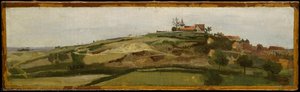
Considered a master of tonal harmony, Corot’s compositions are characterized by horizontal lines dominating the canvas—reflecting the expansive vistas he sought to portray. The hillside depicted in this artwork is meticulously rendered with careful attention to geological formations and vegetation. Notice the subtle gradations of color – ochres, greens, blues – skillfully blended to convey the diffused light characteristic of rural landscapes. Corot’s brushstrokes are loose yet purposeful, conveying a sense of movement and atmosphere without resorting to overtly expressive gestures. The placement of the horses adds an element of dynamism to the scene, subtly guiding the viewer's gaze across the expanse of the hillside.Historical Context: Romanticism's Quiet Rebellion
Corot’s artistic sensibilities emerged during the Romantic era (roughly 1800-1850), a period marked by a reaction against Enlightenment rationalism and an embrace of emotion, imagination, and individualism. While other Romantic artists focused on dramatic narratives and heroic figures—Delacroix's “Liberty Leading the People” being a prime example—Corot sought solace in the unspoiled beauty of nature. He drew inspiration from Eugène Delacroix’s bold use of color and expressive brushwork but rejected his theatrical style, prioritizing instead a quiet contemplation of the natural world. His work reflects the broader Romantic preoccupation with sublime landscapes – vistas that inspire awe and reverence for the power of nature—a concept championed by Edmund Burke and Friedrich Nietzsche.Symbolism Beyond Surface Beauty
Beyond its visual splendor, Corot’s paintings carry symbolic weight. The hillside itself represents stability and permanence amidst the transient beauty of the seasons. The horses symbolize freedom and movement, mirroring the artist's own desire to escape the constraints of urban life and reconnect with the rhythms of the natural world. Furthermore, Corot’s meticulous observation of detail speaks to a deeper philosophical concern—a belief that true understanding comes from immersing oneself in sensory experience and appreciating the subtle wonders hidden within seemingly ordinary landscapes. This artwork invites viewers to pause, breathe deeply, and contemplate the profound beauty inherent in the simplest forms of nature.Obras relacionadas
Biografía del artista
Vida Temprana y Formación
Jean-Baptiste-Camille Corot, un renombrado pintor francés de paisajes y retratos, nació el 16 de julio de 1796 en París. Su familia, perteneciente a la burguesía, le proporcionó un entorno propicio para explorar sus inclinaciones artísticas. Inicialmente, los intereses de Corot se dirigieron hacia otros campos, pero finalmente descubrió su pasión por la pintura alrededor de 1821. Esto marcó el comienzo de su prolífica carrera, que más tarde influiría en el desarrollo del impresionismo.Trayectoria Artística y Obras Notables
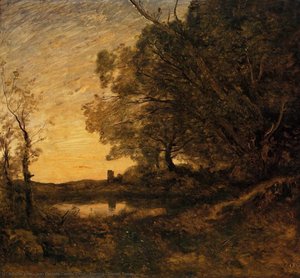
La trayectoria artística de Corot se caracteriza por una mezcla de tradición neoclásica e innovaciones al aire libre (plein air). Algunas de sus obras notables incluyen:- El Reposo (óleo sobre lienzo, circa 1860s), una pieza cautivadora que muestra la maestría de Corot para capturar la esencia de la serenidad.
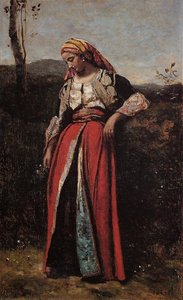
- Lectura Interrumpida (realismo, óleo, circa 1850s), un ejemplo conmovedor de la capacidad de Corot para retratar la vida cotidiana con profundidad y emoción.
- Agostina (realismo, óleo, circa 1860s), un impresionante retrato que ejemplifica la habilidad de Corot para capturar la esencia de sus sujetos.
Influencias y Desarrollo Artístico
Corot fue influenciado por artistas como Gaspard Davidovich Poussin y Claude Lorrain, maestros del paisaje clásico francés. Sin embargo, su propio desarrollo artístico lo llevó a alejarse de las composiciones rígidas y formales del neoclasicismo para abrazar una aproximación más libre e intuitiva al paisaje. Su adopción de la pintura plein air fue revolucionaria en su época, permitiéndole capturar directamente las condiciones atmosféricas cambiantes y la luz natural. También se le considera un precursor del impresionismo debido a su enfoque en la atmósfera, el color y la pincelada suelta.Logros e Importancia Histórica
La vasta producción de Corot ha tenido un impacto duradero en el desarrollo de la pintura de paisajes. Su innovador enfoque, combinando técnicas tradicionales con innovaciones al aire libre, allanó el camino para futuras generaciones de artistas. Aunque no fue reconocido ampliamente durante su vida, su obra ganó una mayor apreciación póstumamente y ahora se le considera una figura clave en la historia del arte francés. Corot influyó directamente a muchos artistas impresionistas como Monet, Renoir y Pissarro, quienes admiraban su capacidad para capturar la atmósfera y la luz natural. Descubra más sobre las pinturas de Jean-Baptiste-Camille Corot en ArtsDot.com: https://ArtsDot.com/@/jean-baptiste-camille-corot Aprenda más sobre el Musée Courbet en Wikipedia: https://en.wikipedia.org/wiki/mus%c3%a9e_courbet_(ornans,_france)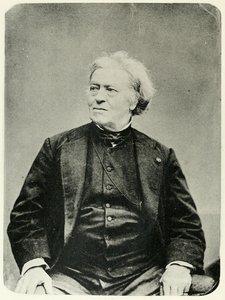
Jean-Baptiste-Camille Corot
1796 - 1875 , Francia
Datos clave
- Estilo Artístico: Neoclasicismo y Plein Air
- Influencia En Artistas: ['Impresionismo']
- Lugar De Nacimiento: París, Francia
- Nacimiento: 16 de julio de 1796
- Nacionalidad: Francesa
- Nombre Completo: Jean-Baptiste-Camille Corot
- Obras Notables:
- El Reposo
- Lectura interrumpida
- Agostina
Artículos relacionados

Paul Cézanne: Las 25 Obras Maestras que Definieron el Arte Moderno | ArtsDot
Descubre las 25 obras maestras de Paul Cézanne que revolucionaron el arte moderno. Explora su técnica, inspiración y significado en paisajes, bodegones y retratos. Reproducciones de alta calidad para decorar tu hogar con arte inolvidable. ¡Explora la colección completa en ArtsDot.com!

John Constable: Las 25 Obras Maestras del Paisaje Inglés | ArtsDot
Descubre las 25 obras maestras de John Constable, el pintor romántico inglés que capturó la belleza del paisaje. Explora su técnica, historia y significado en ArtsDot.com. Reproducciones de arte de alta calidad para tu hogar.
Jean-Baptiste-Camille Corot: A Poetic Realism – Bridging the Barbizon School and Early Impressionism
Explore the life & art of Camille Corot, a pivotal figure bridging the Barbizon School & Impressionism. Discover his poetic realism, signature style, and lasting influence on landscape painting. Learn more at ArtsDot.

Cultivating Visions: A Historical Journey Through Rural Landscapes in Art
Explore the rich history of rural landscape painting with ArtsDot. Discover Impressionist masterpieces, key artists & movements. Find your perfect serene artwork and bring nature's beauty home.

Evocations of Place: A Historical Journey Through Landscape Art
Explore the rich history of landscape art with ArtsDot. Discover renowned artists, movements like Impressionism & Romanticism, and expert guidance for collecting timeless pieces. Find your perfect serene escape today!